Related Research Articles

Habronattus is a genus in the family Salticidae. Most species are native to North America. They are commonly referred to as paradise spiders due to their colorful courtship ornaments and complex dances, similar to birds-of-paradise. Males display intricate coloration, while females are cryptic.

Phanias is a genus of jumping spiders that was first described by Frederick Octavius Pickard-Cambridge in 1901. They are similar to members of Marpissa, but have three pairs of spines beneath the first tibia.

Terralonus is a genus of American jumping spiders that was first described by Wayne Paul Maddison in 1996.

Psilochorus is a genus of spiders in the family Pholcidae.

Phrurolithidae is a family of araneomorph spiders, known as guardstone spiders. The family was first described by Nathan Banks in 1892. First included in the Corinnidae as the subfamily Phrurolithinae, later phylogenetic studies justified a separate family.

Hololena is a genus of North American funnel weavers first described by R. V. Chamberlin & Willis J. Gertsch in 1929.
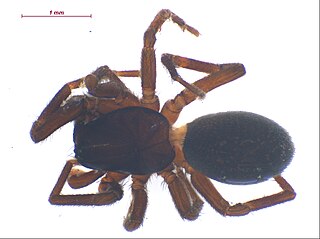
Tricholathys is a genus of cribellate araneomorph spiders in the family Dictynidae, and was first described by R. V. Chamberlin & Wilton Ivie in 1935.

Trachelas is a genus of araneomorph spiders which has variously been placed in families Trachelidae or Corinnidae. Current taxonomy places it in Trachelidae.
Titanebo is a genus of North American running crab spiders that was first described by Carl Eduard Adolph Gerstaecker in 1933.
Floricomus is a genus of North American dwarf spiders that was first described by C. R. Crosby & S. C. Bishop in 1925.

Grammonota is a genus of dwarf spiders that was first described by James Henry Emerton in 1882.
Scotinella formica, synonyms including Phruronellus formica, is a species of true spider in the family Phrurolithidae. It is found in the United States.
Scotinella is a genus of North American araneomorph spiders in the family Phrurolithidae, first described by Nathan Banks in 1911.

Phrurolithus is a genus of araneomorph spiders first described by C. L. Koch in 1839. First placed with the Liocranidae, it was moved to the Corinnidae in 2002, then to the Phrurolithidae in 2014.

Phrurotimpus is a genus of araneomorph spiders first described by R. V. Chamberlin and Wilton Ivie in 1935. The name is a compound adjective meaning "guarding the stone". Originally added to the Liocranidae, it was moved to the Corinnidae in 2002, then to the Phrurolithidae in 2014. They have red egg sacs that look like flattened discs, often found on the underside of stones.

Scotinella redempta is a species of true spider in the family Phrurolithidae, found in the eastern United States and Canada. It has a reddish-brown cephalothorax, and an abdomen with alternating patterns of light and dark spots and stripes. While little is known about the species biology, it is associated with deciduous forests, where it is most commonly found through sifting leaf litter.
Piabuna is a genus of North American araneomorph spiders first described by R. V. Chamberlin & Wilton Ivie in 1933. Originally added to the Liocranidae, it was moved to the Corinnidae in 2002, then to the Phrurolithidae in 2014.

Trachelopachys is a genus of South American araneomorph spiders first described by Eugène Simon in 1897. Originally placed with the Corinnidae, it was moved to the Trachelidae in 2014.
Phonotimpus is a genus of North American araneomorph spiders in the family Phrurolithidae. It was first described by Willis J. Gertsch and Louie Irby Davis in 1940, and placed with the Liocranidae. It was transferred to Corinnidae in 2002, then to the Phrurolithidae in 2014.
References
- 1 2 Chamberlin, R. V. (1921). "A new genus and a new species of spiders in the group Phrurolitheae". The Canadian Entomologist. 53 (3): 69–70. doi:10.4039/Ent5369-3. S2CID 84513559.
- ↑ Bosselaers, J.; Jocqué, R. (2002). "Studies in Corinnidae: cladistic analysis of 38 corinnid and liocranid genera, and transfer of Phrurolithinae". Zoologica Scripta. 31 (3): 265. doi:10.1046/j.1463-6409.2002.00080.x. S2CID 83947168.
- ↑ Ramírez, M. J. (2014). "The morphology and phylogeny of dionychan spiders (Araneae: Araneomorphae)". Bulletin of the American Museum of Natural History. 390: 343. doi:10.1206/821.1. hdl: 11336/18066 . S2CID 86146467.
- 1 2 "Gen. Scotinella Banks, 1911", World Spider Catalog, Natural History Museum Bern, retrieved 2025-01-29
 | This article related to araneomorph spiders is a stub. You can help Wikipedia by expanding it. |