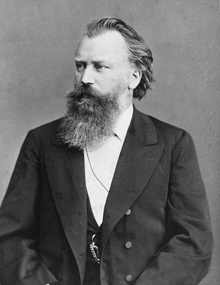
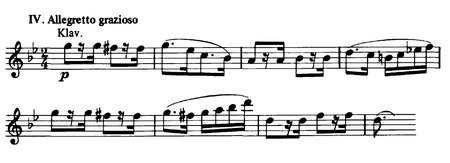
The Piano Concerto in A minor, Op. 16, composed by Edvard Grieg in 1868, was the only concerto Grieg completed. It is one of his most popular works, and is among the most popular of the genre. Grieg, being only 24 years old at the time of the composition, had taken inspiration from Robert Schumann's only concerto, also being in A minor.
The Piano Quintet in F minor, Op. 34, by Johannes Brahms was completed during the summer of 1864 and published in 1865. It was dedicated to Her Royal Highness Princess Anna of Hesse. As with most piano quintets composed after Robert Schumann's Piano Quintet (1842), it is written for piano and string quartet.

The String Quartet No. 6 in B-flat major, Op. 18, No. 6, was written between 1798 and 1800 by Ludwig van Beethoven and published in 1801, and dedicated to Joseph Franz von Lobkowitz.

Beethoven's Piano Concerto No. 3 in C minor, Op. 37 is generally thought to have been composed in 1800, although the year of its composition has been questioned by some contemporary musicologists. It was first performed on 5 April 1803, with the composer as soloist. During that same performance, the Second Symphony and the oratorio Christ on the Mount of Olives were also premiered. The composition was published in 1804, and was dedicated to Prince Louis Ferdinand of Prussia. The first primary theme is reminiscent of that of Mozart's 24th Piano Concerto.
Cyclic form is a technique of musical construction, involving multiple sections or movements, in which a theme, melody, or thematic material occurs in more than one movement as a unifying device. Sometimes a theme may occur at the beginning and end ; other times a theme occurs in a different guise in every part.
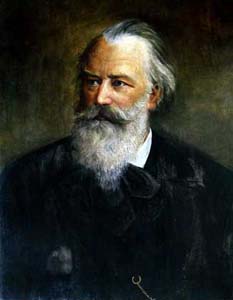
The Clarinet Sonatas, Op. 120, Nos. 1 and 2, are a pair of works written for clarinet and piano by the Romantic composer Johannes Brahms. They were written in 1894 and are dedicated to the clarinetist Richard Mühlfeld. The sonatas stem from a period late in Brahms's life where he discovered the beauty of the sound and tonal colour of the clarinet. The form of the clarinet sonata was largely undeveloped until after the completion of these sonatas, after which the combination of clarinet and piano was more readily used in composers’ new works. These were the last chamber pieces Brahms wrote before his death and are considered two of the great masterpieces in the clarinet repertoire. Brahms also produced a frequently performed transcription of these works for viola with alterations to better suit the instrument.

The Piano Concerto No. 1 in B♭ minor, Op. 23, was composed by Pyotr Ilyich Tchaikovsky between November 1874 and February 1875. It was revised in 1879 and in 1888. It was first performed on October 25, 1875, in Boston by Hans von Bülow after Tchaikovsky's desired pianist, Nikolai Rubinstein, criticised the piece. Rubinstein later withdrew his criticism and became a fervent champion of the work. It is one of the most popular of Tchaikovsky's compositions and among the best known of all piano concerti.
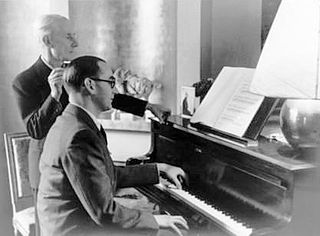
The Piano Concerto for the Left Hand in D major was composed by Maurice Ravel between 1929 and 1930, concurrently with his Piano Concerto in G major. The piece was commissioned by Paul Wittgenstein, a concert pianist who had lost his right arm in the First World War.
The Cello Concerto in B minor, Op. 104, B. 191, is the last solo concerto by Antonín Dvořák. It was written in 1894 for his friend, the cellist Hanuš Wihan, but was premiered in London on March 19, 1896, by the English cellist Leo Stern.
B-flat major is a major scale based on B♭, with pitches B♭, C, D, E♭, F, G, and A. Its key signature has two flats. Its relative minor is G minor and its parallel minor is B-flat minor.
E-flat major is a major scale based on E♭, consisting of the pitches E♭, F, G, A♭, B♭, C, and D. Its key signature has three flats. Its relative minor is C minor, and its parallel minor is E♭ minor,.
G minor is a minor scale based on G, consisting of the pitches G, A, B♭, C, D, E♭, and F. Its key signature has two flats. Its relative major is B-flat major and its parallel major is G major.
The two Serenades, Op. 11 and 16, represent early efforts by Johannes Brahms to write orchestral music. They both date from after the 1856 death of Robert Schumann when Brahms was residing in Detmold and had access to an orchestra.
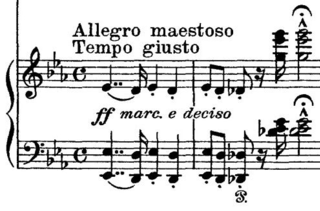
Franz Liszt composed his Piano Concerto No. 1 in E♭ major, S.124 over a 26-year period; the main themes date from 1830, while the final version is dated 1849. The concerto consists of four movements and lasts approximately 20 minutes. It premiered in Weimar on February 17, 1855, with Liszt at the piano and Hector Berlioz conducting.
The Piano Sonata No. 3 in F minor, Op. 5 of Johannes Brahms was written in 1853 and published the following year. The sonata is unusually large, consisting of five movements, as opposed to the traditional three or four. When he wrote this piano sonata, the genre was seen by many to be past its heyday. Brahms, enamored of Beethoven and the classical style, composed Piano Sonata No. 3 with a masterful combination of free Romantic spirit and strict classical architecture. As a further testament to Brahms' affinity for Beethoven, the Piano Sonata is infused with the instantly recognizable motive from Beethoven's Symphony No. 5 during the first, third, and fourth movements. Composed in Düsseldorf, it marks the end of his cycle of three sonatas, and was presented to Robert Schumann in November of that year; it was the last work that Brahms submitted to Schumann for commentary. Brahms was barely 20 years old at its composition. The piece is dedicated to Countess Ida von Hohenthal of Leipzig.

Johannes Brahms composed his Piano Trio No. 2 in C Major, Op. 87, between 1880 and 1882. It is scored for piano, violin and cello. He wrote this piece at the age of 49.
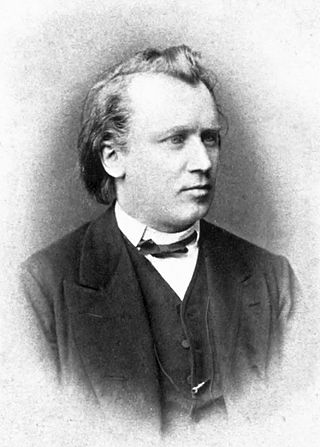
The Piano Quartet No. 3 in C minor, Op. 60, completed by Johannes Brahms in 1875, is scored for piano, violin, viola and cello. It is sometimes called the Werther Quartet after Goethe's The Sorrows of Young Werther. The premiere took place in Vienna on November 18, 1875, to an anxious public. Richard Wagner and his wife Cosima were in attendance.

The Piano Quartet No. 1 in G minor, Op. 25, was composed by Johannes Brahms between 1856 and 1861. It was premiered in 1861 in Hamburg, with Clara Schumann at the piano. It was also played in Vienna on 16 November 1862, with Brahms himself at the piano supported by members of the Hellmesberger Quartet. Like most piano quartets, it is scored for piano, violin, viola, and cello.
Samuel Carlton Cooley was an American violist and composer.
The bassoon repertoire consists of pieces of music composed for bassoon as a principal instrument that may be performed with or without other instruments. Below is a non-exhaustive list of major works for the bassoon.