
Ecdysis is the moulting of the cuticle in many invertebrates of the clade Ecdysozoa. Since the cuticle of these animals typically forms a largely inelastic exoskeleton, it is shed during growth and a new, larger covering is formed. The remnants of the old, empty exoskeleton are called exuviae.

A barnacle is a type of arthropod constituting the infraclass Cirripedia in the subphylum Crustacea, and is hence related to crabs and lobsters. Barnacles are exclusively marine, and tend to live in shallow and tidal waters, typically in erosive settings. They are sessile (nonmobile) and most are suspension feeders, but those in superorder Rhizocephala are parasitic. They have four nektonic larval stages. Around 1,000 barnacle species are currently known. The name "Cirripedia" is Latin, meaning "curl-footed". The study of barnacles is called cirripedology.
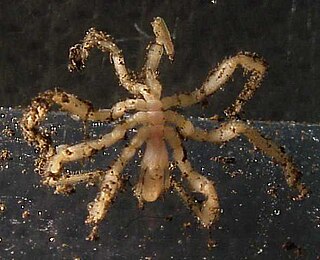
Sea spiders are marine arthropods of order Pantopoda, belonging to class Pycnogonida, hence they are also called pycnogonids. They are cosmopolitan, found in oceans around the world. There are over 1,300 known species, with legs ranging from 1 mm (0.04 in) to over 70 cm (2.3 ft). Most are toward the smaller end of this range in relatively shallow depths; however, they can grow to be quite large in Antarctic and deep waters.
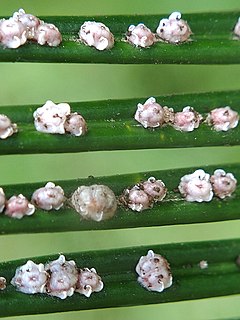
Scale insects are small insects of the order Hemiptera, suborder Sternorrhyncha. Of dramatically variable appearance and extreme sexual dimorphism, they comprise the superfamily Coccoidea. Adult females typically have soft bodies and no limbs, and are concealed underneath domed scales, extruding quantities of wax for protection. Some species are hermaphroditic, with a combined ovotestis instead of separate ovaries and testes. Males, in the species where they occur, have legs and sometimes wings, and resemble small flies. Scale insects are herbivores, piercing plant tissues with their mouthparts and remaining in one place, feeding on sap. The excess fluid they imbibe is secreted as honeydew on which sooty mold tends to grow. The insects often have a mutualistic relationship with ants, which feed on the honeydew and protect them from predators. There are about 8,000 described species.

Elasmucha grisea, common name parent bug, is a species of shield bugs or stink bugs belonging to the family Acanthosomatidae. The term parent bugs includes also the other species of the genus Elasmucha and some species of the family Acanthosomatidae.
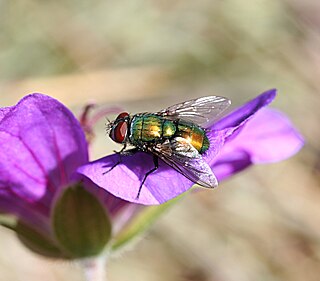
The common green bottle fly is a blowfly found in most areas of the world and is the most well-known of the numerous green bottle fly species. Its body is 10–14 millimetres (0.39–0.55 in) in length – slightly larger than a house fly – and has brilliant, metallic, blue-green or golden coloration with black markings. It has short, sparse black bristles (setae) and three cross-grooves on the thorax. The wings are clear with light brown veins, and the legs and antennae are black. The larvae of the fly may be used for maggot therapy, are commonly used in forensic entomology, and can be the cause of myiasis in livestock and pets.

Macrobrachium rosenbergii, also known as the giant river prawn or giant freshwater prawn, is a commercially important species of palaemonid freshwater prawn. It is found throughout the tropical and subtropical areas of the Indo-Pacific region, from India to Southeast Asia and Northern Australia. The giant freshwater prawn has also been introduced to parts of Africa, Thailand, China, Japan, New Zealand, the Americas and the Caribbean. It is one of the biggest freshwater prawns in the world and is widely cultivated in several countries for food. While M. rosenbergii is considered a freshwater species, the larval stage of the animal depends on brackish water. Once the individual shrimp has grown beyond the planktonic stage and becomes a juvenile, it will live entirely in freshwater.

Actias selene, the Indian moon moth or Indian luna moth, is a species of saturniid moth from Asia. It was first described by Jacob Hübner in 1807. This species is popular among amateur entomologists and is often reared from eggs or cocoons that are available from commercial sources. They fly mainly at night.

Polygonia interrogationis, the question mark, is a North American nymphalid butterfly. It lives in wooded areas, city parks, generally in areas with a combination of trees and open space. The color and textured appearance of the underside of its wings combine to provide camouflage that resembles a dead leaf. The adult butterfly has a wingspan of 4.5–7.6 cm (1.8–3.0 in). Its flight period is from May to September. "The silver mark on the underside of the hindwing is broken into two parts, a curved line and a dot, creating a ?-shaped mark that gives the species its common name."

Diplolepis rosae is a gall wasp which causes a gall known as the rose bedeguar gall, Robin's pincushion, mossy rose gall, or simply moss gall. The gall develops as a chemically induced distortion of an unopened leaf axillary or terminal bud, mostly on field rose or dog rose shrubs. The female lays up to 60 eggs within each leaf bud using her ovipositor. The grubs develop within the gall, and the wasps emerge in spring; the wasp is parthenogenetic with fewer than one percent being males. Previous synonyms for the species are Diplolepis bedeguaris, Rhodites rosae, and Cynips rosae.

Spawn is the eggs and sperm released or deposited into water by aquatic animals. As a verb, to spawn refers to the process of releasing the eggs and sperm, and the act of both sexes is called spawning. Most aquatic animals, except for aquatic mammals and reptiles, reproduce through the process of spawning.

Gerris lacustris, commonly known as the common pond skater or common water strider, is a species of water strider, found across Europe.
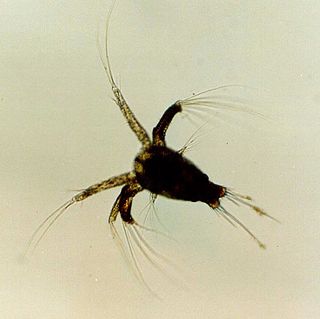
Crustaceans may pass through a number of larval and immature stages between hatching from their eggs and reaching their adult form. Each of the stages is separated by a moult, in which the hard exoskeleton is shed to allow the animal to grow. The larvae of crustaceans often bear little resemblance to the adult, and there are still cases where it is not known what larvae will grow into what adults. This is especially true of crustaceans which live as benthic adults, more-so than where the larvae are planktonic, and thereby easily caught.

Dociostaurus maroccanus, commonly known as the Moroccan locust, is a grasshopper in the insect family Acrididae. It is found in northern Africa, southern and eastern Europe and western Asia. It lives a solitary existence but in some years its numbers increase sharply, and it becomes gregarious and congregates to form swarms which can cause devastation in agricultural areas. The species was first described by Carl Peter Thunberg in 1815.
Pycnogonum stearnsi or Stearns' sea spider is a marine arthropod in the family Pycnogonidae. It is found on the western seaboard of North America.
Nicothoë astaci or the 'lobster louse' is an ectoparasitic copepod that parasitises the gills of the European lobster species Homarus gammarus. The lobster louse was first reported in 1826 by Audoin & Milne-Edwards. N. astaci has been found on lobsters inhabiting locations including Scotland, Lundy Island in the Bristol Channel and as far south as France and Portugal. The louse possesses a narrow suctorial mouthpart to feed on host haemolymph. Internally, In its adult form, Nicothoe is barely mobile and most likely remains in the same position for most of its life. The parasite occurs in groups, particularly near the base of the gills, and study has gone into its effects on the lobsters, which are considerably important, commercially. Not much is known about its life cycle, since there are significant gaps in knowledge of certain stages of its growth.

Dryomyza anilis is a common fly from the family Dryomyzidae. The fly is found through various areas in the Northern hemisphere and has brown and orange coloration with distinctive large red eyes. The life span of the fly is not known, but laboratory-reared males can live 28–178 days. D. anilis has recently been placed back in the genus Dryomyza, of which it is the type species. Dryomyzidae were previously part of Sciomyzidae but are now considered a separate family with two subfamilies.

Lymantria dispar dispar, commonly known as the gypsy moth, European gypsy moth, or North American gypsy moth, is a moth in the family Erebidae that is of Eurasian origin. It has a range that extends over Europe, Africa, and North America.
Aspidiotus destructor, the coconut scale, is a species of armoured scale insect in the family Diaspididae, found in many tropical and subtropical parts of the world. It is a serious pest of coconut and banana, and attacks a range of other fruiting trees and ornamental plants.
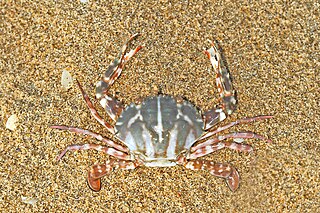
Charybdis feriata, the crucifix crab, is a species of swimming crab in the family Portunidae. It is found in the tropical and subtropical Indo-Pacific region.
