| Robin Hood Farm | |
|---|---|
| Heritage boundaries | |
| Location | 196 Campbelltown Road, Ingleburn, City of Campbelltown, New South Wales, Australia |
| Coordinates | 34°00′39″S150°50′39″E / 34.0108°S 150.8442°E |
| Built | 1860–1862 |
| Owner | Department of Planning and Infrastructure |
| Official name | Robin Hood Farm; Robin Hood Inn; Waratah Dairies |
| Type | State heritage (landscape) |
| Designated | 2 April 1999 |
| Reference no. | 1387 |
| Type | Farm |
| Category | Farming and Grazing |
| Builders | Richard Watson |
Robin Hood Farm is a heritage-listed former dairy farm homestead and now adolescent drug rehabilitation centre located at 196 Campbelltown Road, Ingleburn, in the City of Campbelltown local government area of New South Wales, Australia. It was built from 1860 to 1862 by Richard Watson. It is also known as Robin Hood Inn and Waratah Dairies. The property is owned by Department of Planning and Infrastructure, a department of the Government of New South Wales. It was added to the New South Wales State Heritage Register on 2 April 1999. [1]
Robin Hood Farm is closely associated with the Robin Hood Inn which was established in 1830 on part of the Campbellfields Estate subdivision. Although a number of buildings existed on the Robin Hood Farm estate at this time, no farmhouse as such is recorded. The first license to the inn was issued to Thomas Humphreys in 1830, who was also overseer of a nearby property "Varroville". The Inn's license passed through various hands until 1845 when it was issued to Richard Watson who held it until 1860. It would appear that some time around 1858 Watson had taken up farming, most likely dairying, on the adjacent property which became known as Robin Hood Farm. The coming of the railway may have been a factor in Watson's decision to move from the Inn to the farm. [1]
Watson appears to have left the farm by 1867 and the farm changed hands numerous times until 1912 when Fred Moore, a Campbelltown grazier, purchased the property. Moore purchased many of the surrounding parcels of land which were eventually consolidated into a single land holding of 125 hectares (308 acres), subsequently transferred to his wife, Victoria Moore. [1]
In the early twentieth century both Robin Hood Farm and nearby Varroville Farm were dairies. The Smith Brothers of Concord leased both from W. H. Staniforth of St. Andrews. [2] [1]
The Moores left the farm in 1932 but continued to lease it as a dairy farm until 1959 (1923 Percy, Austin and Arthur Smith (Smith Bros), dairymen of Concord operated dairies at Robin Hood Farm and Varroville until 1958, running their own dairy herd and purchasing milk from local farmers' [3] when Victoria, by then a widow, subdivided and sold most of the land to Frank Wolstenholme Pty Ltd (later Reid Murray Developments Pty Ltd). [1]
The lot containing the farmhouse was sold to Frank Lopresti, a grocer from Lakemba in October 1959. [1]
The farm was acquired by the State Planning Authority in October 1968. [1]
In 1969 architect John Fisher (member of the Institute of Architects, the Cumberland County Council Historic Buildings Committee and on the first Council of the National Trust of Australia (NSW) after its reformation in 1960) was commissioned by the State Planning Authority to restore the first five houses in Campbelltown, which had been resumed under the Cumberland County Planning Scheme. They included Glenalvon House. [1] [4]
A two-storey house of Georgian design, with a distinctive silhouette. The walls of the ground floor rooms fill in the ends of the front verandah forming rooms known as "out-shuts". The roof is galvanised iron, hipped with boxed eaves and a well proportioned chimney at both ends. A striking circular silo stands near the main building. The farmhouse was originally believed to have been built in the 1830s but recent research would suggest that the farm was built some 20–30 years later but after an earlier pattern. The conservation of the building took it back to its original form, stripping away the years of additions. Prior to the building's restoration, the National Trust listing of the building noted that the building contained much original external joinery. The conservation work not only removed the "years of additions," but appears to have removed some of the original joinery and the original wooden columns to the front verandah. [1]
Apart from the farmhouse there are few remaining building elements from the original farm complex left. These include a brick silo, with conical corrugated iron roof that is in urgent need of stabilisation, and the remnants of the Dairy, including a brick cool room with original door, which has been altered to dormitory and office accommodation. There is a narrow gauge rail line set in the cement floor of the dairy which was probably used for transporting large feed bins from one end of the dairy to the other. [1]
As at 28 January 1999, the house is in excellent condition, however, the remnants of the barn structure need to be examined before any further changes are carried out. The silo is in poor condition and needs urgent stabilisation. [1]
The main building has been extensively conserved. The exterior can be considered to be intact in its substantially original form whilst the interior can be considered to be intact in layout and partially intact in fitout. [1]
Conversion of site to Odyssey House - c. 1989, following conservation works under the guidance of Howard Tanner. [1]
A conservation plan for the site was prepared in 1988. As ten years have elapsed since this study was undertaken, it is recommended that the study be updated. The updated plan should address the impact of the "conservation works" on the significant fabric of the building and the impact of the demolition of the barn on the site's overall significance. [1]
As at 30 March 2000, Robin Hood Farm has high significance as a surviving mid nineteenth century farm house. It has a distinctive layout and configuration not represented by other buildings in the area. Together with the surviving villas and farmhouses between Liverpool and Campbelltown, Robin Hood Farm demonstrates the variety of agricultural uses of the area and the use of the area as a rural retreat from the earliest days of white settlement. It provides evidence of the changing use and altered intensity of occupation of the area and particularly the shift from cereal cropping to dairying. [1]
Robin Hood Farm was listed on the New South Wales State Heritage Register on 2 April 1999 having satisfied the following criteria. [1]
The place is important in demonstrating the course, or pattern, of cultural or natural history in New South Wales.
Robin Hood Farm is of historical significance as a rare surviving early dairy farm. It is of further significance for its association with Robin Hood Inn, one of the earliest social institutions in the district and for its association with Robert Watson, an early settler and pastoralist in the area. [1]
The place is important in demonstrating aesthetic characteristics and/or a high degree of creative or technical achievement in New South Wales.
Robin Hood Farm has high aesthetic significance as an unusually designed and well detailed early farmhouse building associated with early dairy farming activities in the Campbelltown district. The associated out buildings, in particular the silo, are also of high aesthetic significance. [1]
The place has a strong or special association with a particular community or cultural group in New South Wales for social, cultural or spiritual reasons.
Robin Hood Farm has high social significance through its links to early settlement and pastoral activities in the Campbelltown district. It has further social significance for its association with the Watson family, a prominent local family and for its association with the Robin Hood Inn, one of the earliest social institutions in the district. [1]
The place has potential to yield information that will contribute to an understanding of the cultural or natural history of New South Wales.
Robin Hood Farm is of high technical/research significance for its demonstration of mid-nineteenth century building techniques. It is of further significance for its demonstration of early farming and dairying techniques as represented by the extant outbuildings and silo. [1]
The place possesses uncommon, rare or endangered aspects of the cultural or natural history of New South Wales.
Robin Hood Farm is one of few surviving mid-nineteenth century dairy farms both in the Campbelltown district and the wider Sydney Metropolitan region. [1]
The place is important in demonstrating the principal characteristics of a class of cultural or natural places/environments in New South Wales.
Robin Hood Farm is an excellent example of a mid-nineteenth century farmhouse and dairy farm. [1]
Varroville is a suburb of Sydney, in the state of New South Wales, Australia. Varroville is located 46 kilometres south-west of the Sydney central business district, in the local government area of the City of Campbelltown and is part of the Macarthur region. Varroville forms part of the scenic hills on the north-west side of the M5 South Western Motorway between Campbelltown and the Camden Valley Way. Of all Sydney suburbs, Varroville has the highest proportion of residents with PhDs.
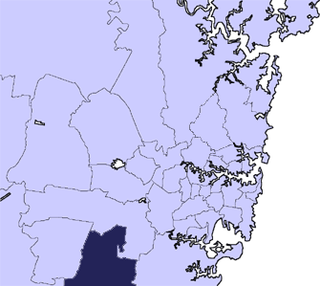
The City of Campbelltown is a local government area in the Macarthur region of south-western Sydney, in New South Wales, Australia. The area is located about 55 kilometres (34 mi) south west of the Sydney central business district and comprises 312 square kilometres (120 sq mi).
Glenalvon House is a heritage-listed homestead located at 8 Lithgow Street, Campbelltown in the City of Campbelltown local government area of New South Wales, Australia. It was designed and built in 1841 by Michael Byrne. It is also known as Glenalvon and Glenalvon and Stables. The property is owned by Department of Planning and Infrastructure, an agency of the Government of New South Wales. It was added to the New South Wales State Heritage Register on 2 April 1999.
Horsley Homestead is a heritage-listed residence at Horsley Drive, Dapto, City of Wollongong, New South Wales, Australia. It was built from 1842 to 1909. The homestead has also previously served as a museum (1972-1985) and as a function venue (1985-1992). It was added to the New South Wales State Heritage Register on 4 August 2000.
Glen Innes Post and Telegraph Office is a heritage-listed post office at Grey Street, Glen Innes, Glen Innes Severn, New South Wales, Australia. It was designed by NSW Government Architect's Office under Walter Liberty Vernon. and built from 1895 to 1896 by Sandbrook Brothers. The property is owned by Australia Post. It was added to the New South Wales State Heritage Register on 23 June 2000. It was added to the Australian Commonwealth Heritage List on 8 November 2011.
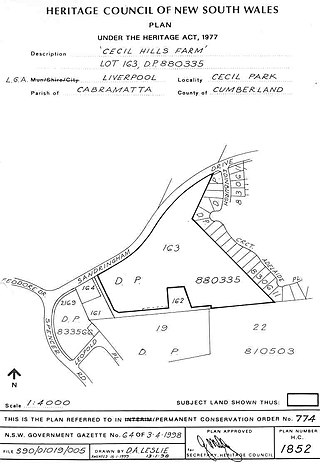
Cecil Hills Farm is a heritage-listed residence at Sandringham Drive, Cecil Hills, New South Wales, a suburb of Sydney, Australia. It was built from 1818 to 1824. The property is owned by the Government of New South Wales. It was added to the New South Wales State Heritage Register on 2 April 1999.
Challoner Cottage is a heritage-listed former children's home dormitory at 82 Bong Bong Road, Renwick, in the Southern Highlands region of New South Wales, Australia. It is also known as Cottage No. 12 or the Old Dormitory Building. It is a surviving feature of the institution variously known as the Mittagong Training School for Boys and Mittagong Farm Home, State Ward Home or Children's Home. It was added to the New South Wales State Heritage Register on 28 March 2014.
Oran Park is a heritage-listed former golf course, private residence and golf clubhouse and now private residence located at 112-130 Oran Park Drive in the south-western Sydney suburb of Oran Park in the Camden Council local government area of New South Wales, Australia. It was built from 1837 to 1946. It is sometimes referred to as Catherine Park House due to a land subdivision of Catherine Fields, however "Catherine Park" is only a developer's name for the area and not a true suburb. The property is privately owned. It was added to the New South Wales State Heritage Register on 5 March 2015.
Windmill Hill is a heritage-listed former farm and now water catchment area located at Wilton Road in the outer south-western Sydney settlement of Appin in the Wollondilly Shire local government area of New South Wales, Australia. It was built from 1820 to 1950. It is also known as Windmill Hill Group, including Ruins, North Farm, Middle Farm aka Larkin Farm and Windmill Hill, South Farm and Steven's Homestead. The property is owned by Water NSW. It was added to the New South Wales State Heritage Register on 27 June 2014.
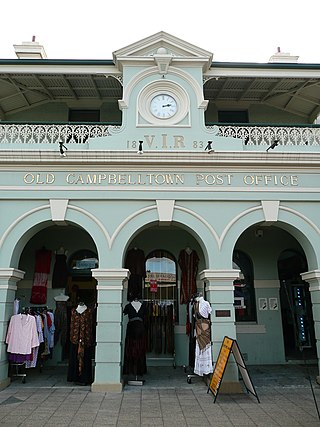
The Campbelltown Post Office is a heritage-listed former post office and now shops and office space at 261 Queen Street, Campbelltown, New South Wales, a suburb of Sydney, Australia. It was designed by James Barnet and built in 1881. It is also known as Campbelltown Post Office (former). The property is privately owned. It was added to the New South Wales State Heritage Register on 2 April 1999.
St John's Roman Catholic Church and Cemetery is a heritage-listed former school and now Roman Catholic church building located in George Street in Campbelltown. It was designed by John Joseph Therry and built from 1824 to 1841. It is also known as St Johns Roman Catholic Church and Cemetery (former), Saint Johns Roman Catholic Church and Old St John's Church. It was added to the New South Wales State Heritage Register on 2 April 1999. The current church, called St John the Evangelist Catholic Church was built in 1886 and is located at Cordeaux Street, Campbelltown in the City of Campbelltown local government area of New South Wales, Australia. The property is owned by Trustees of the Roman Catholic Church for the Diocese of Wollongong.
Epping Forest is a heritage-listed former farm and residence and now vacant building at Mississippi Crescent, Kearns, City of Campbelltown, New South Wales, Australia. It was designed and built from 1825. The property is privately owned. It was added to the New South Wales State Heritage Register on 13 August 1999.
Sugarloaf Farm is a heritage-listed former dairy, wheat farming and pastoral property and now residence and horse riding venue located at Menangle Road, Gilead, City of Campbelltown, New South Wales, Australia. It was designed and built from 1835. It is also known as Mt Huon. The property is owned by the New South Wales Department of Planning and Infrastructure. It was added to the New South Wales State Heritage Register on 2 April 1999.
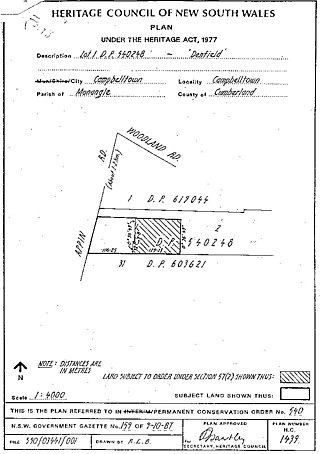
Denfield is a heritage-listed former farm homestead complex, residence, inn and farm and now residence located at Appin Road, St Helens Park in the City of Campbelltown local government area of New South Wales, Australia. It was built in 1837 by John Farley. It was added to the New South Wales State Heritage Register on 2 April 1999.
Glenlee is a heritage-listed former dairy farm, pastoral property and hay production and now olive farm, private home and pastoral property at Glenlee Road, Menangle Park, City of Campbelltown, New South Wales, Australia. It was designed by Henry Kitchen and built from 1824 to 1859 by Robert Gooch and Nathaniel Payton. It is also known as Glenlee, outbuildings, garden & gatelodge. It was added to the New South Wales State Heritage Register on 2 April 1999.
Varroville is a heritage-listed former farm and now rural residence at 196 St Andrews Road, Varroville, New South Wales, Australia. It was designed by Weaver and Kemp and built from 1810 to 1859. It is also known as Varro Ville and Varra Ville. The property is privately owned. It was added to the New South Wales State Heritage Register on 2 April 1999.
The Long's Lane Precinct, also Longs Lane Precinct, comprise a series of heritage-listed terrace houses located at 130 Cumberland Street, 132–134 Cumberland Street, 136-138 Cumberland Street, and 140–142 Cumberland Street, in the inner-city Sydney suburb of The Rocks in the City of Sydney local government area of New South Wales, Australia. The terrace houses were built from 1888 to 1914, and they are also known as 130 Cumberland Street,132–134 Cumberland Street, 136–138 Cumberland Street, Watson's Butchery, and 140–142 Cumberland Street. The properties are owned by NashCap, an Australian-based real estate private equity firm. The precinct and the terrace houses were added to the New South Wales State Heritage Register on 10 May 2002.
Hadley Park is a heritage-listed former Aboriginal land, farm, dairy and gravel quarry and now unused building at 14-278 Old Castlereagh Road, Castlereagh, City of Penrith, New South Wales, Australia. It was built from 1803 to 1812. It was added to the New South Wales State Heritage Register on 20 April 2018.
White Hart Inn Archaeological Site is a heritage-listed inn and archaeological site at Windsor Road, Beaumont Hills in The Hills Shire local government area of New South Wales, Australia. It was built from 1827 to. The property is owned by NSW Department of Planning, Industry and Environment, a department of the Government of New South Wales. The site was added to the New South Wales State Heritage Register on 24 August 2018.
Mamre is a heritage-listed former farm homestead complex, grain cropping, pastoral property and wool production and now residence, community facility, market gardening and nursery production located at Mamre Road in the western Sydney suburb of Orchard Hills in the City of Penrith local government area of New South Wales, Australia. It was built from 1822 to 1832. The property is owned by the New South Wales Department of Planning and Infrastructure. It was added to the New South Wales State Heritage Register on 2 April 1999.
This Wikipedia article was originally based on Robin Hood Farm , entry number 01387 in the New South Wales State Heritage Register published by the State of New South Wales (Department of Planning and Environment) 2018 under CC-BY 4.0 licence , accessed on 2 June 2018.