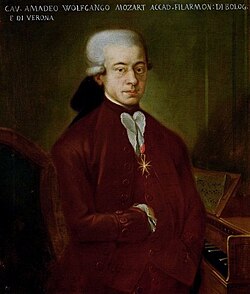
The Serenade for Orchestra No. 9 in D major K. 320, Posthorn , was written by Wolfgang Amadeus Mozart in Salzburg, in 1779. The manuscript is dated 3 August 1779 and was intended for the University of Salzburg's "Finalmusik" ceremony that year. [1]
The serenade is scored for two flutes, piccolo, two oboes, two bassoons, two horns, two trumpets, post horn, timpani and strings. This scoring is unusually large for a work of this type. Normally, the same players would play oboe and flute, but in this case they appear simultaneously. The timpani, also, were not usually part of the serenade orchestra. [2]
It has seven movements:
- Adagio maestoso – Allegro con spirito
- Minuetto
- Concertante: Andante grazioso in G major
- Rondeau: Allegro ma non troppo in G major
- Andantino in D minor
- Minuetto – Trio 1 and 2
- Finale: Presto
The Concertante and Rondeau movements feature prominent concertante sections for flutes, oboes, and bassoons. These were performed on their own in a concert in the old Vienna Burgtheater on 23 March 1783, along with the Haffner symphony, an aria from Idomeneo , and several other works. [3]

The first trio of the second minuet features a solo piccolo (called "flautino" in the manuscript) played over strings. The second trio of the second minuet features a solo for the post horn. This solo gives the serenade its nickname.
A typical performance lasts approximately 45 minutes.


