| Striped woodhaunter | |
|---|---|
| Scientific classification | |
| Kingdom: | Animalia |
| Phylum: | Chordata |
| Class: | Aves |
| Order: | Passeriformes |
| Family: | Furnariidae |
| Genus: | Automolus |
| Species: | A. subulatus |
| Binomial name | |
| Automolus subulatus Spix, 1824 | |
| Synonyms | |
Hyloctistes subulatus [2] | |

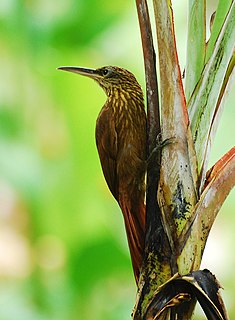
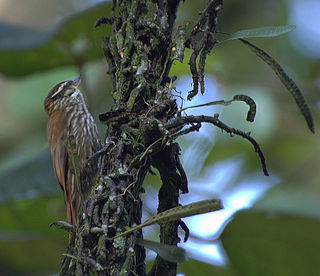
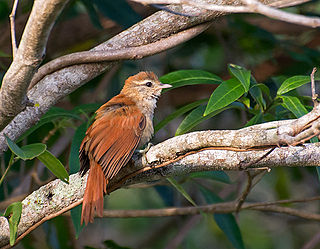
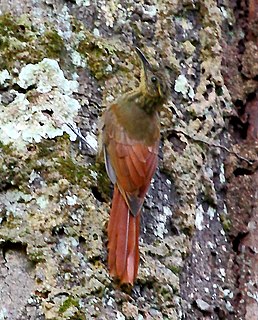
The striped woodhaunter (Automolus subulatus), also known as the Amazonian woodhaunter, is a species of bird in the family Furnariidae.
Birds, also known as Aves, are a group of endothermic vertebrates, characterised by feathers, toothless beaked jaws, the laying of hard-shelled eggs, a high metabolic rate, a four-chambered heart, and a strong yet lightweight skeleton. Birds live worldwide and range in size from the 5 cm (2 in) bee hummingbird to the 2.75 m (9 ft) ostrich. They rank as the world's most numerically-successful class of tetrapods, with approximately ten thousand living species, more than half of these being passerines, sometimes known as perching birds. Birds have wings which are more or less developed depending on the species; the only known groups without wings are the extinct moa and elephant birds. Wings, which evolved from forelimbs, gave birds the ability to fly, although further evolution has led to the loss of flight in flightless birds, including ratites, penguins, and diverse endemic island species of birds. The digestive and respiratory systems of birds are also uniquely adapted for flight. Some bird species of aquatic environments, particularly seabirds and some waterbirds, have further evolved for swimming.
It is found in Bolivia, Brazil, Colombia, Costa Rica, Ecuador, Nicaragua, Panama, Peru, and Venezuela. Its natural habitats are subtropical or tropical moist lowland forests and subtropical or tropical moist montane forests.
Bolivia, officially the Plurinational State of Bolivia is a landlocked country located in western-central South America. The capital is Sucre while the seat of government and financial center is located in La Paz. The largest city and principal industrial center is Santa Cruz de la Sierra, located on the Llanos Orientales a mostly flat region in the east of Bolivia.

Brazil, officially the Federative Republic of Brazil, is the largest country in both South America and Latin America. At 8.5 million square kilometers and with over 208 million people, Brazil is the world's fifth-largest country by area and the fifth most populous. Brazil borders every South American country except Chile and Ecuador. Its capital is Brasília, and its most populated city is São Paulo. The federation is composed of the union of the 26 states, the Federal District, and the 5,570 municipalities. It is the largest country to have Portuguese as an official language and the only one in the Americas; it is also one of the most multicultural and ethnically diverse nations, due to over a century of mass immigration from around the world.
Colombia, officially the Republic of Colombia, is a sovereign state largely situated in the northwest of South America, with territories in Central America. Colombia shares a border to the northwest with Panama, to the east with Venezuela and Brazil and to the south with Ecuador and Peru. It shares its maritime limits with Costa Rica, Nicaragua, Honduras, Jamaica, Haiti, and the Dominican Republic. Colombia is a unitary, constitutional republic comprising thirty-two departments, with the capital in Bogota.
Ovenbirds or furnariids are a large family of small suboscine passerine birds found from Mexico and Central to southern South America. They form the family Furnariidae. The ovenbird, which breeds in North America, is not a furnariid – rather it is a distantly related bird of the wood warbler family, Parulidae.
The woodcreepers (Dendrocolaptinae) comprise a subfamily of suboscine passerine birds endemic to the Neotropics. They have traditionally been considered a distinct family Dendrocolaptidae, but most authorities now place them as a subfamily of the ovenbirds (Furnariidae). They superficially resemble the Old World treecreepers, but they are unrelated and the similarities are due to convergent evolution. The subfamily contains around 57 species in 15 to 20 genera.
Xenops is a genus in the bird family Furnariidae, the ovenbirds. The genus comprises three species of xenops, all of which are found in Mexico, Central America and South America, particularly in tropical rain forests.
Automolus is a genus of bird in the Furnariidae family.
The buff-throated foliage-gleaner is a species of bird in the Furnariidae family.
The tepui foliage-gleaner, also known as the white-throated foliage-gleaner, is a species of bird in the Furnariidae family. It is found in forest and woodland in the tepuis of Brazil, Guyana and Venezuela.
The chestnut-crowned foliage-gleaner is a species of bird in the Furnariidae family.
The rusty-backed spinetail is a Neotropical species of bird in the Furnariidae (ovenbird) family. The taxon from Panama is considered a separate species, the Coiba spinetail.
The long-tailed woodcreeper is a species of bird in the Dendrocolaptinae subfamily. It is monotypic within Deconychura, but formerly this genus also included the spot-throated woodcreeper.
The spot-throated woodcreeper is a species of bird in the Dendrocolaptinae subfamily. It is the only species in the genus Certhiasomus. It was formerly included in Deconychura together with the long-tailed woodcreeper, but the two are not closely related.
The cinnamon-throated woodcreeper is a species of bird in the Dendrocolaptinae subfamily of the ovenbird family (Furnariidae). It makes up the monotypic genus Dendrexetastes.
The red-shouldered spinetail is a species of bird in the ovenbird family Furnariidae. It is endemic to the Caatinga region of north-eastern Brazil. It is threatened by habitat loss.
The montane woodcreeper is a perching bird species in the subfamily Dendrocolaptinae of the ovenbird family (Furnariidae).
The buff-fronted foliage-gleaner is a species of bird in the Furnariidae family, the ovenbirds. It is found in southeastern regions of South America in the cerrado and pantanal of Brazil and Paraguay as well as areas of southeast coastal Brazil; also extreme northeast Argentina. In western Andean and northwest South America, it is found in Venezuela, Colombia, Ecuador, Peru and Bolivia; and in the northwest, it is also found in Panama and Costa Rica.
The recurvebills are two species of Furnariid birds from the genus Syndactyla . They are restricted to humid forests in the South American countries of Bolivia, Peru and Brazil. Their common name refers to the peculiar bill-shape, which, at least in the case of the larger-billed Peruvian recurvebill, is an adaption for manipulating bamboo stems. Both species are overall rufescent brown. The SACC reclassified the recurvebills from the genus Simoxenops to Syndactyla based on studies from Dewberry (2011).
The great spinetail is a species of bird in the Furnariidae family. It is endemic to Peru where its natural habitat is Mediterranean-type shrubby vegetation. It is threatened by habitat loss.
The ocellated woodcreeper is a species of bird in the Dendrocolaptinae subfamily of the ovenbird family (Furnariidae). It sometimes includes the Tschudi's woodcreeper as a subspecies.
The chestnut-rumped woodcreeper is a species of perching bird. Like the other woodcreepers, it belongs to the subfamily Dendrocolaptinae of the ovenbird family (Furnariidae).
Poecilurus is an obsolete genus of birds formerly classified in the Furnariidae (ovenbird) family from South America. It contained three species:
The western woodhaunter is a species of bird in the family Furnariidae.
| This article about an ovenbird is a stub. You can help Wikipedia by expanding it. |