Sumisip | |
|---|---|
| Municipality of Sumisip | |
Map of Basilan with Sumisip highlighted | |
Location within the Philippines | |
| Coordinates: 6°25′N121°59′E / 6.42°N 121.98°E Coordinates: 6°25′N121°59′E / 6.42°N 121.98°E | |
| Country | |
| Region | Bangsamoro Autonomous Region in Muslim Mindanao (BARMM) |
| Province | Basilan |
| District | Lone District |
| Barangays | 29 (see Barangays) |
| Government | |
| • Type | Sangguniang Bayan |
| • Mayor | Gulam S. Salliman-Hataman |
| • Electorate | 20,849 voters (2016) |
| Area | |
| • Total | 567.60 km2 (219.15 sq mi) |
| Population (2015 census) [3] | |
| • Total | 41,730 |
| • Density | 74/km2 (190/sq mi) |
| Time zone | UTC+8 (PST) |
| ZIP code | 7305 |
| PSGC | |
| IDD : area code | +63 (0)62 |
| Climate type | Tropical climate |
| Income class | 1st municipal income class |
| Revenue (₱) | 139,299,986.18 (2016) |
| Native languages | Yakan Chavacano Tagalog |
| Website | www |
Sumisip, officially the Municipality of Sumisip, (Tausūg: Lupah Sumisip; Chavacano: Municipalidad de Sumisip; Tagalog : Bayan ng Sumisip), is a 1st class municipality in the province of Basilan, Philippines. According to the 2015 census, it has a population of 41,730 people. [3]
Tagalog is an Austronesian language spoken as a first language by a quarter of the population of the Philippines and as a second language by the majority. Its standardized form, officially named Filipino, is the national language of the Philippines, and is one of two official languages alongside English.
The Province of Basilan is an island province of the Philippines in the Bangsamoro Autonomous Region. Basilan Island is the largest and northernmost of the major islands of the Sulu Archipelago. It is just off the southern coast of the geographic Zamboanga Peninsula.
The Philippines, officially the Republic of the Philippines, is an archipelagic country in Southeast Asia. Situated in the western Pacific Ocean, it consists of about 7,641 islands that are categorized broadly under three main geographical divisions from north to south: Luzon, Visayas, and Mindanao. The capital city of the Philippines is Manila and the most populous city is Quezon City, both part of Metro Manila. Bounded by the South China Sea on the west, the Philippine Sea on the east and the Celebes Sea on the southwest, the Philippines shares maritime borders with Taiwan to the north, Vietnam to the west, Palau to the east, and Malaysia and Indonesia to the south.
12 barangays that were not on Basilan Island seceded to form the municipality of Tabuan-Lasa through Muslim Mindanao Autonomy Act No. 187, [4] which was subsequently ratified in a plebiscite held on March 29, 2008.
Sumisip is politically subdivided into 29 barangays. [5]
A barangay or baranggay (, formerly referred to as barrio, is the smallest administrative division in the Philippines and is the native Filipino term for a village, district or ward. In metropolitan areas, the term often refers to an inner city neighbourhood, a suburb or a suburban neighborhood. The word barangay originated from balangay, a kind of boat used by a group of Austronesian peoples when they migrated to the Philippines.
| PSGC | Barangay | Population | ±% p.a. | |||
|---|---|---|---|---|---|---|
| 2015 [3] | 2010 [6] | |||||
| 150705001 | Bacung | 4.6% | 1,900 | 2,028 | −1.23% | |
| 150705027 | Baiwas | 2.5% | 1,049 | 974 | 1.42% | |
| 150705028 | Basak | 3.0% | 1,237 | 1,107 | 2.14% | |
| 150705002 | Benembengan Lower | 1.9% | 810 | 582 | 6.50% | |
| 150705035 | Benembengan Upper | 3.5% | 1,443 | 1,017 | 6.89% | |
| 150705036 | Bohe-languyan | 1.9% | 797 | 777 | 0.49% | |
| 150705006 | Buli-buli | 3.0% | 1,271 | 1,021 | 4.26% | |
| 150705007 | Cabcaban | 3.4% | 1,413 | 1,293 | 1.70% | |
| 150705029 | Cabengbeng Lower | 3.0% | 1,237 | 1,131 | 1.72% | |
| 150705030 | Cabengbeng Upper | 3.0% | 1,264 | 1,602 | −4.41% | |
| 150705039 | Ettub-ettub | 4.3% | 1,797 | 1,296 | 6.42% | |
| 150705010 | Guiong | 6.1% | 2,560 | 2,471 | 0.68% | |
| 150705041 | Kaum-Air | 2.0% | 828 | 825 | 0.07% | |
| 150705051 | Kaumpamatsakem | 2.7% | 1,120 | 841 | 5.61% | |
| 150705024 | Libug | 3.2% | 1,320 | 1,252 | 1.01% | |
| 150705042 | Limbocandis | 2.1% | 878 | 631 | 6.49% | |
| 150705043 | Lukketon | 4.0% | 1,662 | 1,544 | 1.41% | |
| 150705031 | Luuk-Bait | 3.7% | 1,553 | 1,719 | −1.92% | |
| 150705032 | Mahatalang | 2.9% | 1,190 | 1,254 | −0.99% | |
| 150705013 | Manaul | 4.5% | 1,887 | 1,666 | 2.40% | |
| 150705014 | Mangal ( Poblacion ) | 7.2% | 3,008 | 2,207 | 6.07% | |
| 150705044 | Marang | 2.4% | 1,014 | 1,078 | −1.16% | |
| 150705045 | Mebak | 3.1% | 1,302 | 754 | 10.96% | |
| 150705047 | Sahaya Bohe Bato | 3.9% | 1,630 | 1,208 | 5.87% | |
| 150705048 | Sapah Bulak | 3.5% | 1,452 | 1,091 | 5.59% | |
| 150705019 | Sumisip Central | 4.0% | 1,671 | 1,462 | 2.58% | |
| 150705050 | Tikus | 3.6% | 1,482 | 1,069 | 6.42% | |
| 150705025 | Tongsengal | 2.5% | 1,036 | 1,095 | −1.05% | |
| 150705022 | Tumahubong | 4.6% | 1,919 | 2,036 | −1.12% | |
| Total | 41,730 | 37,031 | 2.30% | |||
| Population census of Sumisip | ||
|---|---|---|
| Year | Pop. | ±% p.a. |
| 1960 | 13,055 | — |
| 1970 | 14,085 | +0.76% |
| 1975 | 20,885 | +8.22% |
| 1980 | 29,696 | +7.29% |
| 1990 | 33,301 | +1.15% |
| 1995 | 42,003 | +4.45% |
| 2000 | 51,712 | +4.56% |
| 2007 | 71,807 | +4.63% |
| 2010 | 37,031 | −21.42% |
| 2015 | 41,730 | +2.30% |
| Source: Philippine Statistics Authority [3] [6] [7] [8] | ||
In the 2015 census, Sumisip had a population of 41,730. [3]
| Climate data for Sumisip, Basilan | |||||||||||||
|---|---|---|---|---|---|---|---|---|---|---|---|---|---|
| Month | Jan | Feb | Mar | Apr | May | Jun | Jul | Aug | Sep | Oct | Nov | Dec | Year |
| Average high °C (°F) | 27 (81) | 27 (81) | 27 (81) | 28 (82) | 28 (82) | 28 (82) | 28 (82) | 28 (82) | 28 (82) | 28 (82) | 28 (82) | 28 (82) | 28 (82) |
| Average low °C (°F) | 27 (81) | 26 (79) | 27 (81) | 27 (81) | 28 (82) | 28 (82) | 27 (81) | 28 (82) | 28 (82) | 28 (82) | 27 (81) | 27 (81) | 27 (81) |
| Average precipitation mm (inches) | 129 (5.1) | 85 (3.3) | 101 (4.0) | 111 (4.4) | 227 (8.9) | 303 (11.9) | 303 (11.9) | 285 (11.2) | 197 (7.8) | 254 (10.0) | 219 (8.6) | 136 (5.4) | 2,350 (92.5) |
| Average rainy days | 15.9 | 13.5 | 15.1 | 14.8 | 22.9 | 24.7 | 24.9 | 24.3 | 20.7 | 22.6 | 20.5 | 17.4 | 237.3 |
| Source: Meteoblue [9] | |||||||||||||

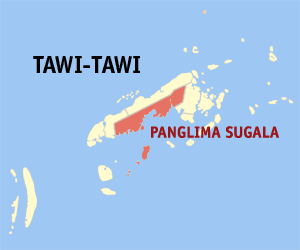
Panglima Sugala, officially the Municipality of Panglima Sugala, is a 3rd class municipality in the province of Tawi-Tawi, Philippines. According to the 2015 census, it has a population of 44,184 people.

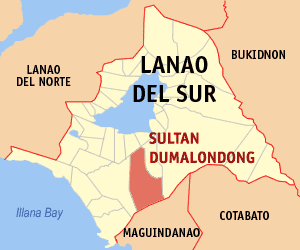
Sultan Dumalondong, officially the Municipality of Sultan Dumalondong, is a 6th class municipality in the province of Lanao del Sur, Philippines. According to the 2015 census, it has a population of 11,298 people.

Lantawan, officially the Municipality of Lantawan,, is a 3rd class municipality in the province of Basilan, Philippines. According to the 2015 census, it has a population of 24,594 people.
Maluso, officially the Municipality of Maluso,, is a 4th class municipality in the province of Basilan, Philippines. According to the 2015 census, it has a population of 40,646 people.

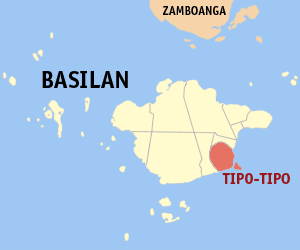
Tipo-Tipo, officially the Municipality of Tipo-Tipo,, is a 3rd class municipality in the province of Basilan, Philippines. According to the 2015 census, it has a population of 19,163 people.

Tuburan, officially the Municipality of Tuburan,, is a 2nd class municipality in the province of Basilan, Philippines. According to the 2015 census, it has a population of 20,207 people.
Datu Saudi-Ampatuan is a 4th class municipality in the province of Maguindanao, Philippines. According to the 2015 census, it has a population of 26,427 people.

Datu Unsay, officially the Municipality of Datu Unsay, is a 5th class municipality in the province of Maguindanao, Philippines. According to the 2015 census, it has a population of 11,813 people.

Guindulungan, officially the Municipality of Guindulungan, is a — municipality in the province of Maguindanao, Philippines. According to the 2015 census, it has a population of 19,911 people.

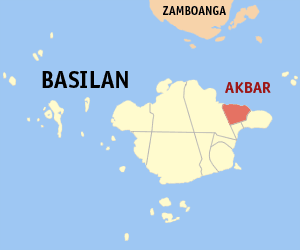
Akbar, officially the Municipality of Akbar,, is a — municipality in the province of Basilan, Philippines. According to the 2015 census, it has a population of 17,531 people.

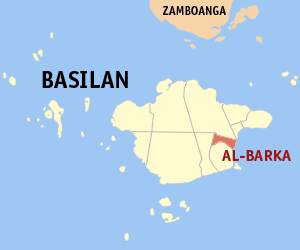
Al-Barka, officially the Municipality of Al-Barka,, is a — municipality in the province of Basilan, Philippines. According to the 2015 census, it has a population of 20,905 people.

Hadji Mohammad Ajul, officially the Municipality of Hadji Mohammad Ajul,, is a — municipality in the province of Basilan, Philippines. According to the 2015 census, it has a population of 19,307 people.
Ungkaya Pukan, officially the Municipality of Ungkaya Pukan,, is a — municipality in the province of Basilan, Philippines. According to the 2015 census, it has a population of 18,441 people.
Mangudadatu, officially the Municipality of Mangudadatu, is a — municipality in the province of Maguindanao, Philippines. According to the 2015 census, it has a population of 25,046 people.
Pandag, officially the Municipality of Pandag, is a — municipality in the province of Maguindanao, Philippines. According to the 2015 census, it has a population of 25,057 people.
Northern Kabuntalan, officially the Municipality of Northern Kabuntalan, is a 5th class municipality in the province of Maguindanao, Philippines. According to the 2015 census, it has a population of 25,232 people.

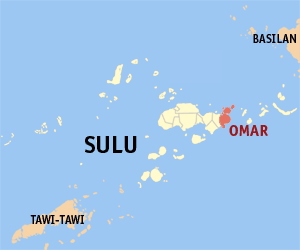
Omar, officially the Municipality of Omar, is a — municipality in the province of Sulu, Philippines. According to the 2015 census, it has a population of 25,116 people.

Hadji Muhtamad, officially the Municipality of Hadji Muhtamad,, is a — municipality in the province of Basilan, Philippines. According to the 2015 census, it has a population of 25,085 people.

Tabuan-Lasa, officially the Municipality of Tabuan-Lasa,, is a — municipality in the province of Basilan, Philippines. According to the 2015 census, it has a population of 24,188 people.

Datu Hoffer Ampatuan, officially the Municipality of Datu Hoffer Ampatuan, is a — municipality in the province of Maguindanao, Philippines. According to the 2015 census, it has a population of 25,012 people.
| This article about a location in the Autonomous Region in Muslim Mindanao is a stub. You can help Wikipedia by expanding it. |