The bass guitar, electric bass, or simply bass, is the lowest-pitched member of the guitar family. It is a plucked string instrument similar in appearance and construction to an electric or an acoustic guitar, but with a longer neck and scale length, and typically four to six strings or courses. Since the mid-1950s, the bass guitar has largely replaced the double bass in popular music.

An electric guitar is a guitar that requires external amplification in order to be heard at typical performance volumes. It uses one or more pickups to convert the vibration of its strings into electrical signals, which ultimately are reproduced as sound by loudspeakers. The sound can be shaped or electronically altered to achieve different timbres or tonal qualities, making it quite different than an acoustic guitar. Often, this is done through the use of effects such as reverb, distortion and "overdrive"; the latter is considered to be a key element of electric blues guitar music and rock guitar playing.

C.F. Martin & Company is an American guitar manufacturer established in 1833, by Christian Frederick Martin. It is highly respected for its acoustic guitars and is a leading manufacturer of flat top guitars. The company has also made mandolins and as well as several models of electric guitars and electric basses, although none of these other instruments are currently in production.

The acoustic bass guitar is a bass instrument with a hollow wooden body similar to, though usually larger than a steel-string acoustic guitar. Like the traditional electric bass guitar and the double bass, the acoustic bass guitar commonly has four strings, which are normally tuned E-A-D-G, an octave below the lowest four strings of the 6-string guitar, which is the same tuning pitch as an electric bass guitar.

The Gibson L-5 guitar was first produced in 1922 by the Gibson Guitar Corporation, then of Kalamazoo, Michigan, under the direction of acoustical engineer and designer Lloyd Loar, and has been in production ever since. It was considered the premier guitar of the company during the big band era. It was originally offered as an acoustic instrument, with electric models not made available until the 1940s.

Epiphone is an American musical instrument manufacturer founded in 1873 by Anastasios Stathopoulos, currently based in Nashville, Tennessee. In 1957, Epiphone, Inc. was purchased by Gibson and relocated from New York to Kalamazoo, Michigan. Epiphone was Gibson's main rival in the archtop market prior to 1957. Aside from guitars, Epiphone also made double basses, banjos, and other string instruments. However, the company's weakness in the aftermath of World War II and death of Epaminondas Stathopoulos in 1943 allowed Gibson to purchase it. Epiphone also manufactures resonator guitars under the Dobro brand.
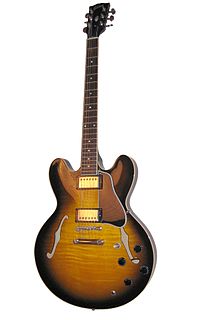
A semi-acoustic guitar or hollow-body electric is a type of electric guitar that originates from the 1930s. It has both a sound box and one or more electric pickups. This is not the same as an acoustic-electric guitar, which is an acoustic guitar with the addition of pickups or other means of amplification, added by either the manufacturer or the player.

An archtop guitar is a hollow steel-stringed acoustic or semiacoustic guitar with a full body and a distinctive arched top, whose sound is particularly popular with jazz, blues, and rockabilly players.

Karl Höfner GmbH & Co. KG is a German manufacturer of musical instruments, with one division that manufactures guitars and basses, and another that manufactures other string instruments, such as violins, violas, cellos, double basses and bows for stringed instruments.
Variax is the name of a line of guitars developed and marketed by Line 6. They differ from typical electric and acoustic guitars in that internal electronics process the sound from individual strings to model (replicate) the sound of specific guitars and other instruments. The maker claims it is the first guitar family that can emulate the tones of other notable electric and acoustic guitars. It also provides a banjo and a sitar tone. The Variax is currently available as an electric guitar, but modeling acoustic guitars and modeling electric bass guitars have been available in the past.
Washburn Guitars is an American manufacturer and importer of guitars, mandolins, and other string instruments. The original company was established in 1883 in Chicago, Illinois. The modern Washburn is a division of US Music Corp., in turn now owned by JAM Industries USA.

The tenor guitar or four-string guitar is a slightly smaller, four-string relative of the steel-string acoustic guitar or electric guitar. The instrument was initially developed in its acoustic form by Gibson and C.F. Martin so that players of the four-string tenor banjo could double on guitar.
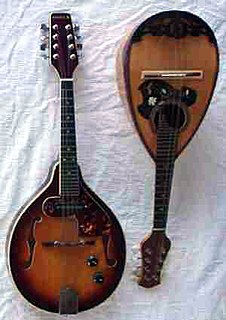
The electric mandolin is an instrument tuned and played as the mandolin and amplified in similar fashion to an electric guitar. As with electric guitars, electric mandolins take many forms:

A multi-neck guitar is a guitar that has multiple fingerboard necks. They exist in both electric and acoustic versions. Although multi-neck guitars are quite common today, they are not a modern invention. Examples of multi-neck guitars and lutes go back at least to the Renaissance.

Schecter Guitar Research, commonly known simply as Schecter, is an American manufacturing company founded in 1976 by David Schecter, which originally produced only replacement parts for existing guitars from manufacturers such as Fender and Gibson.
The scale length or scale of a string instrument is the maximum vibrating length of the strings that produce sound, and determines the range of tones that string can produce at a given tension. It's also called string length. On instruments in which strings are not "stopped" or divided in length, such as the piano, it is the actual length of string between the nut and the bridge.
A solid-body musical instrument is a string instrument such as a guitar, bass or violin built without its normal sound box and relying on an electromagnetic pickup system to directly detect the vibrations of the strings; these instruments are usually plugged into an instrument amplifier and loudspeaker to be heard. Solid-body instruments are preferred in situations where acoustic feedback may otherwise be a problem and are inherently both less expensive to build and more rugged than acoustic electric instruments.

John Lennon's musical instruments were both diverse and many, and his great fame resulted in his personal choices having a strong impact on cultural preferences.

Collings Guitars is an Austin, Texas based stringed instrument manufacturer. The company was founded in 1973 by Bill Collings who in 2008 was called "one of the most recognized and respected names amongst aficionados of modern acoustic instruments". Their acoustic guitars have been highly regarded for decades. In addition to acoustic guitars they also make electric guitars, archtop guitars, mandolins, and ukuleles.

The Gibson L series is a series of small-body guitars produced and sold by Gibson Guitar Corporation in the early 20th century. The first guitars of this series, Gibson L-0 and Gibson L-1, were introduced first as arch-tops (1902), and later as flat tops in 1926. The L series was later gradually replaced by the LG series in the 1940s.


