
Many countries and territories have installed significant solar power capacity into their electrical grids to supplement or provide an alternative to conventional energy sources. Solar power plants use one of two technologies:

Solar power is a fast-growing industry in Australia. As of September 2023, Australia's over 3.60 million solar PV installations had a combined capacity of 32.9 GW photovoltaic (PV) solar power, of which at least 3,823 MW were installed in the preceding 12 months. In 2019, 59 solar PV projects with a combined capacity of 2,881 MW were either under construction, constructed or due to start construction having reached financial closure. Solar accounted for 12.4% of Australia's total electrical energy production in 2021.

Solar power accounted for an estimated 8.2 per cent of electricity in Germany in 2019, which was almost exclusively from photovoltaics (PV). About 1.5 million photovoltaic systems were installed around the country in 2014, ranging from small rooftop systems, to medium commercial and large utility-scale solar parks. Germany's largest solar farms are located in Meuro, Neuhardenberg, and Templin with capacities over 100 MW.

EDF Renewables is a wholly owned subsidiary of the French utility EDF Group, specializing in renewable energy production. As an integrated operator, the Group develops and finances the construction of renewable energy facilities, and manages operations and maintenance for its own account and for third parties.

The energy sector in Hawaii has rapidly adopted solar power due to the high costs of electricity, and good solar resources, and has one of the highest per capita rates of solar power in the United States. Hawaii's imported energy costs, mostly for imported petroleum and coal, are three to four times higher than the mainland, so Hawaii has motivation to become one of the highest users of solar energy. Hawaii was the first state in the United States to reach grid parity for photovoltaics. Its tropical location provides abundant ambient energy.

Solar power in Gujarat, a state of India, is a fast developing industry given that the large state is mostly arid. It was one of the first states to develop solar generation capacity in India.

Energy in Greece is dominated by fossil gas and oil. Electricity generation is dominated by the one third state owned Public Power Corporation. In 2009 DEI supplied for 85.6% of all electric energy demand in Greece, while the number fell to 77.3% in 2010. Almost half (48%) of DEI's power output in 2010 was generated using lignite. 12% of Greece's electricity comes from hydroelectric power plants and another 20% from natural gas. Between 2009 and 2010, independent companies' energy production increased by 56%, from 2,709 Gigawatt hour in 2009 to 4,232 GWh in 2010.

A photovoltaic power station, also known as a solar park, solar farm, or solar power plant, is a large-scale grid-connected photovoltaic power system designed for the supply of merchant power. They are different from most building-mounted and other decentralized solar power because they supply power at the utility level, rather than to a local user or users. Utility-scale solar is sometimes used to describe this type of project.

The Perovo Solar Park or Perove Solar Park is a 100 MWp photovoltaic power station located at Klyuchi - a part of Perove, Simferopol Raion, Crimea, Ukraine. As of July 2012, it was the world's fourth-largest solar farm, and was made up of 440,000 solar panels. It is owned by Activ Solar, and the final 20 MW stage was completed on December 29, 2011.
Solar power in France including overseas territories reached an installed capacity figure of 11.2 GW in 2020, and rose further to 17.1 GW at the end of 2022. Government plans announced in 2022 foresee solar PV capacity in France rising to 100 GW by 2050.

Solar power in Mexico has the potential to produce vast amounts of energy. 70% of the country has an insolation of greater than 4.5 kWh/m2/day. Using 15% efficient photovoltaics, a square 25 km (16 mi) on each side in the state of Chihuahua or the Sonoran Desert could supply all of Mexico's electricity.

Solar power in South Africa includes photovoltaics (PV) as well as concentrated solar power (CSP). In 2016, South Africa had 1,329 MW of installed solar power capacity. Installed capacity is expected to reach 8,400 MW by 2030.

Solar power in New Zealand is increasing in capacity, despite no government subsidies or interventions being available. As at the end of December 2022, New Zealand has 255 MW of grid-connected photovoltaic (PV) solar power installed, of which 65 MW (25%) was installed that year. In the 12 months to September 2022, 249 gigawatt-hours of electricity was estimated to have been generated by grid-connected solar, 0.57% of all electricity generated in the country.
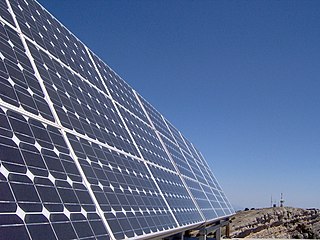
Solar power in Idaho comprised 550 MW in 2019. A 2016 report by the National Renewable Energy Laboratory estimated that rooftops alone have the potential to host 4,700 MW of solar panels, and thus provide 26.4% of all electricity used in Idaho. A large increase in the state's solar generating capacity began starting year 2015 when 461 MW of solar power was contracted to be built in Idaho.
Mount Signal Solar, also known as Imperial Valley Solar Project, is a 794 MWp (614 MWAC) photovoltaic power station west of Calexico, California, United States, in the southern Imperial Valley, near the Mexican border. The facility is being developed and constructed by 8minutenergy Renewables in three phases, with two completed as of 2018. At full build-out, it will be one of the world's largest PV solar farms with a capacity of about 800 MWp (600 MWAC). The project has been supported by several environmental groups, as the power station was built on low productivity farmland.
Building Energy is a renewable energy company that develops, engineers, constructs, and operates projects. The company employs approximately 200 full-time employees and owns several renewable assets within solar energy, energy storage, wind energy, biomass and hydropower.

Mohammed bin Rashid Al Maktoum Solar Park is a solar park spread over a total area of 77 km2 (30 sq mi) in Saih Al-Dahal, about 50 km (31 mi) south of the city of Dubai in the United Arab Emirates (UAE).
Neoen is a French producer of exclusively renewable energy headquartered in Paris, France. Founded in 2008, it develops, finances, builds and operates solar power plants, wind farms and energy storage solutions. As at 30 June 2023, the company's total capacity was 7 GW, made up of 47% solar, 34% wind and 19% battery storage. Neoen aims to attain 10 GW in operation or under construction by 2025.


