
Takydromus is a genus of lizards, commonly called grass lizards or oriental racers. Species of the genus Takydromus are endemic to a large part of Asia. Members of this genus are noticeable because of their slender appearance and their agile movements. The word takydromus derives from Greek ταχυδρόμος (takhudromos), "fast-running", from ταχύς (takhus), "swift" + δρόμος (dromos), "course, race".
Takydromus haughtonianus, commonly known as the Goalpara grass lizard, is a species of lizard in the family Lacertidae. The species is endemic to India.

Takydromus khasiensis is a species of lizard. It is found in Northeast India, adjacent Myanmar (=Burma), and northern part of Bangladesh. The type locality is the Khasi Hills.

Takydromus sexlineatus, the Asian grass lizard, six-striped long-tailed grass lizard, or long-tailed grass lizard, is an arboreal, diurnal species of lizard. The tail length is usually over three times the body length in this species.
Takydromus tachydromoides, the Japanese grass lizard, is a wall lizard species of the genus Takydromus. It is found in Japan. Its Japanese name is 'kanahebi' (カナヘビ). 'Hebi' means 'snake' in Japanese, although this lizard is not a snake. There are three lizards found in the four main islands of Japan. The other two are the Japanese gekko, and the Japanese five-lined skink.
Takydromus toyamai (ミヤコカナヘビ), also known commonly as the Miyako grass lizard, is a species of lizard in the family Lacertidae. The species is endemic to the Ryukyu Islands.

Takydromus formosanus, also known as the Formosa grass lizard, is a species of lizard endemic to Taiwan. Its body is about 6 cm long, and the total length reaches 22 cm. Its back is brown, with a yellow-green stripe on its side. It is mainly found in mountains at elevations of up to 1500 m, living in grasses and shrubs. It is diurnal and eats small invertebrates. It is capable of caudal autotomy. The species was described by George Albert Boulenger in 1894.

Takydromus amurensis, the Amur grass lizard, is a species of lizard in the family Lacertidae. It is found in Russia, China, Korea, and Japan.
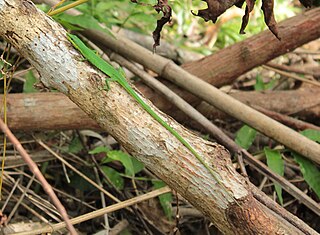
Takydromus dorsalis, the Sakishima grass lizard, is a species of lizard in the family Lacertidae. It is endemic to Ishigaki Island in Japan.
Takydromus hani, the southeast Asian green grass lizard , is a species of lizard in the family Lacertidae. It is endemic to Vietnam.
Takydromus madaensis, the Ma Da grass lizard , is a species of lizard in the family Lacertidae. It is endemic to Vietnam.
Takydromus sauteri, known commonly as the Koshun grass lizard, is a species of lizard in the family Lacertidae. The species is endemic to Orchid Island in Taiwan.

Takydromus smaragdinus, the green grass lizard, is a species of lizard in the family Lacertidae. It is endemic to the Ryukyu Islands in Japan.
Takydromus stejnegeri is a species of lizard in the family Lacertidae. The species is endemic to Taiwan.
Takydromus sylvaticus, the Chung-an ground lizard, is a species of lizard in the family Lacertidae. It is endemic to China.
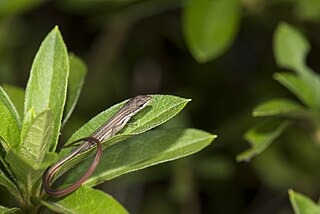
Takydromus viridipunctatus is a species of lizard in the family Lacertidae. It is endemic to Taiwan.
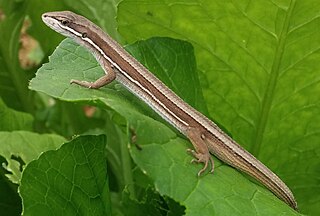
Takydromus wolteri, also known commonly as the mountain grass lizard, is a species of lizard in the family Lacertidae. The species is native to East Asia.
Takydromus yunkaiensis, the Yunkai grass lizard, is a species of lizard in the family Lacertidae. It is endemic to China.

