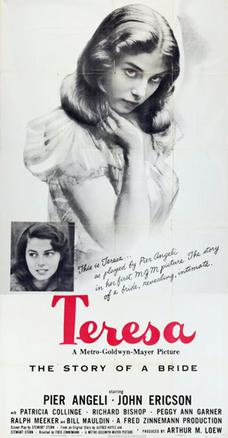
The film follows the relationship between a young American G.I. (Ericson) and his Italian wife (Angeli), who meet during the Italian campaign of World War II. Back in America, the couple's relationship is challenged by post-traumatic stress disorder and the newfound pressures of domestic life.[3]
While fighting in Italy during World War II, American G.I. Philip Cass meets and falls in love with a woman named Teresa Russo. Cass, a sensitive young man, is bullied by his commanding officer for his perceived "softness," but finds a kindred spirit in Teresa, who barters with the American servicemen for precious food supplies. After the war, Philip courts Teresa, and the two are married in the bombed-out ruins of her village's church.
Although Philip and Teresa love each other dearly, their relationship is strained after the couple moves in with Philip's overbearing mother Clara in New York City. Philip suffers from severe post-traumatic stress disorder, only exasperated by his mother emotional manipulations, fighting Teresa for his perceived affections. Philip is unable to hold a job, and his stress is only further exasperated when Teresa reveals she is pregnant, and he tells her to leave.
It's only after speaking to his Veterans Affairs counselor Frank that Philip finally gains the courage to stand up to his mother. He reconciles with Teresa shortly after the birth of their child, and the three move into their own apartment.
Teresa was director Fred Zinneman's second film dealing with the topics of post-traumatic stress disorder and veteran rehabilitation, after 1950's The Men. According to Zinneman's autobiography, the film was originally an adaptation of Alfred Hayes' novel The Girl on the Via Flaminia, but Stewart Stern's screenplay differed so much from the original story that any association with the novel was dropped early in pre-production.[3] Hayes nonetheless retained a "Story by" credit, and the novel would later be adapted into a 1953 United Artists film, Act of Love (1953).[3]
Zinnerman's direction was influenced by Italian neorealism, including the usage of unknown actors and location filming.[3] Pier Angeli and Ralph Meeker had only appeared in one prior movie each (1950's Tomorrow Is Too Late and 1951's Four in a Jeep) and John Ericson made his film debut, still a year from his star-making turn in Broadway's Stalag 17. The role of Grissom was played by Bill Mauldin, who was not a professional actor but a well-known editorial cartoonist. Teresa was also the film debut of Rod Steiger, as Philip's social worker Frank.
According to MGM records, the film made $743,000 in the United States and Canada, and $1,004,000 elsewhere, recording a profit of $421,000.[1]
Critical response
In a review for the The San Bernardino Sun, Bob Thomas writes "Teresa is an American picture with a European flavor. For that reason, it may not find favor with the majority of moviegoers. But many will admire its realism, natural acting and real backgrounds.... At times there is too much plot, but the Italian and New York backgrounds and the actors (especially newcomers Pier Anceli and John Ericson) make it believable."[4]
Manny Farber for the The Nation called it "a rather warm love story about a war bride (Angeli) orienting herself in a new country.... has some refreshing talent working for it in the way of uninhibited non-actors and a poetic director."[5]
This page is based on this Wikipedia article Text is available under the CC BY-SA 4.0 license; additional terms may apply. Images, videos and audio are available under their respective licenses.