Related Research Articles

Fyodor Mikhailovich Dostoevsky, sometimes transliterated as Dostoyevsky, was a Russian novelist, short story writer, essayist and journalist. Dostoevsky's literary works explore the human condition in the troubled political, social, and spiritual atmospheres of 19th-century Russia, and engage with a variety of philosophical and religious themes. His most acclaimed novels include Crime and Punishment (1866), The Idiot (1869), Demons (1872), and The Brothers Karamazov (1880). His 1864 novella, Notes from Underground, is considered to be one of the first works of existentialist literature. Numerous literary critics regard him as one of the greatest novelists in all of world literature, as many of his works are considered highly influential masterpieces.
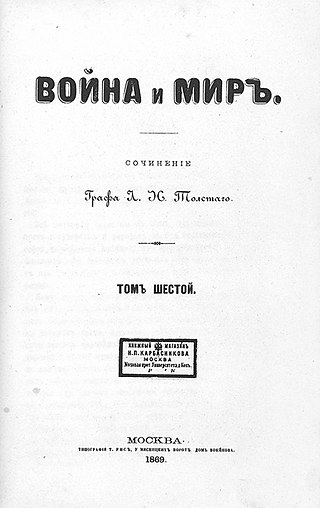
War and Peace is a literary work by the Russian author Leo Tolstoy that mixes fictional narrative with chapters on history and philosophy. It was first published serially, then published in its entirety in 1869. It is regarded as Tolstoy's finest literary achievement and remains an internationally praised classic of world literature.
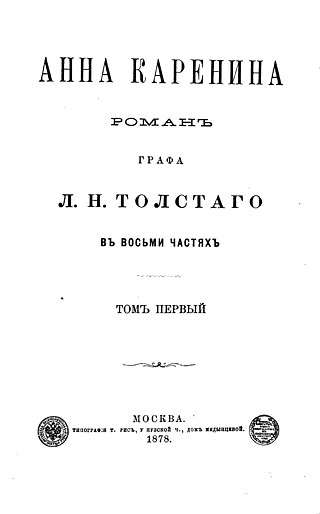
Anna Karenina is a novel by the Russian author Leo Tolstoy, first published in book form in 1878. Widely considered to be one of the greatest works of literature ever written, Tolstoy himself called it his first true novel. It was initially released in serial installments from 1875 to 1877, all but the last part appearing in the periodical The Russian Messenger.
This article contains information about the literary events and publications of 1885.
You don't know about me without you have read a book by the name of 'The Adventures of Tom Sawyer'; but that ain't no matter. That book was made by a Mr Mark Twain, and he told the truth, mainly.

The Kingdom of God Is Within You is a non-fiction book written by Leo Tolstoy. A Christian anarchist philosophical treatise, the book was first published in Germany in 1894 after being banned in his home country of Russia. It is the culmination of 30 years of Tolstoy's thinking, and lays out a new organization for society based on an interpretation of Christianity focusing on universal love.

Constance Clara Garnett was an English translator of nineteenth-century Russian literature. She was the first English translator to render numerous volumes of Anton Chekhov's work into English and the first to translate almost all of Fyodor Dostoevsky's fiction into English. She also rendered works by Ivan Turgenev, Leo Tolstoy, Nikolai Gogol, Ivan Goncharov, Alexander Ostrovsky, and Alexander Herzen into English. Altogether, she translated 71 volumes of Russian literature, many of which are still in print today.

Tatyana Nikitichna Tolstaya is a Russian writer, TV host, publicist, novelist, and essayist from the Tolstoy family.
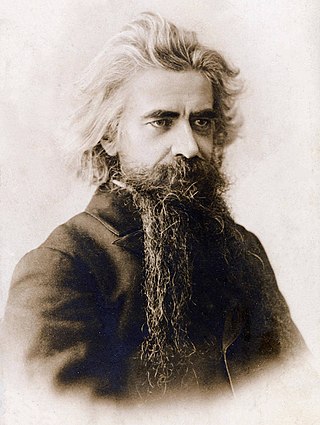
Vladimir Sergeyevich Solovyov was a Russian philosopher, theologian, poet, pamphleteer, and literary critic, who played a significant role in the development of Russian philosophy and poetry at the end of the 19th century and in the spiritual renaissance of the early 20th century.
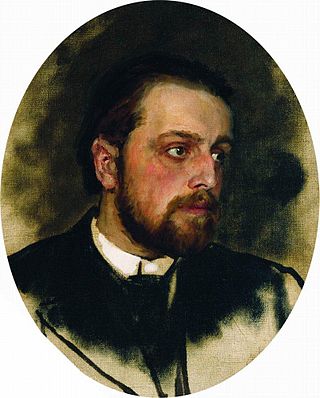
Vladimir Grigoryevich Chertkov (Russian: Влади́мир Григо́рьевич Чертко́в; also transliterated as Chertkoff, Tchertkoff, or Tschertkow was the editor of the works of Leo Tolstoy, and one of the most prominent Tolstoyans. After the revolutions of 1917, Chertkov was instrumental in creating the United Council of Religious Communities and Groups, which eventually came to administer the Russian SFSR's conscientious objection program.

Countess Alexandra (Sasha) Lvovna Tolstaya, often anglicized to Tolstoy, was the youngest daughter and secretary of the noted Russian novelist Leo Tolstoy.
The social novel, also known as the social problemnovel, is a "work of fiction in which a prevailing social problem, such as gender, race, or class prejudice, is dramatized through its effect on the characters of a novel". More specific examples of social problems that are addressed in such works include poverty, conditions in factories and mines, the plight of child labor, violence against women, rising criminality, and epidemics because of over-crowding and poor sanitation in cities.
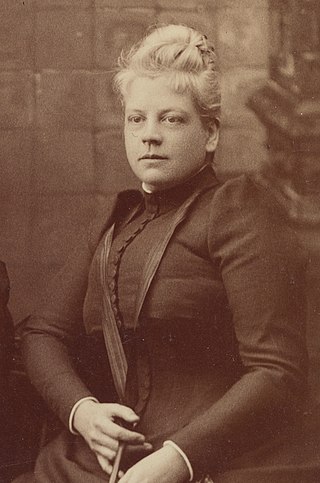
Isabel Florence Hapgood was an American ecumenist, writer and translator, especially of Russian and French texts.

Count Lev Nikolayevich Tolstoy, usually referred to in English as Leo Tolstoy, was a Russian writer who is regarded as one of the greatest authors of all time. He received nominations for the Nobel Prize in Literature every year from 1902 to 1906 and for the Nobel Peace Prize in 1901, 1902, and 1909; the fact that he never won is a major controversy.
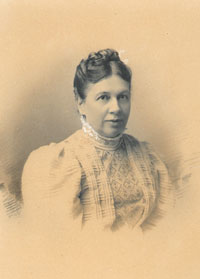
Countess Sophia Andreyevna Tolstaya, was a Russian diarist, and the wife of Russian writer Count Leo Tolstoy.

Robert Nisbet Bain (1854–1909) was a British historian and linguist who worked for the British Museum.

Lidia Ivanovna Veselitskaya, March 17, 1857 – February 23, 1936) was a Russian novelist, short story writer, memoirist, and translator who used the pseudonyms V. Mikulich and L. Chernavina.
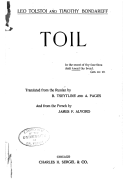
The Triumph of the Farmer or Industry and Parasitism is a treatise by Russian peasant philosopher Timofei Bondarev. The work details Bondarev's labor philosophy, in particular his idea of "bread-labor", by which every man is responsible for the physical labor required to sustain himself. The treatise captivated writer Leo Tolstoy, who began a long correspondence with Bondarev and endeavored for years to see the work published. An abbreviated version was published in 1888, and the full work was published in 1906.
"The Coffee-House of Surat" is a short story by Leo Tolstoy written in 1891, first published in Russian in 1893, and first published in English in 1901. Like several other of Tolstoy's works, this work is based on a French piece translated by Tolstoy himself, by Jacques-Henri Bernardin de Saint-Pierre. Due to the censorship in Russia, Tolstoy had to adjust the tale somewhat.
"Posthumous Notes of the Hermit Fëdor Kuzmich" is a short story by Leo Tolstoy written in December, 1905, and then only published in 1912, over the ferocious objections of the tsarist censors and two years after Tolstoy's death. It was never completed.
Twenty-Three Tales is a popular compilation of short stories by Leo Tolstoy. According to its publisher, Oxford University Press, the collection is about contemporary classes in Russia during Tolstoy's time, written in a brief, morality-tale style. It was translated into English by Louise Maude and Aylmer Maude.
References
- 1 2 Leo Tolstoy (2000). Divine and human and other stories. Translated by Peter Sekirin. Zondervan Publishing House. p. 19. ISBN 9780310223672.
- 1 2 John Andrew Frey, Victor Hugo (1999). A Victor Hugo Encyclopedia. Greenwood Publishing. p. 197. ISBN 9780313298967.
- ↑ Sophia Tolstoy (1985). O. A. Golinenko (ed.). The Diaries of Sophia Tolstoy. Random House. p. 286. ISBN 9780394528182.
- ↑ Leo Tolstoy (1967). "Poor People". In Miriam Morton (ed.). A Harvest of Russian Children's Literature. University of California Press. p. 200. ISBN 9780520008861.
- ↑ Leo Tolstoy (2000). "The Poor People". Divine and human and other stories. Zondervan Publishing House. p. 49. ISBN 9780310223672.

