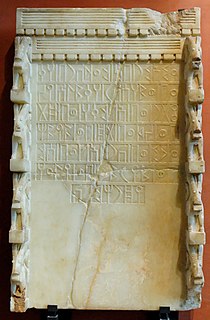
Yemen is one of the oldest centers of civilization in the Near East. Its relatively fertile land and adequate rainfall in a moister climate helped sustain a stable population, a feature recognized by the ancient Greek geographer Ptolemy, who described Yemen as Eudaimon Arabia meaning "fortunate Arabia" or "Happy Arabia". Yemenis had developed the South Arabian alphabet by the 12th to 8th centuries BCE, which explains why most historians date all of the ancient Yemeni kingdoms to that era.

Politics of Yemen is in an uncertain state due to a 2014–15 coup d'état. An armed group known as the Houthis or Ansar Allah seized control of the Northern Yemeni government and announced it would dissolve parliament, as well as install a "presidential council", "transitional national council", and "supreme revolutionary council" to govern the country for an interim period. However, the deposed president, Abdrabbuh Mansur Hadi, has declared he is still in office and is working to establish a rival government in Aden.

Yemen, sometimes spelled Yaman, officially the Republic of Yemen, is a country at the southern end of the Arabian Peninsula in Western Asia. It is the second-largest Arab sovereign state in the peninsula, occupying 527,970 square kilometres. The coastline stretches for about 2,000 kilometres. It is bordered by Saudi Arabia to the north, the Red Sea to the west, the Gulf of Aden and Guardafui Channel to the south, and the Arabian Sea and Oman to the east. Yemen's territory encompasses more than 200 islands, including Socotra, one of the largest islands in the Middle East. Yemen is a member of the Arab League, United Nations, Non-Aligned Movement and the Organisation of Islamic Cooperation.

Yahya Muhammad Hamid ed-Din became Imam of the Zaydis in 1904 after the death of his father, Muhammad Al-Mansur, and Imam of Yemen in 1918. His name and title in full was "His majesty Amir al-Mumenin al-Mutawakkil 'Ala Allah Rab ul-Alamin Imam Yahya bin al-Mansur Bi'llah Muhammad Hamidaddin, Imam and Commander of the Faithful".

Arwa Al-Sulayhi, full name Arwā bint Aḥmad ibn Muḥammad ibn Jaʿfar ibn Mūsā Aṣ-Ṣulayḥī Al-Ismāʿīliyyah was a long-reigning ruler of Yemen, firstly as the co-ruler of her first two husbands and then as sole ruler, from 1067 until her death in 1138. She was the last of the rulers of the Sulayhid Dynasty and was also the first woman to be accorded the prestigious title of Hujjah in the Isma'ili branch of Shia Islam, signifying her as the closest living image of God's will in her lifetime, in the Ismaili doctrine. She is popularly referred to as As-Sayyidah Al-Ḥurrah, Al-Malikah Al-Ḥurrah (Arabic: ٱلْمَلِكَة ٱلْحُرَّة or Al-Ḥurrātul-Malikah, and Malikat Sabaʾ Aṣ-Ṣaghīrah.
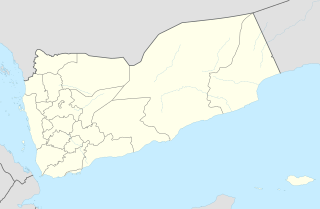
Sanaa International Airport is the primary international airport of Yemen located in Sanaa, the capital of Yemen. It serves the city of Sanaa. Initially, a small passenger terminal was built in the 1970s. The runway is shared with a large military base with several fighter jets and transport aircraft of the Yemeni Air Force.

Islam came to Yemen around 630 during Muhammad's lifetime and the rule of the Persian governor Badhan. Thereafter, Yemen was ruled as part of Arab-Islamic caliphates, and became a province in the Islamic empire.

Sanaa, also spelled Sanaʽa or Sana, is the largest city in Yemen and the centre of Sanaʽa Governorate. The city is not part of the Governorate, but forms the separate administrative district of "Amanat Al-Asemah". Under the Yemeni constitution, Sanaʽa is the capital of the country, although the seat of the internationally recognised government moved to Aden in the aftermath of the September 21 Revolution. Aden was declared as the temporary capital by President Abdrabbuh Mansur Hadi in March 2015.

The Tahirids were an Arab Muslim dynasty that ruled Yemen from 1454 to 1517. They succeeded the Rasulid Dynasty and were themselves replaced by the Mamluks of Egypt after only 63 years in power.
Al-Mansur al-Husayn II was an Imam of Yemen who ruled in 1727-1748. He belonged to the Qasimid family which claimed descent from Muhammad, who dominated the Zaidi imamate of Yemen in 1597-1962.
The Sulayhid dynasty was an Ismaili Shi'ite dynasty established in 1047 by Ali ibn Muhammad al-Sulayhi that ruled most of historical Yemen at its peak. The Sulayhids brought to Yemen peace and a prosperity unknown since Himyaritic times. The regime was confederate with the Cairo-based Fatimid Caliphate, and was a constant enemy of the Rassids - the Zaidi Shi'ite rulers of Yemen throughout its existence. The dynasty ended with Arwa al-Sulayhi affiliating to the Taiyabi Ismaili sect, as opposed to the Hafizi Ismaili sect that the other Ismaili dynasties such as the Zurayids and the Hamdanids adhered to.
Topics related to Yemen include:
Al-Hadi ila’l-Haqq Yahya was a religious and political leader on the Arabian Peninsula. He was the first Zaydi imam who ruled portions of Yemen from 897 to 911. He is also the ancestor of the Rassid Dynasty which ruled Yemen intermittently until North Yemen Civil War in 1962.
Al-Mutawakkil Ahmad bin Sulayman (1106–1171) was an imam of the Zaidi state in Yemen who revived the polity after a long interregnum, wielding power in 1138–1171.
The following lists events that happened in 2015 in Yemen.

The Yemeni Crisis began with the 2011–12 revolution against President Ali Abdullah Saleh, who had led Yemen for more than three decades. After Saleh left office in early 2012 as part of a mediated agreement between the Yemeni government and opposition groups, the government led by Saleh's former vice president, Abdrabbuh Mansur Hadi, struggled to unite the fractious political landscape of the country and fend off threats both from Al-Qaeda in the Arabian Peninsula and Houthi militants that had been waging a protracted insurgency in the north for years. In 2014, Houthi fighters swept into the capital of Sana'a and forced Hadi to negotiate a "unity government" with other political factions. The rebels continued to apply pressure on the weakened government until, after his presidential palace and private residence came under attack from the militant group, Hadi resigned along with his ministers in January 2015. The following month, the Houthis declared themselves in control of the government, dissolving Parliament and installing an interim Revolutionary Committee led by Mohammed Ali al-Houthi, a cousin of Houthi leader Abdul-Malik al-Houthi. However, Hadi escaped to Aden, where he declared that he remains Yemen's legitimate president, proclaimed the country's temporary capital, and called on loyal government officials and members of the military to rally to him. On 27 March 2015, BBC reported that Hadi had "fled rebel forces in the city of Aden" and subsequently "arrived in Saudi Arabia's capital Riyadh" as "Saudi authorities began air strikes in Yemen". Civil war subsequently erupted between Hadi's government and the Houthis. Since 2017 the separatist Southern Transitional Council (STC) has also fought against the government.
The aftermath of the Houthi takeover in Yemen refers to developments following the Houthis' takeover of the Yemeni capital of Sana'a and dissolution of the government, which eventually led to a civil war and the Saudi Arabian-led intervention in Yemen.
The following is a timeline of the history of the city of Aden, Yemen.

The Islamic State of Iraq and the Levant – Yemen Province is a branch of the militant Islamist group Islamic State of Iraq and the Levant (ISIL), active in Yemen. ISIL announced the group's formation on 13 November 2014.
The following is a timeline of the Yemeni Civil War (2015–present), which began in March 2015 and is ongoing.


