
Matsutake, Tricholoma matsutake, is a species of choice edible mycorrhizal mushroom that grows in East Asia, northern Europe, and North America. It is prized in Japanese cuisine for its distinct spicy-aromatic odor.

Tricholoma is a genus of fungus that contains many fairly fleshy white-spored gilled mushrooms which are found worldwide generally growing in woodlands. These are ectomycorrhizal fungi, existing in a symbiotic relationship with various species of coniferous or broad-leaved trees. The generic name derives from Ancient Greek: τριχο-, romanized: tricho-, lit. 'hair' and Ancient Greek: λῶμα, romanized: loma, lit. 'fringe, border' although only a few species have shaggy caps which fit this description.

Tricholoma equestre or Tricholoma flavovirens, commonly known as the man on horseback or yellow knight is a widely eaten but arguably toxic fungus of the genus Tricholoma that forms ectomycorrhiza with pine trees.

Tricholoma magnivelare, commonly known as the matsutake, white matsutake, ponderosa mushroom, pine mushroom, or American matsutake, is a gilled mushroom found East of the Rocky Mountains in North America growing in coniferous woodland. These ectomycorrhizal fungi are typically edible species that exist in a symbiotic relationship with various species of pine, commonly jack pine. They belong to the genus Tricholoma, which includes the closely related East Asian songi or matsutake as well as the Western matsutake and Meso-American matsutake.

Tricholoma pardinum, commonly known as spotted tricholoma, tiger tricholoma, tigertop, leopard knight, or dirty trich, is a gilled mushroom widely distributed across North America, Europe, and parts of Asia. It is generally found in beech woodland in summer and autumn. Two subspecies have been described from southern Europe. First officially described by Christiaan Hendrik Persoon in 1801, T. pardinum has had a confusing taxonomic history that extends over two centuries. In 1762, German naturalist Jacob Christian Schäffer described the species Agaricus tigrinus with an illustration corresponding to what is thought to be T. pardinum, and consequently, the name Tricholoma tigrinum has been used erroneously in some European field guides.

Tricholoma terreum, commonly known as the grey knight or dirty tricholoma, is a grey-capped mushroom of the large genus Tricholoma. It is found in coniferous woodlands in Europe, and has also been encountered under introduced pine trees in Australia and New Zealand. It is regarded as edible. A 2014 article speculated that it may be poisonous, but Sitta et al. in 2016 published in the same journal a counter article demonstrating the unfounded nature of such speculation.

Ripartites is a genus of fungi in the family Tricholomataceae. The genus has a widespread distribution and originally contained five species. Species in Ripartites have small, round to subglobose spores, which are yellowish-brown and ornamented. Macroscopically, they resemble Clitocybe. Ripartites was circumscribed by Petter Karsten in 1879.
Ripartites tricholoma, commonly known as the bearded seamine, is a species of fungus in the family Tricholomataceae. It was first described scientifically as Agaricus tricholoma by Albertini and Lewis David von Schweinitz in 1805, and later transferred into the genus Ripartites by Petter Karsten in 1879. It is found in North America and Europe, and has also been collected in Costa Rica.
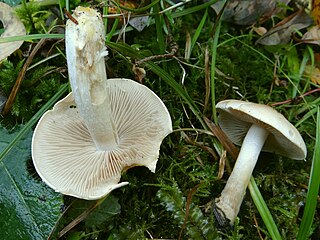
Tricholoma album, commonly known as the white knight, is an all-white mushroom of the large genus Tricholoma. It is found in Europe, India, and possibly North America. The cap and gills are white. The whitish stipe has no ring.

Tricholoma orirubens, commonly known as blushing tricholoma, is an edible gilled mushroom native to Europe. The grey-capped fruit bodies are generally found singly or in small groups in deciduous and coniferous woodland in autumn.

Tricholoma myomyces is a mushroom of the agaric genus Tricholoma, usually considered to be a synonym of Tricholoma terreum. The species was first described scientifically by Christian Hendrik Persoon in 1794 as Agaricus myomyces, and later transferred to the genus Tricholoma by Danish mycologist Jakob Emanuel Lange in 1933. It is found in Europe and northern North America.
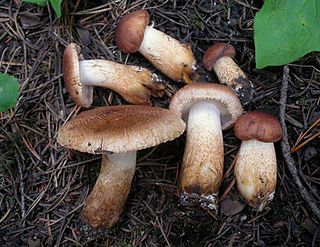
Tricholoma vaccinum, commonly known as the russet scaly tricholoma, the scaly knight, or the fuzztop, is a fungus of the agaric genus Tricholoma. It produces medium-sized fruit bodies (mushrooms) that have a distinctive hairy reddish-brown cap with a shaggy margin when young. The cap, which can reach a diameter of up to 6.5 cm (2.6 in) wide, breaks up into flattened scales in maturity. It has cream-buff to pinkish gills with brown spots. Its fibrous, hollow stipe is white above and reddish brown below, and measures 4 to 7.5 cm long. Although young fruit bodies have a partial veil, it does not leave a ring on the stipe.

Tricholoma ustale, commonly known as the burnt knight, is a species of mushroom in the large genus Tricholoma. It is found in Asia, Europe, and North America, though those from North America may represent one or more different species.
Tricholoma albidum is a mushroom of the agaric genus Tricholoma.

Tricholoma arvernense is a mushroom of the agaric genus Tricholoma. First described as a variety of Tricholoma sejunctum by French mycologist Marcel Bon in 1975, he promoted it to species status a year later.

Tricholoma vernaticum is an agaric fungus of the genus Tricholoma native to the Pacific Northwest region of the United States. The fungus was originally described in 1976 as a species of Armillaria when that genus was more inclusive; it received its current name twenty years later. The stout fruit bodies (mushrooms) have moist white to grayish caps, a membranous ring on the stipe, and an odor resembling cucumbers. Mycorrhizal with conifers, the fungus fruits in the spring or early summer, with its mushrooms appearing on the ground singly or in groups at high elevations, often at the edge of melting snowbanks. The edibility of the mushroom is unknown, but it has a strong unpleasant odor and a mealy taste.
Gerhardtia is a genus of fungi in the family Lyophyllaceae. It was circumscribed in 1994 by French mycologist Marcel Bon, with Gerhardtia incarnatobrunnea as the type species. It is distinguished from similar genera by having spores with an irregular outline. Some authorities place Gerhardtia in synonymy with Lyophyllum. The New Zealand species Gerhardtia pseudosaponacea, described as new to science in 2014, is similar in appearance to Tricholoma saponaceum, including its weakly soap-like odor.
