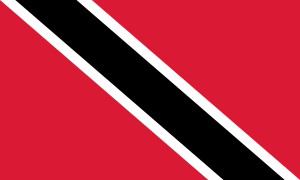
This article is about the demographic features of Guyana, including population density, ethnicity, education level, health of the populace, economic status, religious affiliations and other aspects of the population.
Caribbean English dialects of the English language are spoken in the Caribbean and Liberia, most countries on the Caribbean coast of Central America, and Guyana and Suriname on the coast of South America. Caribbean English is influenced by the English-based Creole varieties spoken in the region, but they are not the same. In the Caribbean, there is a great deal of variation in the way English is spoken. Scholars generally agree that although the dialects themselves vary significantly in each of these countries, they primarily have roots in British English and West African languages. Caribbean English in countries with a majority Indian population like Trinidad and Tobago and Guyana has been influenced by Hindustani and other South Asian languages in addition to British English and West African languages.
Indo-Caribbeans are Caribbean people with roots in the Indian subcontinent. They are mostly descendants of the original jahaji indentured workers brought by the British, the Dutch and the French during colonial times.

Indo-Trinidadians and Tobagonians or Indian-Trinidadians, are nationals of Trinidad and Tobago whose ancestors came from South Asia.
Afro-Trinidadians and Tobagonians are people from Trinidad and Tobago who are largely of West African and Sub-Saharan descent. Social interpretations of race in Trinidad and Tobago are often used to dictate who is of African descent; for example, a person might appear "white" in appearance but may still be considered "black" based on significant African ancestry. Mulatto-Creole, Zambo, Pardo, Quadroon or Octoroon were all racial terms used to measure the amount of African ancestry someone possessed in Trinidad and throughout Latin American and Caribbean history.
Dougla is a word used by people especially in Trinidad and Tobago, Suriname and Guyana to describe people who are of mixed African and Indian subcontinent descent.

The Panyols are an ethnic group in Trinidad and Tobago of mixed Spanish, Amerindian, Afro-Latin American, and Afro-Trinidadian and Tobagonian descent. They comprise the Cocoa Estate Plantations owners community along with peasant workers from Venezuela and Colombia, also referred to as Cocoa panyols. They were born of the shared Island nation, on both sides of the Gulf of Paria, Peninsulas that settling within the Northern Range Rain Forest Mountains Valleys of Trinidad and Tobago Caura River, down the mountains into the Tacarigua River into the Caroni River, and the Orinoco, and Caura River Venezuela. They played an important role in the development of the cocoa industry in Trinidad and Tobago, running the Cocoa Estate and not to be confused with the freed community of former slaves.
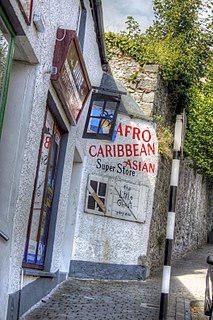
Afro-Caribbean is the shorten ethnicity term of African-Caribbean which refers to the ethnicity and cultural heritage of Caribbean people whose ancestors were taken from Africa via the trans-Atlantic slave trade to the Caribbean Islands between the 15th & 19th century to work primarily on various sugar plantations and in domestic households. Other names for the ethnic group include, Black Caribbean, Afro-West Indian, Black West Indian or Afro-Antillean. The term was not used by West Indians themselves but was first coined by Americans in the late 1960s. This points to a controversial turn. This is because West Indian is the official term used by those from that region, and the rest of the world. The name West Indian was first used by Christopher Columbus, to describe the inhabitants that he found. Columbus was originally attempting to reach the country of India by heading west instead of heading east. Subsequently, as a result of the days of Empire, each group of colonies were given a specific description. For example, those living in the British Empire were called British West Indian. Therefore it was natural to conclude that French West Indians and Dutch West Indians, were all part of those self named empires. The term West Indian includes all of those who are born in the region, regardless of skin colour. Historically speaking, West Indian is the correct term used and accepted by those in the region and the rest of the world.
The culture of Trinidad and Tobago reflects the influence of Indian, European, Spanish, Jewish, Arab, and African cultures. The histories of Trinidad and Tobago are different. There are differences in the cultural influences which have shaped each island. Trinidad and Tobago is an English-speaking country with strong links to the United Kingdom.
The Southern Caribbean is a group of islands that neighbor mainland South America in the West Indies. St. Lucia lies to the north of the region, Barbados in the east, Trinidad & Tobago at its southernmost point, and Aruba at the most westerly section.
Chinese Trinidadians and Tobagonians are Trinidadians and Tobagonians of Chinese ancestry. The group includes people from China, Hong Kong and Overseas Chinese who have immigrated to Trinidad and Tobago and their descendants, including those who have emigrated to other countries. The term is usually applied both to people of mixed and unmixed Chinese ancestry, although the former usually appear as mixed race in census figures. Chinese settlement began in 1806. Between 1853 and 1866 2,645 Chinese immigrants arrived in Trinidad as indentured labour for the sugar and cacao plantations. Immigration peaked in the first half of the twentieth century, but was sharply curtailed after the Chinese Revolution in 1949. After peaking at 8,361 in 1960, the (unmixed) Chinese population in Trinidad declined to 3,800 in 2000.
Chinese Caribbeans are people of Han Chinese ethnic origin living in the Caribbean. There are small but significant populations of Chinese and their descendants in all countries of the Greater Antilles. They are all part of the large Chinese diaspora known as Overseas Chinese.

The following outline is provided as an overview of and topical guide to Trinidad and Tobago:
Trinidadian and Tobagonian British people are citizens or residents of the United Kingdom whose ethnic origins lie fully or partially in Trinidad and Tobago.
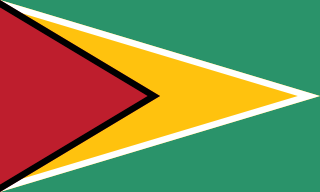
Guyanese people are people identified with the country of Guyana, which is located on the northern coast of South America and is bordered by the Atlantic Ocean, Brazil, Venezuela and Surinam. Geographically, Guyana is part of the South American mainland, however it is much more culturally similar to the nearby island nations of the Caribbean such as Trinidad and Tobago, Barbados, Saint Vincent and the Grenadines and Grenada with respect to culture. In fact, Guyana is considered a Caribbean country even though it is not an island nation located in the Caribbean Sea, as are most Caribbean nations.
British Indo-Caribbean people are residents of the United Kingdom who were born in the Caribbean and whose ancestors are indigenous to India. The UK has a large population of Indo-Caribbean people.
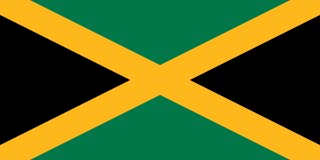
Jamaicans are the citizens of Jamaica and their descendants in the Jamaican diaspora. Most Jamaicans are of African descent, with smaller minorities of Europeans, East Indians, Chinese and others or mixed ancestry. The bulk of the Jamaican diaspora resides in other Anglophone countries, namely Australia, Canada, United States and the United Kingdom and, to a lesser extent, other Caribbean countries and Commonwealth realms. Outside of Anglophone countries, the largest diaspora of Jamaicans lies in Costa Rica, where Jamaicans make up a significant percentage of the population.