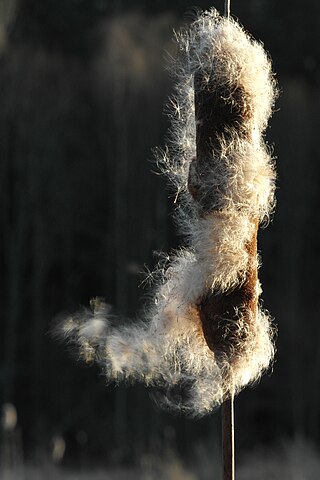
Typha is a genus of about 30 species of monocotyledonous flowering plants in the family Typhaceae. These plants have a variety of common names, in British English as bulrush or reedmace, in American English as cattail, or punks, in Australia as cumbungi or bulrush, in Canada as bulrush or cattail, and in New Zealand as reed, cattail, bulrush or raupo. Other taxa of plants may be known as bulrush, including some sedges in Scirpus and related genera.

A reedbed or reed bed is a natural habitat found in floodplains, waterlogged depressions and estuaries. Reedbeds are part of a succession from young reeds colonising open water or wet ground through a gradation of increasingly dry ground. As reedbeds age, they build up a considerable litter layer that eventually rises above the water level and that ultimately provides opportunities in the form of new areas for larger terrestrial plants such as shrubs and trees to colonise.

Typha latifolia is a perennial herbaceous wetland plant in the genus Typha. It is known in English as bulrush, and in American as broadleaf cattail. It is found as a native plant species throughout most of Eurasia and North America, and more locally in Africa and South America. The genome of T. latifolia was published in 2022.
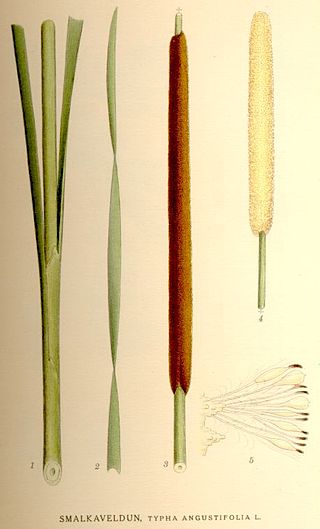
Typha angustifolia L. is a perennial herbaceous plant of genus Typha. This cattail is an "obligate wetland" species that is commonly found in the northern hemisphere in fresh water or brackish locations.

Calamotropha paludella is a species of moth of the family Crambidae. It is found in Europe, Africa, Australia and large parts of Asia.
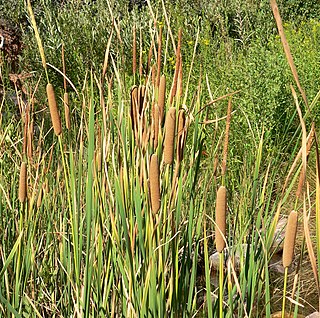
Typha domingensis, known commonly as southern cattail or cumbungi, is a perennial herbaceous plant of the genus Typha.

The bulrush wainscot is a moth of the family Noctuidae. It is found from Ireland and Portugal to southern Fennoscandia, east to western Siberia, the Altai Mountains, Yakutia, Turkey, the Caucasus, Lebanon, Egypt, Arabia, Iraq, Iran, Afghanistan and Central Asia.
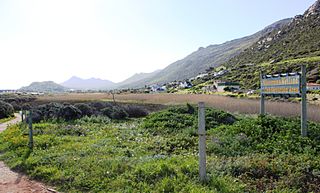
Lower Silvermine Wetlands is a nature reserve on the Cape Peninsula, in Cape Town, South Africa.

Uitkamp Wetland Nature Reserve is a 32-hectare (79-acre) wetland reserve located in Durbanville in the Western Cape province of South Africa.
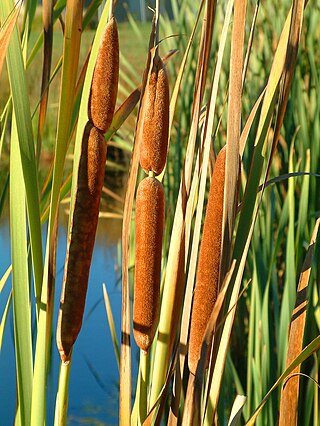
Typha orientalis, commonly known as bulrush, cumbungi, or raupō, is a perennial herbaceous plant in the genus Typha. It is native to Australia, New Zealand, Malaysia, Indonesia, Japan, Korea, Mongolia, Myanmar, Philippines, China and the Russian Far East.
Cehei Pond Nature Reserve is situated in north-western Romania, in Crasna river floodplain, in Sălaj County and is a protected area with aquatic vegetation and fauna specific to such area.
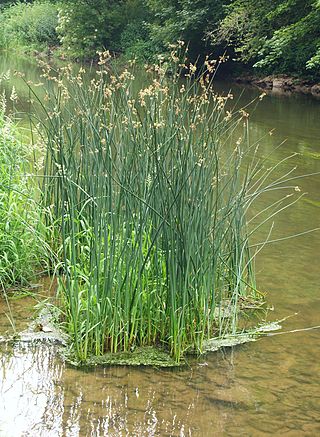
Bulrush is a vernacular name for several large wetland grass-like plants

Typha laxmannii, the graceful cattail, is a wetland plant species, widespread across Europe and Asia. Typha laxmannii is not as tall as many of the other species in the genus, rarely more than 130 cm high. A noticeable space separates the staminate (male) flowers from the pistillate (female) ones.

Typha capensis is an aquatic plant known from southern and eastern Africa as far north as Uganda. It has also been reported from Brazil.
Typha shuttleworthii is a species of cattail found in southern Europe as well as in Iran and Turkey.
Typha subulata is a plant species native to Argentina and Uruguay. The species grows in freshwater marshes. Type collection was made in 1966 in the Río Negro Province, Departamento de General Roca.
Typha × provincialis is a plant of hybrid origin, endemic to southern France. Type collection was obtained from near St. Tropez in Provence. It apparently originated as a cross between the two very widespread species T. domingensis and T. latifolia.Typha × provincialis grows in freshwater marshes.
Typha × bavarica is a plant of hybrid origin, endemic to southern Germany. It apparently originated as a cross between the two very widespread species T. angustifolia and T. shuttleworthii.Typha × bavarica grows in freshwater marshes.

Lake Fúquene is a heart-shaped lake located in the Ubaté-Chiquinquirá Valley, part of the Altiplano Cundiboyacense, in the north of Cundinamarca, Colombia, at the border with Boyacá. The Andean lake, at an average altitude of 2,540 metres (8,330 ft), was considered sacred in the religion of the Muisca who inhabited the area before the Spanish conquest of the Muisca in the 1530s.

Typha × glauca is a hybrid species of plant originating as a cross between T. angustifolia and T. latifolia. It shows invasive behavior in the Midwestern United States

