Vali (governor)

Last updated
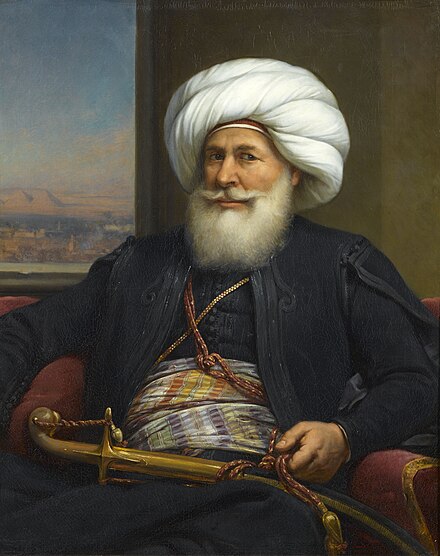
Mehemet Ali Viceroy of Egypt , by Auguste Couder, 1841. ModernEgypt, Muhammad Ali by Auguste Couder, BAP 17996.jpg
Mehemet Ali Viceroy of Egypt , by Auguste Couder, 1841.
Rostom (Rustam Khan), Safavid viceroy of Kartli, Georgia. rostom xani.gif
Rostom (Rustam Khan), Safavid viceroy of Kartli, Georgia.

Wāli or vali (from Arabic والي Wāli) is an administrative title that was used during the Caliphate and Ottoman Empire to designate governors of administrative divisions. It is still in use in some countries influenced by Arab or Muslim culture. The division that a Wāli governs is called Wilayah, or, in the case of Ottoman Turkey, "Vilayet".

Arabic Central Semitic language

Arabic is a Central Semitic language that first emerged in Iron Age northwestern Arabia and is now the lingua franca of the Arab world. It is named after the Arabs, a term initially used to describe peoples living in the area bounded by Mesopotamia in the east and the Anti-Lebanon mountains in the west, in northwestern Arabia, and in the Sinai Peninsula. Arabic is classified as a macrolanguage comprising 30 modern varieties, including its standard form, Modern Standard Arabic, which is derived from Classical Arabic.

Caliphate Islamic form of government

A caliphate is an Islamic state under the leadership of an Islamic steward with the title of caliph, a person considered a religious successor to the Islamic prophet Muhammad and a leader of the entire ummah (community). Historically, the caliphates were polities based in Islam which developed into multi-ethnic trans-national empires. During the medieval period, three major caliphates succeeded each other: the Rashidun Caliphate (632–661), the Umayyad Caliphate (661–750) and the Abbasid Caliphate (750–1258). In the fourth major caliphate, the Ottoman Caliphate, the rulers of the Ottoman Empire claimed caliphal authority from 1517. During the history of Islam, a few other Muslim states, almost all hereditary monarchies, have claimed to be caliphates.

Ottoman Empire Former empire in Asia, Europe and Africa

The Ottoman Empire, historically known in Western Europe as the Turkish Empire or simply Turkey, was a state that controlled much of Southeast Europe, Western Asia and North Africa between the 14th and early 20th centuries. It was founded at the end of the 13th century in northwestern Anatolia in the town of Söğüt by the Oghuz Turkish tribal leader Osman I. After 1354, the Ottomans crossed into Europe, and with the conquest of the Balkans, the Ottoman beylik was transformed into a transcontinental empire. The Ottomans ended the Byzantine Empire with the 1453 conquest of Constantinople by Mehmed the Conqueror.

Contents

Algerian term

In Algeria, a wāli is the "governor" and administrative head of each of the 48 provinces of the country, and is chosen by the president.

Algeria country in North Africa

Algeria, officially the People's Democratic Republic of Algeria, is a country in the Maghreb region of North Africa. The capital and most populous city is Algiers, located in the far north of the country on the Mediterranean coast. With an area of 2,381,741 square kilometres (919,595 sq mi), Algeria is the tenth-largest country in the world, the world's largest Arab country, and the largest in Africa. Algeria is bordered to the northeast by Tunisia, to the east by Libya, to the west by Morocco, to the southwest by the Western Saharan territory, Mauritania, and Mali, to the southeast by Niger, and to the north by the Mediterranean Sea. The country is a semi-presidential republic consisting of 48 provinces and 1,541 communes (counties). It has the highest human development index of all non-island African countries.

A governor is, in most cases, a public official with the power to govern the executive branch of a non-sovereign or sub-national level of government, ranking under the head of state. In federations, governor may be the title of a politician who governs a constituent state and may be either appointed or elected. The power of the individual governor can vary dramatically between political systems, with some governors having only nominal or largely ceremonial power, while others having a complete control over the entire government.

Provinces of Algeria type of administrative entity

Algeria is divided into 48 wilayas (provinces) and 1541 baladiyahs. The capital city of a baladiyah, daïra, or province always gives those entities their name, even Algiers, the capital of the country gave it its name.

Iranian term

In Iran the term is known as Vāli and refers to the governor-general or local lord of an important province. During the Safavid reign 1501-1722 the former rulers of the then subordinated provinces of the Georgian Kartli and Kakheti kingdom, the Kurdish emirate of Ardalan, the chiefs of Lorestān Province and of Khuzestan Province in western Iran were regarded as hereditary governor-generals titled Vāli equal to the Beylerbeylik (Safavid Persia). These "lords of the marches" should protect Iran's western borders against foreign powers. During the Qajar rule 1785-1925 the kingdom of Georgia was lost to Russia and the hereditary lords were replaced by officials of the central power. Mainly these officials came from the group of imperial princes and royal notables and were made Vāli of important provinces. For example, the crown prince bore traditionally the title of Vāli of Azerbaijan (Iran).

Iran Country in Western Asia

Iran, also called Persia and officially known as the Islamic Republic of Iran, is a country in Western Asia. With over 81 million inhabitants, Iran is the world's 18th most populous country. Comprising a land area of 1,648,195 km2 (636,372 sq mi), it is the second largest country in the Middle East and the 17th largest in the world. Iran is bordered to the northwest by Armenia and the Republic of Azerbaijan, to the north by the Caspian Sea, to the northeast by Turkmenistan, to the east by Afghanistan and Pakistan, to the south by the Persian Gulf and the Gulf of Oman, and to the west by Turkey and Iraq. The country's central location in Eurasia and Western Asia, and its proximity to the Strait of Hormuz, give it geostrategic importance. Tehran is the country's capital and largest city, as well as its leading economic and cultural center.

Kartli Historical Region in Georgia

Kartli is a historical region in central-to-eastern Georgia traversed by the river Mtkvari (Kura), on which Georgia's capital, Tbilisi, is situated. Known to the Classical authors as Iberia, Kartli played a crucial role in the ethnic and political consolidation of the Georgians in the Middle Ages. Kartli had no strictly defined boundaries and they significantly fluctuated in the course of history. After the partition of the kingdom of Georgia in the 15th century, Kartli became a separate kingdom with its capital at Tbilisi. The historical lands of Kartli are currently divided among several administrative regions of Georgia.

Kakheti Mkhare in Georgia

Kakheti is a region (mkhare) formed in the 1990s in eastern Georgia from the historical province of Kakheti and the small, mountainous province of Tusheti. Telavi is its capital. The region comprises eight administrative districts: Telavi, Gurjaani, Qvareli, Sagarejo, Dedoplistsqaro, Signagi, Lagodekhi and Akhmeta. Kakheti is bordered by the Russian Federation to the Northeast, Azerbaijan to the Southeast, and Mtskheta-Mtianeti and Kvemo Kartli to the west. Kakheti has a strong linguistic and cultural identity, since its ethnographic subgroup of Kakhetians speak Kakhetian dialect.

Ottoman Empire term

"Vali" was the title in the Ottoman Empire of the most common type of Ottoman governor, in charge of a vilayet (in Ottoman Turkish), often a military officer such as a pasha; see Subdivisions of the Ottoman Empire.

The Vilayets of the Ottoman Empire were the first-order administrative division, or provinces, of the later empire, introduced with the promulgation of the Vilayet Law of 21 January 1867. The reform was part of the ongoing administrative reforms that were being enacted throughout the empire, and enshrined in the Imperial Edict of 1856. The reform was at first implemented experimentally in the Danube Vilayet, specially formed in 1864 and headed by the leading reformist Midhat Pasha. The reform was gradually implemented, and not until 1884 was it applied to the entirety of the Empire's provinces.

Ottoman Turkish, or the Ottoman language, is the variety of the Turkish language that was used in the Ottoman Empire. It borrows, in all aspects, extensively from Arabic and Persian, and it was written in the Ottoman Turkish alphabet. During the peak of Ottoman power, Arabic and Persian vocabulary accounted for up to 88% of the Ottoman vocabulary, while words of foreign origin heavily outnumbered native Turkish words.

Pasha or Paşa, in older works sometimes anglicized as bashaw, was a higher rank in the Ottoman political and military system, typically granted to governors, generals, dignitaries and others. As an honorary title, Pasha, in one of its various ranks, is similar to a British peerage or knighthood, and was also one of the highest titles in the 20th century Kingdom of Egypt.

Turkish term

In Turkey (the main successor state to the Ottoman Empire), a wāli (spelled as "vali") is the "governor" and administrative head of each of the 81 provinces of the country, and is appointed by the government.

Turkey Republic in Western Asia

Turkey, officially the Republic of Turkey, is a transcontinental country located mainly in Western Asia, with a smaller portion on the Balkan Peninsula in Southeast Europe. East Thrace, located in Europe, is separated from Anatolia by the Sea of Marmara, the Bosphorous strait and the Dardanelles. Turkey is bordered by Greece and Bulgaria to its northwest; Georgia to its northeast; Armenia, the Azerbaijani exclave of Nakhchivan and Iran to the east; and Iraq and Syria to the south. Istanbul is the largest city, but more central Ankara is the capital. Approximately 70 to 80 per cent of the country's citizens identify as Turkish. Kurds are the largest minority; the size of the Kurdish population is a subject of dispute with estimates placing the figure at anywhere from 12 to 25 per cent of the population.

Succession of states is a theory and practice in international relations regarding successor states. A successor state is a sovereign state over a territory and populace that was previously under the sovereignty of another state. The theory has its root in 19th-century diplomacy. A successor state often acquires a new international legal personality, which is distinct from a continuing state, also known as a continuator, which despite change to its borders retains the same legal personality and possess all its existing rights and obligations.

Provinces of Turkey first-level administrative division of Turkey

Turkey is divided into 81 provinces. Each province is divided into a number of different districts. Each provincial government is seated in the central district. The central district usually bears the name of the province. There are only three exceptions to this naming scheme:

Omani Sultanate term

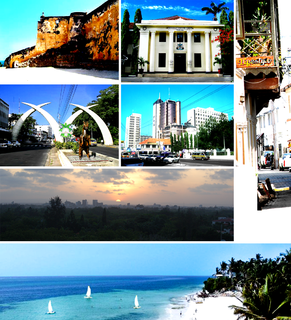
The Sultanate of Oman, when it ruled Mombasa, Kenya, appointed a wali for the city known locally as LiWali. The term is still used today to denote settlements of Oman, such as the Wilayat Madha, a settlement which intersects the road between Madam in Sharjah and Hatta in Dubai in the United Arab Emirates (UAE). Many Rulers of the Trucial States (also called Trucial Oman in the past) appointed walis to look after towns on their behalf, including employing slaves for that purpose.

Mombasa City in Mombasa County, Kenya

Mombasa is a city in a coast of Kenya along the Indian Ocean. It is the country's oldest and second-largest city, with an estimated population of about 1.5 million people in 2017. Its metropolitan region is the second largest in the country and has a population of approximately 3 million people. Administratively, Mombasa is the county seat of Mombasa County.

Kenya republic in East Africa

Kenya, officially the Republic of Kenya, is a country in Africa with 47 semiautonomous counties governed by elected governors. At 580,367 square kilometres (224,081 sq mi), Kenya is the world's 48th largest country by total area. With a population of more than 52.2 million people, Kenya is the 27th most populous country. Kenya's capital and largest city is Nairobi while its oldest city and first capital is the coastal city of Mombasa. Kisumu City is the third largest city and a critical inland port at Lake Victoria. Other important urban centres include Nakuru and Eldoret.

Madha Wilayah in Oman

The Omani territory of Madha or Wādī Madḥāʾ is an exclave of Musandam Governorate, enclaved by the United Arab Emirates (UAE); inside it, there is a second-order enclave Nahwa, part of UAE Emirate of Sharjah. Madha is located halfway between the Musandam Peninsula and the rest of Oman.

Moroccan term

Since 1997 regionalisation reform, a Wāli is the governor of one of the sixteen regions of Morocco.

Pakistani term

In Pakistan, the rulers of the former princely state of Swat were given the title of Wali.

Philippine term

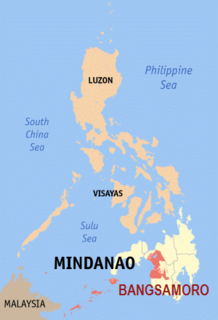
In the Philippines, the term Wali is the proposed name for the titular head of Bangsamoro, a proposed, autonomous political entity in the large southern island of Mindanao. The Bangsamoro, which is intended to give devolved powers to Filipino Muslims, is intended to supersede Autonomous Region in Muslim Mindanao. The Wali (analogous to the present Governor of the ARMM) will have ceremonial functions and powers such as moral guardianship of the territory and convocation and dissolution of its proposed legislature. [1]

See also

Related Research Articles

In the Philippines, regions, are administrative divisions that serve primarily to organize the provinces of the country for administrative convenience. Currently, the archipelagic republic of the Philippines is divided into 17 regions. Most national government offices provide services through their regional branches instead of having direct provincial offices. These regional offices are usually in the city designated as the regional center.

Bey” is a Turkish title for chieftain, traditionally applied to the leaders or rulers of various sized areas in the Ottoman Empire. The feminine equivalent title was Begum. The regions or provinces where "beys" ruled or which they administered were called beylik, roughly meaning "khanate", "emirate" or "principality" in the first case and "province" or "governorate" in the second.

Autonomous Region in Muslim Mindanao former autonomous region of the Philippines

The Autonomous Region in Muslim Mindanao was an autonomous region of the Philippines, located in the Mindanao island group of the Philippines, that consisted of five predominantly Muslim provinces: Basilan, Lanao del Sur, Maguindanao, Sulu, and Tawi-Tawi. It was the only region that had its own government. The region's de facto seat of government was Cotabato City, although this self-governing city was outside its jurisdiction.

The administrative divisions of the Ottoman Empire were administrative divisions of the state organisation of the Ottoman Empire. Outside this system were various types of vassal and tributary states.

A wilayah is an administrative division, usually translated as "state", "province", or occasionally as "governorate". The word comes from the Arabic "w-l-y", "to govern": a wāli—"governor"—governs a wilayah, "that which is governed". Under the Caliphate, the term referred to any constituent near-sovereign state.

Beylerbey or Beylerbeyi was a high rank in the western Islamic world in the late Middle Ages and early modern period, from the Seljuks of Rum and the Ilkhanids to Safavid Persia and the Ottoman Empire. Initially designating a commander-in-chief, it eventually came to be held by senior provincial governors. In Ottoman usage, where the rank survived the longest, it designated the governors-general of some of the largest and most important provinces, although in later centuries it became devalued into a mere honorific title. Its equivalents in Arabic were amir al-umara, and in Persian, mir-i miran.

Childir Eyalet Ottoman province

The Eyalet of Childir or Akhalzik was an eyalet of the Ottoman Empire in the Southwestern Caucasus. The area of the former Çıldır Eyalet is now divided between Samtskhe-Javakheti and the Autonomous Republic of Adjara in Georgia and provinces of Artvin, Ardahan and Erzurum in Turkey. The administrative center was Çıldır between 1578-1628, Ahıska between 1628-1829, and Oltu between 1829-1845.

The Philippines has four main classes of elected administrative divisions, often lumped together as local government units (LGUs). They are, from the highest to the lowest division:

  1. Autonomous regions
  2. Provinces and independent cities
  3. Municipalities and component cities
  4. Barangays
Ottoman Syria parts of modern-day Syria or Greater Syria which were subjected to Ottoman rule

Ottoman Syria refers to divisions of the Ottoman Empire within the Levant, usually defined as the region east of the Mediterranean Sea, west of the Euphrates River, north of the Arabian Desert and south of the Taurus Mountains.

Islam in Georgia (country)

Islam in Georgia was introduced in 654 when an army sent by the Third Caliph of Islam, Uthman, conquered Eastern Georgia and established Muslim rule in Tbilisi. Currently, Muslims constitute approximately 9.9% of the Georgian population. According to other sources, Muslims constitute 10-11% of Georgia's population.
Mount Lebanon Mutasarrifate

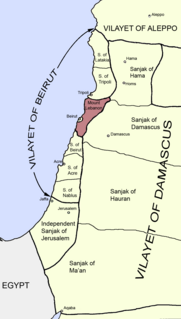
The Mount Lebanon Mutasarrifate was one of the Ottoman Empire's subdivisions following the Tanzimat reform. After 1861 there existed an autonomous Mount Lebanon with a Christian mutasarrıf, which had been created as a homeland for the Maronites under European diplomatic pressure following the 1860 massacres.

Bangsamoro Autonomous Region in Philippines

Bangsamoro, officially the Bangsamoro Autonomous Region in Muslim Mindanao (BARMM),, is an autonomous region within the southern Philippines.

The 1864 “VIlayet Law” was introduced during the Tanzimat era of the Ottoman Empire administration. This era of administration was marked by reform movements, with provincial movements led largely by Midhat Paşa, a key player in the Vilayet Law itself. The Vilayet Law reorganized the provinces within the empire, replacing the eyalet system.
Comprehensive Agreement on the Bangsamoro

The Comprehensive Agreement on Bangsamoro (CAB) is a final peace agreement signed between the Government of the Philippines and the Moro Islamic Liberation Front on 27 March 2014 at the Malacañang Palace in Manila. Under the agreement, the Islamic separatists would turn over their firearms to a third party, which would be selected by the rebels and the Philippine government. The MILF agreed to decommission its armed wing, the Bangsamoro Islamic Armed Forces (BIAF). In return, the government would establish an autonomous Bangsamoro. Power sharing was a central point to the autonomy redesign.

An autonomous region of the Philippines is a first-level administrative division and it has the authority to control the region's culture and economy. It is a minority entity that has a higher population of a particular minority ethnic group. The Constitution of the Philippines allows for two autonomous regions: for Cordilleras and Muslim Mindanao.

Safavid Georgia

The province of Georgia was a velayat (province) of the Safavid Empire located in the area of present-day Georgia. The territory of the province was principally made up of the two subordinate eastern Georgian kingdoms of Kartli and Kakheti and, briefly, parts of the Principality of Samtskhe. The city of Tiflis was its administrative center, the base of Safavid power in the province, and the seat of the rulers of Kartli. It also housed an important Safavid mint.

Chief Minister of Bangsamoro

The Chief Minister of Bangsamoro is the executive head of the Bangsamoro Autonomous Region in Muslim Mindanao, an autonomous region within the Philippines.

Wali of Bangsamoro

The Wali of Bangsamoro is the ceremonial head of the Bangsamoro Autonomous Region in Muslim Mindanao, an autonomous region within the Philippines.

References

  1. Kabiling, Genalyn (11 September 2014). "PNoy submits draft Bangsamoro law Entity to have 58 exclusive powers; UN, Canada hail move". Manila Bulletin. Manila Bulletin. Retrieved 2 February 2015.