Related Research Articles

Fielding in the sport of cricket is the action of fielders in collecting the ball after it is struck by the batsman, to limit the number of runs that the batsman scores and/or to get the batsman out by catching the ball in flight or by running the batsman out. There are a number of recognised fielding positions, and they can be categorised into the offside and leg side of the field. Fielding generally involves preventing the ball from going to or over the edge of the field, and getting the ball to either wicket as quickly as possible.

The wicket-keeper in the sport of cricket is the player on the fielding side who stands behind the wicket or stumps being watchful of the batsman and ready to take a catch, stump the batsman out and run out a batsman when occasion arises. The wicket-keeper is the only member of the fielding side permitted to wear gloves and external leg guards. The role of the keeper is governed by Law 27 of the Laws of Cricket.

This is a general glossary of the terminology used in the sport of cricket. Where words in a sentence are also defined elsewhere in this article, they appear in italics. Certain aspects of cricket terminology are explained in more detail in cricket statistics and the naming of fielding positions is explained at fielding (cricket).
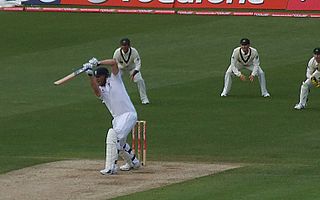
An all-rounder is a cricketer who regularly performs well at both batting and bowling. Although all bowlers must bat and quite a handful of batsmen do bowl occasionally, most players are skilled in only one of the two disciplines and are considered specialists. Some wicket-keepers have the skills of a specialist batsman and have been referred to as all-rounders, but the term wicket-keeper-batsman is more commonly applied to them, even if they are substitute wicket keepers who also bowl.
Alan Philip Eric Knott is a former cricketer who represented England at international level in both Tests and One-Day Internationals (ODI). Knott is widely regarded as one of the most eccentric characters in cricket, and is also regarded as one of the greatest wicket-keepers to ever play the game. He was described by cricket journalist Simon Wilde as "a natural gloveman, beautifully economical in his movements and armed with tremendous powers of concentration".

In cricket, a dismissal occurs when a batsman's period of batting is brought to an end by the opposing team. It is also known as the batsman being out, the batting side losing a wicket, and the fielding side taking a wicket. The ball becomes dead, and the dismissed batsman must leave the field of play permanently for the rest of their team's innings, and is replaced by a teammate. A team's innings ends if 10 of the 11 team members are dismissed—as players bat in pairs, when only one person is undismissed it is not possible for the team to bat any longer. This is known as bowling out the batting team, who are said to be all out.

Cricket clothing and equipment is regulated by the laws of cricket. Cricket whites, sometimes called flannels, are the loose fitting clothes which are worn while playing cricket so as not to restrict the player's movement. Use of protective equipment, such as cricket helmets, gloves and pads, is also regulated.

Alec James Stewart is an English former cricketer, and former captain of the England cricket team, who played Test cricket and One Day Internationals as a right-handed wicket-keeper-batsman. He is the fourth-most-capped English cricketer ever in Test matches and third-most-capped in One Day Internationals (ODIs), having played in 133 Tests and 170 ODIs.

Adam Craig Gilchrist is an Australian cricket commentator and former international cricketer and captain of the Australia national cricket team. He was an attacking left-handed batsman and record-breaking wicket-keeper, who redefined the role for the Australia national team through his aggressive batting. Widely regarded as one of the greatest wicket-keeper-batsman in the history of the game, Gilchrist held the world record for the most dismissals by a wicket-keeper in One Day International (ODI) cricket until it was surpassed by Kumar Sangakkara in 2015 and the most by an Australian in Test cricket.

Ian Andrew Healy is an Australian former international cricketer who played for Queensland domestically. A specialist wicketkeeper and useful right-hand middle-order batsman, he made an unheralded entry to international cricket in 1988, after only six first-class games. His work ethic and combativeness was much needed by an Australian team. Over the next decade, Healy was a key member of the side as it enjoyed a sustained period of success. By the time of his retirement, Healy held the world record for most Test dismissals by a wicket-keeper.

Cricket and Baseball are the best-known members of a family of related bat-and-ball games. Both have fields that are 400 feet (120 m) or more in diameter, offensive players who can hit a thrown ball out of the field and run between safe areas to score runs (points), and have a major game format lasting about 3 hours.

Caught is a method of dismissing a batsman in cricket. A batsman is caught if the batsman hits the ball, from a legitimate delivery, with the bat, and the ball is caught by the bowler or a fielder before it hits the ground.
Rodney William Marsh is an Australian former professional cricketer who played as a wicketkeeper for the Australian national cricket team.

Mahendra Singh Dhoni, is a former Indian international cricketer who captained the Indian national team in limited-overs formats from 2007 to 2017 and in Test cricket from 2008 to 2014. Under his captaincy, India won the inaugural 2007 ICC World Twenty20, the 2010 and 2016 Asia Cups, the 2011 ICC Cricket World Cup and the 2013 ICC Champions Trophy. A right-handed middle-order batsman and wicket-keeper, Dhoni is one of the highest run scorers in One Day Internationals (ODIs) with more than 10,000 runs scored and is considered an effective "finisher" in limited-overs formats. He is widely regarded as one of the greatest wicket-keeper batsmen and captains in the history of the game. He was also the first wicket-keeper to effect 100 stumpings in ODI cricket.

John McCarthy Blackham was a Test cricketer who played for Victoria and Australia.

Farokh Maneksha Engineerpronunciation (help·info) is a former Indian cricketer. He played 46 Tests for India, and he played first-class cricket for Bombay in India from 1959 to 1975 and for Lancashire in England from 1968 to 1976. Engineer was the last from his community to play for India, as not a single Parsee male has represented the country after him. His role is represented by Boman Irani in 83 (film)
In cricket, the batting order is the sequence in which batters play through their team's innings, there always being two batters taking part at any one time. All eleven players in a team are required to bat if the innings is completed.

Denesh Ramdin is a Trinidadian cricketer of Indian descent who plays internationally for the West Indies. He is a right-handed wicketkeeper-batsman.
The Australian cricket team toured India from February to April 2001 for a three-Test series and a five-match ODI series. The series is considered one of India's finest, as they secured victory against Australia in the Test series, in the process breaking Australia's 16-match win streak in Tests, and being the third side to win a Test match after being asked to follow-on during the match in Kolkata. The Kolkata match has been called by some as one of the greatest matches in the sport's history.
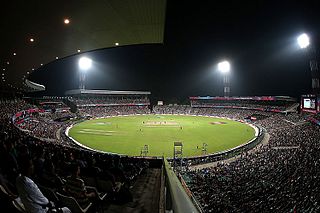
Cricket is a bat-and-ball game played between two teams of eleven players on a field at the centre of which is a 22-yard (20-metre) pitch with a wicket at each end, each comprising two bails balanced on three stumps. The batting side scores runs by striking the ball bowled at the wicket with the bat, while the bowling and fielding side tries to prevent this and dismiss each batter. Means of dismissal include being bowled, when the ball hits the stumps and dislodges the bails, and by the fielding side either catching the ball after it is hit by the bat and before it hits the ground, or hitting a wicket with the ball before a batter can cross the crease in front of the wicket. When ten batters have been dismissed, the innings ends and the teams swap roles. The game is adjudicated by two umpires, aided by a third umpire and match referee in international matches.
References
- ↑ S Rajesh. The year of the wicketkeeper-batsman. ESPNcricinfo.
- ↑ What’s The Role Of A Wicket-keeper/Batsman. Red Bull.
- ↑ Deepu Narayana. Who Is the Greatest Wicket-keeper Batsman of All Time? Dennis Does Cricket.
- ↑ Bill Russell. The 10 Greatest Wicket-Keeper Batsmen of All Time. Sporteology.
- ↑ The Top 10 Wicket-Keepers in Cricket History. Totalsportek.
- ↑ Aadi Jalan. Ranking the top 10 wicketkeeper-batsmen of all time. Sportskeeda.
