Related Research Articles
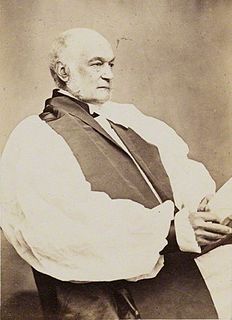
George Moberly was an English cleric who was headmaster of Winchester College, and then served as Bishop of Salisbury from 1869 until his death.
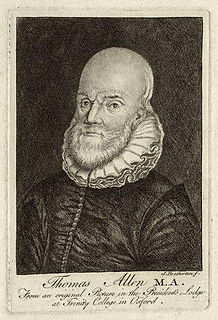
Thomas Allen was an English mathematician and astrologer. Highly reputed in his lifetime, he published little, but was an active private teacher of mathematics. He was also well connected in the English intellectual networks of the period.
Benedict Barnham was a London merchant, alderman and sheriff of London and MP.

Henry Smith was an English clergyman, widely regarded as "the most popular Puritan preacher of Elizabethan London." His sermons at St. Clement Danes drew enormous crowds, and earned him a reputation as "Silver Tongued" Smith. The collected editions of his sermons, and especially his tract, "God's Arrow Against Atheists" were among the most frequently reprinted religious writings of the Elizabethan age.
John Coldwell (c.1535–1596) was an English physician and bishop.

Henry Ussher was an Irish Protestant churchman, a founder of Trinity College, Dublin, and Church of Ireland Archbishop of Armagh.
Matthew Nicholas (1594–1661) was an English Dean of St. Paul's Cathedral, London.

John Gostlin or GostlynMD was an English academic and physician, Master of Gonville and Caius College, Cambridge from 1619 and Regius Professor of Physic.
William Burton was an English clergyman, known for his writings, an insider's view of the Puritan ascendancy at Norwich, and as an eyewitness to heresy executions.
Sir William Wray, 1st Baronet, of Glentworth, Lincolnshire was an English Member of Parliament.
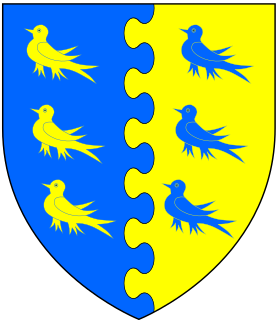
William Fleetwood was an English lawyer and politician. He was Member of Parliament for Marlborough in 1558, Lancaster in 1559 and 1567, and for the City of London several times between 1572 and 1592, but his most significant position was as Recorder of London from 1571 to 1591. A lawyer of the Middle Temple, he was a Queen's Serjeant in 1592.
Thomas Playfere was an English churchman and theologian, Lady Margaret's Professor of Divinity at Cambridge from 1596.
Thomas Palfreyman was an English author and musician.
Robert Crichton or Creighton, Lord Elliock (1530–1591), of Elliock, in Nithsdale, was joint Lord Advocate of Scotland. He purchased Clunie Castle and the adjoining lands from the Diocese of Dunkeld where his cousin, Robert Crichton, was bishop.
William Hinde (1569?–1629) was an English priest and author, of Puritan views.
John Villiers was an English courtier from the Villiers family. The eldest son of Sir George Villiers and Mary Beaumont, later Countess of Buckingham, he was the brother of King James I's favourite, George Villiers, 1st Duke of Buckingham.
Edward William Grinfield (1785–1864) was an English biblical scholar.

The Regius Professorship of Hebrew in the University of Oxford is a professorship at the University of Oxford, founded by Henry VIII in 1546.
Robert Wilmot was a Church of England clergyman, known as a playwright.
References
- Dils, Joan A. "Foster, William". Oxford Dictionary of National Biography (online ed.). Oxford University Press. doi:10.1093/ref:odnb/9973.(Subscription or UK public library membership required.).
- Attribution

