Related Research Articles
Multiple chemical sensitivity (MCS), also known as idiopathic environmental intolerances (IEI), is an unrecognized and controversial diagnosis characterized by chronic symptoms attributed to exposure to low levels of commonly used chemicals. Symptoms are typically vague and non-specific. They may include fatigue, headaches, nausea, and dizziness.
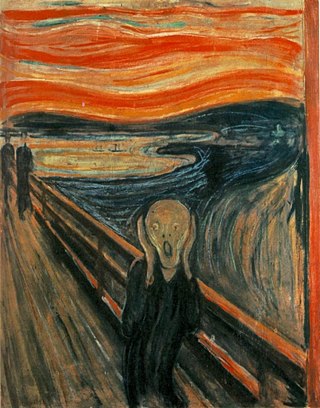
Anxiety disorders are a cluster of mental disorders characterized by significant and uncontrollable feelings of anxiety and fear such that a person's social, occupational, and personal functions are significantly impaired. Anxiety may cause physical and cognitive symptoms, such as restlessness, irritability, easy fatigue, difficulty concentrating, increased heart rate, chest pain, abdominal pain, and a variety of other symptoms that may vary based on the individual.

Hypochondriasis or hypochondria is a condition in which a person is excessively and unduly worried about having a serious illness. Hypochondria is an old concept whose meaning has repeatedly changed over its lifespan. It has been claimed that this debilitating condition results from an inaccurate perception of the condition of body or mind despite the absence of an actual medical diagnosis. An individual with hypochondriasis is known as a hypochondriac. Hypochondriacs become unduly alarmed about any physical or psychological symptoms they detect, no matter how minor the symptom may be, and are convinced that they have, or are about to be diagnosed with, a serious illness.

Somatization disorder was a mental and behavioral disorder characterized by recurring, multiple, and current, clinically significant complaints about somatic symptoms. It was recognized in the DSM-IV-TR classification system, but in the latest version DSM-5, it was combined with undifferentiated somatoform disorder to become somatic symptom disorder, a diagnosis which no longer requires a specific number of somatic symptoms. ICD-10, the latest version of the International Statistical Classification of Diseases and Related Health Problems, still includes somatization syndrome.
Adjustment disorder is a maladaptive response to a psychosocial stressor. It is classified as a mental disorder. The maladaptive response usually involves otherwise normal emotional and behavioral reactions that manifest more intensely than usual, causing marked distress, preoccupation with the stressor and its consequences, and functional impairment.
Cyberchondria, otherwise known as compucondria, is the unfounded escalation of concerns about common symptomology based on review of search results and literature online. Articles in popular media position cyberchondria anywhere from temporary neurotic excess to adjunct hypochondria. Cyberchondria is a growing concern among many healthcare practitioners as patients can now research any and all symptoms of a rare disease, illness or condition, and manifest a state of medical anxiety.
Post-concussion syndrome (PCS), also known as persisting symptoms after concussion, is a set of symptoms that may continue for weeks, months, years after a concussion. PCS is medically classified as a mild traumatic brain injury (TBI). About 35% of people with concussion experience persistent or prolonged symptoms 3 to 6 months after injury. Prolonged concussion is defined as having concussion symptoms for over four weeks following the first accident in youth and for weeks or months in adults.
A health professional, healthcare professional, or healthcare worker is a provider of health care treatment and advice based on formal training and experience. The field includes those who work as a nurse, physician, physician assistant, registered dietitian, veterinarian, veterinary technician, optometrist, pharmacist, pharmacy technician, medical assistant, physical therapist, occupational therapist, dentist, midwife, psychologist, audiologist, healthcare scientist, or who perform services in allied health professions. Experts in public health and community health are also health professionals.
Somatization is a tendency to experience and communicate psychological distress as bodily and organic symptoms and to seek medical help for them. More commonly expressed, it is the generation of physical symptoms of a psychiatric condition such as anxiety. The term somatization was introduced by Wilhelm Stekel in 1924.
Nosophobia, also known as disease phobia or illness anxiety disorder, is the irrational fear of contracting a disease, a type of specific phobia. Primary fears of this kind are fear of contracting HIV infection, pulmonary tuberculosis (phthisiophobia), venereal diseases, cancer (carcinophobia), heart diseases (cardiophobia), and catching the common cold or flu.
Somatosensory amplification (SSA) is a tendency to perceive normal somatic and visceral sensations as being relatively intense, disturbing and noxious. It is a common feature of hypochondriasis and is commonly found with fibromyalgia, major depressive disorder, some anxiety disorders, Asperger syndrome, and alexithymia. One common clinical measure of SSA is the Somatosensory Amplification Scale (SSAS).

The ICD-11 of the World Health Organization (WHO) describes occupational burnout as an occupational phenomenon resulting from chronic workplace stress that hasn't been successfully managed, with symptoms characterized by "feelings of energy depletion or exhaustion; increased mental distance from one’s job, or feelings of negativism or cynicism related to one's job; and reduced professional efficacy." It is classified as a mismatch between the challenges of work and a person's mental and physical resources, but is not recognized as a standalone medical condition.
Somatic symptom disorder, also known as somatoform disorder, is defined by one or more chronic physical symptoms that coincide with excessive and maladaptive thoughts, emotions, and behaviors connected to those symptoms. The symptoms are not purposefully produced or feigned, and they may or may not coexist with a known medical ailment.

Hazard controls for COVID-19 in workplaces are the application of occupational safety and health methodologies for hazard controls to the prevention of COVID-19. Vaccination is the most effective way to protect against severe illness or death from COVID-19. Multiple layers of controls are recommended, including measures such as remote work and flextime, increased ventilation, personal protective equipment (PPE) and face coverings, social distancing, and enhanced cleaning programs.
The COVID-19 pandemic has impacted the mental health of people across the globe. The pandemic has caused widespread anxiety, depression, and post-traumatic stress disorder symptoms. According to the UN health agency WHO, in the first year of the COVID-19 pandemic, prevalence of common mental health conditions, such as depression and anxiety, went up by more than 25 percent. The pandemic has damaged social relationships, trust in institutions and in other people, has caused changes in work and income, and has imposed a substantial burden of anxiety and worry on the population. Women and young people face the greatest risk of depression and anxiety.
The COVID-19 pandemic has impacted hospitals around the world. Many hospitals have scaled back or postponed non-emergency care. This has medical consequences for the people served by the hospitals, and it has financial consequences for the hospitals. Health and social systems across the globe are struggling to cope. The situation is especially challenging in humanitarian, fragile and low-income country contexts, where health and social systems are already weak. Health facilities in many places are closing or limiting services. Services to provide sexual and reproductive health care risk being sidelined, which will lead to higher maternal mortality and morbidity. The pandemic also resulted in the imposition of COVID-19 vaccine mandates in places such as California and New York for all public workers, including hospital staff.
The COVID-19 pandemic has impacted healthcare workers physically and psychologically. Healthcare workers are more vulnerable to COVID-19 infection than the general population due to frequent contact with infected individuals. Healthcare workers have been required to work under stressful conditions without proper protective equipment, and make difficult decisions involving ethical implications. Health and social systems across the globe are struggling to cope. The situation is especially challenging in humanitarian, fragile and low-income country contexts, where health and social systems are already weak. Services to provide sexual and reproductive health care risk being sidelined, which will lead to higher maternal mortality and morbidity.
The COVID-19 pandemic has had many impacts on global health beyond those caused by the COVID-19 disease itself. It has led to a reduction in hospital visits for other reasons. There have been 38 per cent fewer hospital visits for heart attack symptoms in the United States and 40 per cent fewer in Spain. The head of cardiology at the University of Arizona said, "My worry is some of these people are dying at home because they're too scared to go to the hospital." There is also concern that people with strokes and appendicitis are not seeking timely treatment. Shortages of medical supplies have impacted people with various conditions.
Long COVID or long-haul COVID is a group of health problems persisting or developing after an initial COVID-19 infection. Symptoms can last weeks, months or years and are often debilitating. The World Health Organization defines long COVID as starting three months after infection, but other definitions put the start of long COVID at four weeks.
There is increasing evidence suggesting that COVID-19 causes both acute and chronic neurologicalor psychological symptoms. Caregivers of COVID-19 patients also show a higher than average prevalence of mental health concerns. These symptoms result from multiple different factors.
References
- 1 2 3 "Public health nurse on the 'worried well' during COVID-19". Purdue News Service. Retrieved 2021-04-05.
- 1 2 3 4 5 Gray, Denis Pereira; Dineen, Molly; Sidaway-Lee, Kate (1 February 2020). "The worried well" (PDF). British Journal of General Practice . 70 (691): 84–85. doi:10.3399/bjgp20X708017. ISSN 0960-1643. PMC 7018435 . PMID 32001474.
- ↑ "Worried Well." TERMIUM Plus . Ottawa: Translation Bureau, Government of Canada. 2021 April 4.
- ↑ Breakwell, Glynis M. (2014). The Psychology of Risk (2nd ed.). Cambridge University Press. p. 134. ISBN 978-1-107-01701-6.
- ↑ Pontious, Michael J. (1 January 2002). "Understanding the "Worried Well"" (PDF). The Journal of Family Practice. 51 (1): 30. PMID 11927059.
- ↑ Singh, Pipin (17 February 2020). "GP training: Consulting with the 'worried well'" . GPonline. Retrieved 23 February 2020.
- ↑ Great Britain. Parliament. House of Commons. Home Affairs Committee (2010). Policing: Police and Crime Commissioners; Second Report of Session 2010-11; Report, Together with Formal Minutes, Oral and Written Evidence. The Stationery Office. p. 9. ISBN 978-0-215-55544-1.
- 1 2 Department of the Interior and Related Agencies Appropriations for 1981: Hearings Before a Subcommittee of the Committee on Appropriations, House of Representatives, Ninety-sixth Congress, Second Session. U.S. Government Printing Office. 1980. p. 670.
- ↑ Buck, Carol J. (2017). 2018 ICD-10-CM Physician Professional Edition - E-Book. Elsevier Health Sciences. p. 460. ISBN 978-0-323-56780-0.
- ↑ "ICD-10 Version:2016". icd.who.int. Retrieved 26 February 2020.
- ↑ "Health anxiety". nhs.uk. 18 October 2017. Retrieved 23 February 2020.
- 1 2 3 4 5 Lebron, Andrea. "Pre-Emergency Safety Planning: Managing Worried Well Patients". www.ravemobilesafety.com. Retrieved 2021-04-05.
- ↑ "worried well" . Oxford English Dictionary (Online ed.). Oxford University Press.(Subscription or participating institution membership required.)
- 1 2 "Wellcome Trust" . account.wellcome.ac.uk. Retrieved 23 February 2020.[ dead link ]
- ↑ Garfield, Sidney R. [1970] 2006. "The Delivery of Medical Care." The Permanente Journal 10(2):46-56.
- ↑ Miller, David; Acton, Timothy M. G.; Hedge, Barbara (July 1988). "The Worried Well: Their Identification and Management". Journal of the Royal College of Physicians of London. 22 (3): 158–165. ISSN 0035-8819. PMC 5379321 . PMID 3411543.
- ↑ Garfield, Sidney R.; Collen, Morris F.; Feldman, Robert; Soghikian, Krikor; Richart, Robert H.; Duncan, James H. (1976-02-19). "Evaluation of an Ambulatory Medical-Care Delivery System". New England Journal of Medicine. 294 (8): 426–431. doi:10.1056/NEJM197602192940806. ISSN 0028-4793. PMID 813145.
- ↑ Davey, T., and J. Green. 1991. "The worried well: Ten years of a new face for an old problem." AIDS Care 3(3):289-93. doi : 10.1080/09540129108253075.
- ↑ Subcommittee on National Security, Veterans Affairs and International Relations of the Committee on Government Reform. 2001 November 29. "Risk Communication: National Security and Public Health." 1st session, 107th Congress, 107-22.
- ↑ Molinari, Noelle-Angelique, Tanya Telfair LeBlanc, and William Stephens. 2018. "The Impact of a Case of Ebola Virus Disease on Emergency Department Visits in Metropolitan Dallas–Fort Worth, TX, July, 2013-July, 2015: An Interrupted Time Series Analysis." PLoS Currents 2018(10). PMC 5878099; PMID 29623242
- ↑ "Talking therapy could help to battle rising 'cyberchondria' | Imperial News | Imperial College London". Imperial News. 7 September 2017. Retrieved 2021-04-05.
- ↑ Stack, Rebecca (14 September 2017). "Dear worried well, the internet is not your friend". The Conversation. Retrieved 2021-04-05.
- ↑ "Think you need a COVID-19 test? The nation's testing czar says you might not". NBC News. 6 August 2020. Retrieved 2021-04-05.
- ↑ Smith, Chris. "If you're among the 'worried well' you don't need a COVID-19 test | Opinion". The Leaf-Chronicle. Retrieved 2021-04-05.