Yusuf III, Sultan of Granada

Last updated

Yusuf III (Arabic : يوسف الثالث) (1374–1417) was the thirteenth Nasrid ruler of the Moorish Emirate of Granada in Al-Andalus on the Iberian Peninsula from 1408 to 1417. He inherited the throne from his brother, Muhammed VII, and was a noted builder and poet.
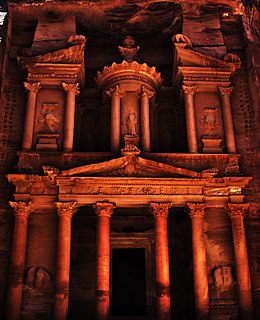
Nasrid dynasty dynasty

The Nasrid dynasty was the last Muslim dynasty in the Iberian Peninsula, ruling the Emirate of Granada from 1230 until 1492. The Nasrid dynasty rose to power after the defeat of the Almohad Caliphate in 1212 at the Battle of Las Navas de Tolosa. Twenty-three emirs ruled Granada from the founding of the dynasty in 1230 by Muhammad I until 2 January 1492, when Muhammad XII surrendered all lands to King Ferdinand II of Aragon and Queen Isabella I of Castille. Today, the most visible evidence of the Nasrid dynasty is the Alhambra palace complex built under their rule.

Moors medieval Muslim inhabitants of the Maghreb, Iberian Peninsula, Sicily, and Malta

The term "Moors" refers primarily to the Muslim inhabitants of the Maghreb, the Iberian Peninsula, Sicily, and Malta during the Middle Ages. The Moors initially were the indigenous Maghrebine Berbers. The name was later also applied to Arabs.

Emirate of Granada Historic Iberian state

The Emirate of Granada, also known as the Nasrid Kingdom of Granada, was an emirate established in 1230 by Muhammad ibn al-Ahmar. After Prince Idris left Iberia to take the Almohad Caliphate leadership, the ambitious Ibn al-Ahmar established the last Muslim dynasty on the Iberian peninsula, the Nasrids. The Nasrid emirs were responsible for building the Alhambra palace complex as it is known today. By 1250, the Emirate was the last part of the Iberian peninsula held by the Muslims. It roughly corresponded to the modern Spanish provinces of Granada, Almería, and Málaga. Andalusian Arabic was the mother tongue of the majority of the population. For two more centuries, the region enjoyed considerable cultural and economic prosperity.

Yusuf had constructed the northernmost of the Nasrid dynasty palaces on the hill of the Alhambra. His palace was allowed to fall into ruin after the Christian takeover, leaving only a lovely arcade and tower. Terraced gardens were reconstructed in the 20th century.

Alhambra palace and fortress complex in Granada, Andalusia, Spain

The Alhambra is a palace and fortress complex located in Granada, Andalusia, Spain. It was originally constructed as a small fortress in AD 889 on the remains of Roman fortifications, and then largely ignored until its ruins were renovated and rebuilt in the mid-13th century by the Nasrid emir Mohammed ben Al-Ahmar of the Emirate of Granada, who built its current palace and walls. It was converted into a royal palace in 1333 by Yusuf I, Sultan of Granada. After the conclusion of the Christian Reconquista in 1492, the site became the Royal Court of Ferdinand and Isabella, and the palaces were partially altered in the Renaissance style. In 1526 Charles I & V commissioned a new Renaissance palace better befitting the Holy Roman Emperor in the revolutionary Mannerist style influenced by humanist philosophy in direct juxtaposition with the Nasrid Andalusian architecture, but it was ultimately never completed due to Morisco rebellions in Granada.

Palace grand residence, especially a royal residence or the home of a head of state

A palace is a grand residence, especially a royal residence, or the home of a head of state or some other high-ranking dignitary, such as a bishop or archbishop.

Christian usually refers to:

The following is a section of one of Yusuf's poems from Hispano-Arabic Poetry: A Student Anthology, published by James Monroe. It is typical of the romantic, yearning poetry of al-Andalus, which inspired the later romantic poetry of European chivalry. However, later Christian poems were strictly limited to male-female yearning, unlike this example.

James Monroe 5th President of the United States

James Monroe was an American statesman and Founding Father who served as the fifth president of the United States from 1817 to 1825. A member of the Democratic-Republican Party, Monroe was the last president of the Virginia dynasty, and his presidency coincided with the Era of Good Feelings. He is perhaps best known for issuing the Monroe Doctrine, a policy of opposing European colonialism in the Americas. He also served as the governor of Virginia, a member of the United States Senate, the U.S. ambassador to France and Britain, the seventh Secretary of State, and the eighth Secretary of War.
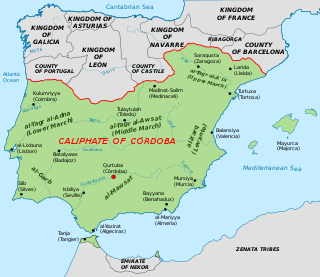
al-Andalus southern portion of the Iberian Peninsula once inhabited by Moors

al-Andalus, also known as Muslim Spain, Muslim Iberia, or Islamic Iberia, was a medieval Muslim territory and cultural domain that in its early period occupied most of Iberia, today's Portugal and Spain. At its greatest geographical extent, it occupied the northwest of the Iberian peninsula and a part of present day southern France Septimania and for nearly a century extended its control from Fraxinet over the Alpine passes which connect Italy with the remainder of Western Europe. The name more generally describes the parts of the peninsula governed by Muslims at various times between 711 and 1492, though the boundaries changed constantly as the Christian Reconquista progressed, eventually shrinking to the south around modern-day Andalusia and then to the Emirate of Granada.
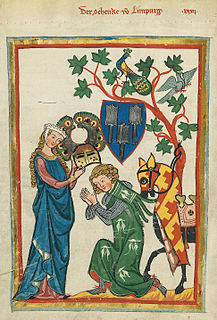
Chivalry traditional ideology and code of conduct of knights

Chivalry, or the chivalric code, is an informal, varying code of conduct developed between 1170 and 1220, but never decided on or summarized in a single document. It was associated with the medieval Christian institution of knighthood; knights' and gentlewomen's behaviours were governed by chivalrous social codes. The ideals of chivalry were popularized in medieval literature, especially the Matter of Britain and Matter of France, the former based on Geoffrey of Monmouth's Historia Regum Britanniae, written in the 1130s, which introduced the legend of King Arthur. All of these were taken as historically accurate until the beginnings of modern scholarship in the 19th century.

Related Research Articles

Almohad Caliphate langue Arabic dialictic

The Almohad Caliphate was a Moroccan Berber Muslim movement and empire founded in the 12th century.

Yusuf ibn Tashfin King of Almoravid

Yusuf ibn Tashfin also, Tashafin, Teshufin; or Yusuf was leader of the Berber Moroccan Almoravid empire. He co-founded the city of Marrakesh and led the Muslim forces in the Battle of Zallaqa/Sagrajas. Ibn Tashfin came to al-Andalus from Africa to help the Muslims fight against Alfonso VI, eventually achieving victory and promoting an Islamic system in the region. He was married to Zainab al-Nafzawiyya, whom he reportedly trusted politically.

Abū Yaʿqūb Yūsuf al-Mustanṣir was Caliph of Morocco from 1213 until his death. Son of the previous caliph, Muhammad al-Nasir, the ten-year-old Yusuf was unexpectedly appointed heir by his father on his deathbed. He was confirmed as Almohad Caliph in election by the Almohad sheikhs after his father’s death, and took up the caliphal title "al-Mustansir bi-Llah". Yusuf’s mother was a Christian slave Qamar.

Court of the Lions courtyard in Alhambra, Granada

The Court of the Lions (Spanish: Patio de los Leones; Arabic: بهو السباع‎) is the main courtyard of the Nasrid dynasty Palace of the Lions, in the heart of the Alhambra, the Moorish citadel formed by a complex of palaces, gardens and forts in Granada, Spain. It was commissioned by the Nasrid sultan Muhammed V of the Emirate of Granada in Al-Andalus. Its construction started in the second period of his reign, between 1362 and 1391 AD. The site is now part of the UNESCO World Heritage List and minted in Spain's 2011 limited edition of 2 € Commemorative Coins.

Generalife palace in Granada, Spain

The Palacio de Generalife was the summer palace and country estate of the Nasrid rulers of the Emirate of Granada in Al-Andalus, now beside the city of Granada in the autonomous community of Andalusia, Spain.

Moroccan literature is a literature written in (Moroccan) Arabic, Berber, French or Spanish, particularly by people of Morocco, but also of Al-Andalus.

Abu al-Waleed Ahmad Ibn Zaydún al-Makhzumi (1003–1071) or simply known as Ibn Zaydún or Abenzaidún according to Christian sources was a famous Arab poet of Cordoba and Seville. He was considered the greatest neoclassical poet of al-Andalus.

James T. Monroe is an American scholar. He is emeritus professor of Arabic and Comparative Literature at the University of California at Berkeley, focusing on Classical Arabic Literature and Hispano-Arabic Literature. His doctorate was from Harvard University. Professor Monroe "works in the areas of lyric poetry, the Middle Ages, and East-West relations with particular interest in the importance of the Arab contribution to Spanish civilization."

Ismail I was the grandson of Muhammed II al-Faqih and the fifth Nasrid ruler of the Emirate of Granada in Al-Andalus on the Iberian Peninsula in 1314–1325.

Ibn Hamdis Medieval Arab poet

Ibn Ḥamdīs al-ʾAzdī al-Ṣīqillī was a Sicilian Arab poet.

Abu ’l-ʿAbbāsAḥmad ibn ʿAbd Allāh ibn Hurayra al-ʿUtbī, nicknamed al-Aʿmā al-Tuṭīlī or the Blind Poet of Tudela, was a Andalusian mūwallad poet who composed in Arabic. Although born in Tudela, he was raised in Seville, where he gained talent in poetry. He later lived in Murcia. He died young. He was one of the best-known strophic poets and songwriters of the Almoravid period in Al-Andalus (1091–1145) and competed with Ibn Bajjah in witty compositions at the court of Ibn Tifilwit, the Almoravid governor in Saragossa. He wrote panegyrics to both the Almoravids in al-Andalus and the Banu Kasim in Alpuente (Al-Sahla) and was famous for his love poems. Especially well-known is the elegy he wrote on the death of his wife, whom he invokes by the name of Amina.

'Ibn Khafajah or Abu Ishaq Ibn Ibrahim Ibn Abu Al-Fath Ibn Khafajah (1058-1138/9) of Alzira was one of the most famous poets of Al-Andalus during the reign of the Almoravids. He was born in 1058 in Alzira near Valencia where he spent most of his life.

Ibn Zamrak or Abu Abduallah Muhammad ibn Yusuf ibn Muhammad ibn Ahmad ibn Muhammad ibn Yusuf al-Surayhi, (1333–1393) was an Arab Andalusian poet and statesman from Granada, Al-Andalus. Some his poems still decorate the fountains and palaces of Alhambra in Granada.

Muhammed VIII (1411–1431), common alternative spelling Muhammad, known as "the left handed", was the fourteenth Nasrid ruler of the Moorish Emirate of Granada in Al-Andalus on the Iberian Peninsula.

Moorish Gibraltar Wikimedia list article

The history of Moorish Gibraltar began with the landing of the Muslims in Hispania and the fall of the Visigothic Kingdom of Toledo in 711 and ended with the fall of Gibraltar to Christian hands 751 years later, in 1462, with an interregnum during the early 14th century.

Abd al-Majid ibn Abdun, or in full Abu Mohammed Abd al-Majid ibn Abdun al-Yaburi عبد المجيد بن عبدون اليابري(c. 1050- 1135, died in Évora) was a poet from Al-Andalus. He was the secretary of one of the two kings of the Taifa of Badajoz Umar ibn Mohammed al-Muwakkil (1078) of the Berber Miknasa Aftasid dynasty. When the Aftasid dynasty was defeated and Badajoz conquered by the Almoravids, Ibn Abdun became the secretary of Yusuf ibn Tashfin and later of his son Ali ibn Yusuf. He wrote a diwan. One of his best known poems is a qasida (elegy) on the downfall of the house of the Aftasids, known as al-Qasidah al-bassamah or sometimes the Abduniyya. Ibn Badrun, himself a well known poet of Al-Andalus, wrote a lengthy commentary on the poems and prose of Ibn Abdun, translated and edited by Reinhart Dozy in 1848.

References

    Yusuf III, Sultan of Granada
    Cadet branch of the Banu Khazraj
    Born: 1376 Died: 1417
    Regnal titles
    Preceded by
    Muhammed VII
    Sultan of Granada
    14081417
    Succeeded by
    Muhammed VIII