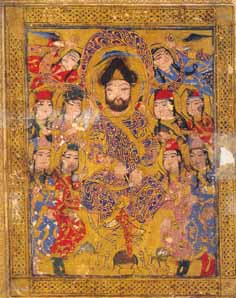
Ali ibn al-Husayn al-Iṣfahānī, also known as Abul-Faraj was an historian of Arab-Quraysh origin who is noted for collecting and preserving ancient Arabic lyrics and poems in his major work, the Kitāb al-Aghānī.
Ahmad ibn Rustah Isfahani, more commonly known as Ibn Rustah, was a 10th-century Persian explorer and geographer born in Rosta district, Isfahan, Persia. He wrote a geographical compendium known as Book of Precious Records. The information on his home town of Isfahan is especially extensive and valuable. Ibn Rustah states that, while for other lands he had to depend on second-hand reports, often acquired with great difficulty and with no means of checking their veracity, for Isfahan he could use his own experience and observations or statements from others known to be reliable. Thus we have a description of the twenty districts (rostaqs) of Isfahan containing details not found in other geographers' works. Concerning the town itself, we learn that it was perfectly circular in shape, with a circumference of half a farsang, walls defended by a hundred towers, and four gates.

Abū Bishr ʻAmr ibn ʻUthmān ibn Qanbar Al-Baṣrī, known as Sībawayh or Sībawayhi was Persian, a leading grammarian of Basra and author of Arabic linguistics. His famous work, Al-Kitāb, or "The Book", is a seminal encyclopedic grammar of the Arabic language.
Abu-Abdullah Muhammad ibn Īsa Māhānī was a Persian Muslim mathematician and astronomer born in Mahan, and active in Baghdad, Abbasid Caliphate. His known mathematical works included his commentaries on Euclid's Elements, Archimedes' On the Sphere and Cylinder and Menelaus' Sphaerica, as well as two independent treatises. He unsuccessfully tried to solve a problem posed by Archimedes of cutting a sphere into two volumes of a given ratio, which was later solved by 10th century mathematician Abū Ja'far al-Khāzin. His only known surviving work on astronomy was on the calculation of azimuths. He was also known to make astronomical observations, and claimed his estimates of the start times of three consecutive lunar eclipses were accurate to within half an hour.

Abu Yahya Zakariya' ibn Muhammad al-Qazwini or Zakarya Qazvini (1203–1283) was a Persian physician, astronomer, geographer and proto-science fiction writer of Arab descent. He belonged to a family of jurists who had long before settled in Qazvin. He drew his origin from an Arab family and was probably a descendant of the Medinian Sahabi Anas bin Malik.

'Urwah ibn al-Zubayr ibn al-'Awwam al-Asadi was among the seven fuqaha (jurists) who formulated the fiqh of Medina in the time of the Tabi‘in and one of the Muslim historians.

ʿAbd Allāh ibn al-Zubayr ibn al-ʿAwwām was the leader of a caliphate based in Mecca that rivaled the Umayyads between 683 until his death. The son of al-Zubayr ibn al-Awwam and Asma bint Abi Bakr, Ibn al-Zubayr was a member of the Quraysh and the first child born to the Muhajirun, Islam's earliest converts. During his youth, he participated in the early Muslim conquests alongside his father in Syria and Egypt, and later played a role in the Muslim conquests of North Africa and northern Iran in 647 and 650, respectively. During the First Muslim Civil War, he fought on the side of his aunt A'isha and the Banu Umayya against Caliph Ali. Though little is heard of Ibn al-Zubayr during the subsequent reign of the first Umayyad caliph Mu'awiya I, it was known that he opposed Mu'awiya's designation of his son Yazid I as his successor. Ibn al-Zubayr, along with much of the Quraysh and Ansar of the Hejaz, opposed the caliphate being an inheritable institution of the Banu Umayya.
Az-Zubayr ibn Abd al-Muttalib was the son of Shaiba ibn Hashim and Fatimah bint Amr, hence an uncle of Muhammad. He was full brother to Abu Talib and to Muhammad's father Abdullah.
Hishām ibn ʿUrwah was a prominent narrator of hadith, son of Urwah ibn al-Zubayr, grandson of Zubayr ibn al-Awwam and Asma bint Abu Bakr. In Medinah, his pupils included people as well known as Malik ibn Anas.
Aḥmad ibn Muḥammad ibn al-Faqih al-Hamadani was a 10th-century Persian historian and geographer, famous for his Mukhtasar Kitab al-Buldan written in Arabic.

Mukhtār ibn Abī ʿUbayd al-Thaqafī was an early Islamic revolutionary based in Kufa, who led an abortive rebellion against the Umayyads in revenge for the death of Husayn ibn Ali at the Battle of Karbala.
Safiyyah bint Abd al-Muttalib was a companion and aunt of the Islamic prophet Muhammad.
Abd al-Hamid ibn Yahya al-Katib was the secretary to the last Umayyad Caliph, Marwan II, and a supreme stylist of early Arabic prose.

Az-Zubayr ibn Al-Awam was a companion of Muhammad and a commander in the Rashidun army.
Ibn al-Awwam, also called Abu Zakariya Ibn al-Awwam, was an Andalusian Arab agriculturist who flourished at Seville in southern Spain in the later 12th century. He wrote a lengthy handbook on agriculture entitled in Arabic Kitāb al-Filāḥa, which is the most comprehensive treatment of the subject in medieval Arabic, and one of the most important medieval works on the subject in any language. It was published in Spanish and French translations in the 19th century. The edition in French is about 1350 pages.
Al-Zubayr ibn Bakkār (Arabic: أبو عبدالله الزبير بن بكار بن عبد الله بن مصعب بن ثابت بن عبد الله بن الزبير بن العوام,, a descendant of Al-Zubayr ibn al-ʻAwwām, was a leading Arab Muslim historian and genealogist of the Arabs, particularly the Hijaz region. He composed a number of works on genealogy that made him a standing authority on the subject of the genealogies of the Quraysh tribe. Ibn Hajar al-Asqalani regarded him as the most reliable authority for Quraysh genealogical matters.
Abu Salma Hammad ibn Salamah ibn Dinar al-Basri, the son of Salamah ibn Dinar, was Basra's mufti, a prominent narrator of hadith and one of the earliest grammarians of the Arabic language, who had a great influence on his student, Sibawayh.
Yunus ibn Habib was a reputable 8th-century Arab or Persian linguist. An early literary critic and expert on poetry, Ibn Habib's criticisms of poetry were known, along with those of contemporaries such as Al-Asma'i, as a litmus test for measuring later writers' eloquence.
Abu'l-Qasim al-Husayn ibn Ali al-Maghribi, also called al-wazir al-Maghribi and by the surname al-Kamil Dhu'l-Wizaratayn, was the last member of the Banu'l-Maghribi, a family of statesmen who served in several Muslim courts of the Middle East in the 10th and early 11th centuries. Abu'l-Qasim himself was born in Hamdanid Aleppo before fleeing with his father to Fatimid Egypt, where he entered the bureaucracy. After his father's execution, he fled to Palestine, where he raised the local Bedouin leader Mufarrij ibn Daghfal to rebellion against the Fatimids (1011–13). As the rebellion began to falter, he fled to Iraq, where he entered the service of the Buyid emirs of Baghdad. Soon after he moved to the Jazira, where he entered the service of the Uqaylids of Mosul and finally the Marwanids of Mayyafariqin. He was also a poet and author of a number of treatises, including a "mirror for princes".


