2014 South-Eastern Australian heatwave

Last updated

The 2014 South-Eastern Australian Heatwave was a prolonged period of time in which highly unseasonal weather was recorded across the south and south-eastern corridor of mainland Australia. The heatwave commenced during early May, and was the longest ever recorded in Australia's modern history, lasting in some places up to 15 days. Sydney, Melbourne and Adelaide were most hard hit, with temperatures in these areas breaking late Autumn records and causing a distinct lack of precipitation, especially in Sydney, Australia's most populous city. The cause of this phenomenon was a large blocking High pressure system situated over the Tasman sea, which pushed usual Autumn cold fronts far south of the mainland.

Australia Country in Oceania

Australia, officially the Commonwealth of Australia, is a sovereign country comprising the mainland of the Australian continent, the island of Tasmania and numerous smaller islands. It is the largest country in Oceania and the world's sixth-largest country by total area. The neighbouring countries are Papua New Guinea, Indonesia and East Timor to the north; the Solomon Islands and Vanuatu to the north-east; and New Zealand to the south-east. The population of 25 million is highly urbanised and heavily concentrated on the eastern seaboard. Australia's capital is Canberra, and its largest city is Sydney. The country's other major metropolitan areas are Melbourne, Brisbane, Perth and Adelaide.
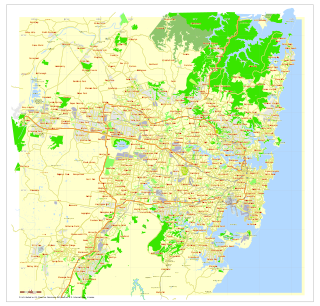
Sydney City in New South Wales, Australia

Sydney is the state capital of New South Wales and the most populous city in Australia and Oceania. Located on Australia's east coast, the metropolis surrounds Port Jackson and extends about 70 km (43.5 mi) on its periphery towards the Blue Mountains to the west, Hawkesbury to the north, the Royal National Park to the south and Macarthur to the south-west. Sydney is made up of 658 suburbs, 40 local government areas and 15 contiguous regions. Residents of the city are known as "Sydneysiders". As of June 2017, Sydney's estimated metropolitan population was 5,131,326, and is home to approximately 65% of the state's population.

Melbourne City in Victoria, Australia

Melbourne is the capital and most populous city of the Australian state of Victoria, and the second most populous city in Australia and Oceania. Its name refers to an urban agglomeration of 9,992.5 km2 (3,858.1 sq mi), comprising a metropolitan area with 31 municipalities, and is also the common name for its city centre. The city occupies much of the coastline of Port Phillip bay and spreads into the hinterlands towards the Dandenong and Macedon ranges, Mornington Peninsula and Yarra Valley. It has a population of approximately 4.9 million, and its inhabitants are referred to as "Melburnians".

Contents

Background

The 2014 heatwave was caused by a High pressure system located over the Tasman sea, pushing cold fronts further south. The arrival of the heatwave could not have come at a worse time; south-eastern New South Wales and Victoria had experienced a generally dry summer and had been receiving less precipitation than average; the high pressure system only added to this problem. Furthermore, the anticipation of an El Nino weather pattern shifted from California during the mid year, which brings drought causing weather, also added to the problem. Despite being titled a 'heatwave', many were pleased with the comfortable weather conditions of around 25°C (77°F) in Sydney, 5 above average for May, but climatologists noted that if the phenomenon had occurred in the Summer, temperatures would have ranged in excess of 35°C (95°F). South Australia, New South Wales and Victoria were mainly affected by the unusual weather.

California State of the United States of America

California is a state in the Pacific Region of the United States. With 39.6 million residents, California is the most populous U.S. state and the third-largest by area. The state capital is Sacramento. The Greater Los Angeles Area and the San Francisco Bay Area are the nation's second and fifth most populous urban regions, with 18.7 million and 8.8 million residents respectively. Los Angeles is California's most populous city, and the country's second most populous, after New York City. California also has the nation's most populous county, Los Angeles County, and its largest county by area, San Bernardino County. The City and County of San Francisco is both the country's second-most densely populated major city after New York and the fifth-most densely populated county, behind only four of the five New York City boroughs.

South Australia

Adelaide recorded a total of 11 days above 20°C (68°F), which was well above the average of 18.9°C (66°F). On May 16, Adelaide registered a temperature of 27.4°C (81°F) which was close to 10 degrees above average and more typical of a summer day. [1] Climatologist Blair Trewin from the Bureau of Meteorology stated that it was the warmest temperature on record this late in Autumn, which dates over 100 years. [2]

Victoria

Much of Victoria recorded temperatures well above the 16.7°C (62°F) average for the time of year. Melbourne recorded 12 consecutive days above 20°C (68°F), beating the previous record of 10 days set in May 1972. [1] [3] Retailers were also caught out as they struggled to sell winter fashion items such as coats, boots, gloves and beanies.

New South Wales

A large proportion of NSW was hit with very low levels of precipitations and numerous days of clear, warm weather. Sydney was the hardest hit out of the 3 capitals. The city smashed previous records set in 1972, achieving 16 days above 22°C (72°F), which is unheard of for May, and recorded a temperature of 27.5°C (82°F) on May 22. The weather blitzed the heatwave life span of around 4 days, stretching longer than a fortnight with cooling temperatures still above average; Doctor Sarah Perkins of the Climate Change Research Centre stating It's actually quite scary, especially if it lasts for two weeks - that's incredible. Sydney received only 25 mm of rain prior and during the heatwave, well below the average of 120.5mm, and the knock on effect resulted in drier soils, sparking fresh debate on the climate change issue and the potential for a bush fire season further enhanced by the chance of an El Nino. Public pools and beaches were also affected by the weather, as they remained open far longer than usual for the public. The heatwave finally ended on May 24, having stretched an astonishing 9 days. However, temperatures still remained quite far above average and the prospect of a warmer than average winter was clear following the warmest year on record;2013. [1] [2] [3] [4] [5]

See also

References