This article is being considered for deletion in accordance with Wikipedia's deletion policy. Please share your thoughts on the matter at this article's entry on the Articles for deletion page. Feel free to improve the article, but the article must not be blanked, and this notice must not be removed, until the discussion is closed. For more information, particularly on merging or moving the article during the discussion, read the guide to deletion.%5B%5BWikipedia%3AArticles+for+deletion%2F2007+Western+North+American+heat+wave+%282nd+nomination%29%5D%5DAFD
Western heat wave of 2007
The 2007 western North American heat wave was a record-breaking event that began in late June 2007. The heat stretched from Mexico to Alberta, Saskatchewan, Manitoba and into northwestern Ontario.[1] The record heat has exacerbated already present record-breaking drought conditions in much of the Western U.S., allowing fires to grow to record-breaking sizes.
A heat wave is a period of excessively hot weather, which may be accompanied by high humidity, especially in oceanic climate countries. While definitions vary, a heat wave is usually measured relative to the usual weather in the area and relative to normal temperatures for the season. Temperatures that people from a hotter climate consider normal can be termed a heat wave in a cooler area if they are outside the normal climate pattern for that area.
Mexico, officially the United Mexican States, is a country in the southern portion of North America. It is bordered to the north by the United States; to the south and west by the Pacific Ocean; to the southeast by Guatemala, Belize, and the Caribbean Sea; and to the east by the Gulf of Mexico. Covering almost 2,000,000 square kilometres (770,000 sq mi), the nation is the fifth largest country in the Americas by total area and the 13th largest independent state in the world. With an estimated population of over 120 million people, the country is the eleventh most populous state and the most populous Spanish-speaking state in the world, while being the second most populous nation in Latin America after Brazil. Mexico is a federation comprising 31 states and Mexico City, a special federal entity that is also the capital city and its most populous city. Other metropolises in the state include Guadalajara, Monterrey, Puebla, Toluca, Tijuana and León.
Alberta is a western province of Canada. With an estimated population of 4,067,175 as of 2016 census, it is Canada's fourth most populous province and the most populous of Canada's three prairie provinces. Its area is about 660,000 square kilometres (250,000 sq mi). Alberta and its neighbour Saskatchewan were districts of the Northwest Territories until they were established as provinces on September 1, 1905. The premier has been Rachel Notley since May 2015.
The combination of conditions forced major freeway closures, animal and human deaths, evacuations, and destruction of property.
Emergency evacuation is the urgent immediate egress or escape of people away from an area that contains an imminent threat, an ongoing threat or a hazard to lives or property.
Much of eastern North America experienced more average conditions through July 2007, with little in the way of prolonged heat waves. However, drought remained a problem in some areas of the east, particularly parts of the southeast.
The 2006–08 Southeastern United States drought was a crippling drought that struck the southeast of the U.S. Several reasons, including an unusually strong Bermuda high pressure and La Niña in the eastern Pacific Ocean were responsible for the drought. 2007 was particularly dry across the region, with rivers and lakes dropping to record-low levels and in some areas, the worst drought in over 500 years.
Record highs
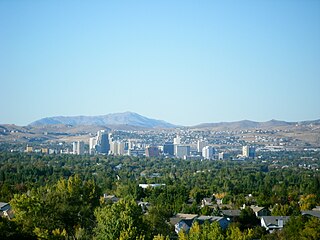
Reno, Nevada, reached 108 °F (42 °C) on July 5 easily breaking the previous record of 100 °F (38 °C).[2]
Reno is a city in the U.S. state of Nevada, located in the western part of the state, approximately 22 miles (35 km) from Lake Tahoe. Known as "The Biggest Little City in the World", Reno is famous for its hotels and casinos. It is the county seat of Washoe County, in the northwestern part of the state. The city sits in a high desert at the foot of the Sierra Nevada and its downtown area occupies a valley informally known as the Truckee Meadows. It is named after Union Major General Jesse L. Reno, who was killed in action at the Battle of South Mountain on Fox's Gap.
At 116 °F (47 °C), Las Vegas, Nevada, was one degree shy of its all-time record set in 2005 and 1942.[2]
St. George, Utah, reached 118 °F (48 °C) on July 5, according to the local weather station as mentioned in the front page of the July 6 edition of The Salt Lake Tribune,[3] which would be the highest temperature ever-recorded in Utah.[2]
St. George is a city in and the county seat of Washington County, Utah, United States. Located in the southwestern part of the state on the Arizona border, near the tri-state junction of Utah, Arizona and Nevada, it is the principal city of the St. George Metropolitan Statistical Area. The city lies in the northeasternmost part of the Mojave Desert, adjacent to the Pine Valley Mountains near the convergence of three distinct geological areas: the Mojave Desert, Colorado Plateau, and Great Basin. The city is 118 miles northeast of Las Vegas and 300 miles south-southwest of Salt Lake City on Interstate 15. The St. George area is well known for its natural environment and proximity to several state and national parks.
The Salt Lake Tribune is a daily newspaper published in the city of Salt Lake City, Utah, with the largest paid circulation in the state. The Tribune, often referred to as just "the Trib," is owned by Paul Huntsman and printed through a joint operating agreement with the Deseret News through the Newspaper Agency Corporation. For almost 100 years it was a family-owned newspaper held by the heirs of U.S. Senator Thomas Kearns. After Kearns died in 1918 the company was controlled by his widow, Jennie Judge Kearns, and then the newspaper's longtime publisher was John F. Fitzpatrick, who started his career as secretary to Senator Kearns in 1913 and remained publisher until his death in 1960. John W. Gallivan, nephew to Mrs. Kearns, joined The Tribune in 1937 and succeeded Fitzpatrick as publisher in 1960 where he remained as Chairman until the merger with TCI, Inc. in 1997.
Firefighters blamed the heat and existing record-breaking drought for dozens of wildfires in the West.
The area was in the midst of an unusual drought; in Los Angeles, California, with only 3.21in(82mm) of precipitation in the entire 2006-2007 rain season, it was, at that time, the driest year on record, receiving less rain than Death Valley in a normal year.[10]
Wildfires, such as the destructive Angora Fire, killed dozens, forced the closure of major freeways, and destroyed homes.
In central Utah, the largest wildfire in state history consumed 283,000 acres (1,150km2) or 468 square miles (114,526 hectares) and forced the closure of I-15 and I-70.[11]
In northeastern Utah a wildfire moving at the speed of 30mph (50km/h) killed three men on a farm.[12]
Portions of suburban Salt Lake City in Herriman were forced to evacuate as fires threatened their homes.
I-80 was closed in northern Nevada as fires burned a combined total of 55 square miles (144 square kilometres) and forced evacuations near Winnemucca.[13]
Damage to wildlife and lifestock
The extreme heat warmed rivers in Yellowstone resulting in the deaths of hundreds of trout.[14]
The high temperatures and drought destroyed crops and stressed cattle in Montana.[15]
This page is based on this Wikipedia article Text is available under the CC BY-SA 4.0 license; additional terms may apply. Images, videos and audio are available under their respective licenses.