1983 Great Britain and Ireland heat wave

Last updated

The 1983 Great Britain and Ireland heat wave was a severe weather event that affected the islands of Great Britain and Ireland, and was once the warmest July on record for the United Kingdom, until it was beaten by the summer of 2006 [1] . Both United Kingdom and Ireland have also experienced low rainfall throughout the month of July [2] .

Great Britain island in the North Atlantic off the north-west coast of continental Europe

Great Britain is an island in the North Atlantic Ocean off the northwest coast of continental Europe. With an area of 209,331 km2 (80,823 sq mi), it is the largest of the British Isles, the largest European island, and the ninth-largest island in the world. In 2011, Great Britain had a population of about 61 million people, making it the world's third-most populous island after Java in Indonesia and Honshu in Japan. The island of Ireland is situated to the west of Great Britain, and together these islands, along with over 1,000 smaller surrounding islands, form the British Isles archipelago.

Ireland Island in north-west Europe, 20th largest in world, politically divided into the Republic of Ireland and Northern Ireland (a part of the UK)

Ireland is an island in the North Atlantic. It is separated from Great Britain to its east by the North Channel, the Irish Sea, and St George's Channel. Ireland is the second-largest island of the British Isles, the third-largest in Europe, and the twentieth-largest on Earth.
Contents

Great Britain

In Great Britain, the heat wave of 1983 was once the warmest July on record until the European heat wave of 2006. The CET Central England Station recorded a daily mean temperature of 19.5 °C (67.1 °F) for the month of July [3] , and a daily mean temperature of 17.07 °C (62.73 °F) for the entire summer of 1983 [4] . Before the heat wave formed, many locations in the English Midlands, East and South East England received less than their average rainfall for the month of June, with only 12 millimetres (0.47 in) of rainfall recorded at London Heathrow in June 1983 [5] .

The Midlands Place in England

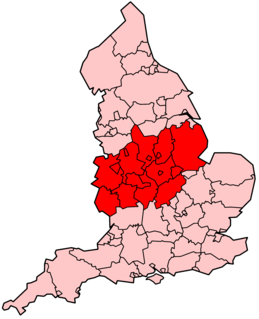
The Midlands is an area of central England that borders the South East, South West, North West, East of England and Yorkshire and the Humber. Its largest city is Birmingham. Broadly corresponding to the early medieval Kingdom of Mercia, it was important in the Industrial Revolution of the 18th and 19th centuries. The Midlands are split between the East Midlands and West Midlands, with East Anglia sometimes included.

East of England Place in England

The East of England is one of nine official regions of England at the first level of NUTS for statistical purposes. It was created in 1994 and was adopted for statistics from 1999. It includes the ceremonial counties of Bedfordshire, Cambridgeshire, Essex, Hertfordshire, Norfolk and Suffolk. Essex has the highest population in the region.

South East England Place in England

South East England is the most populous of the nine official regions of England at the first level of NUTS for statistical purposes. It consists of Berkshire, Buckinghamshire, East Sussex, Hampshire, the Isle of Wight, Kent, Oxfordshire, Surrey and West Sussex. As with the other regions of England, apart from Greater London, the south east has no elected government.

London Heathrow and other locations around Great Britain recorded over five consecutive days with temperatures over 30 °C (86 °F), making it an official heatwave in the United Kingdom [6] . Many locations in Wales, Scotland, South West and Northern England received less than 50% of their average rainfall, with some places even receiving less than 20% [7] .

Heathrow Airport major international airport serving London, England, United Kingdom

Heathrow Airport, also known as London Heathrow, is a major international airport in London, United Kingdom. Heathrow is the second busiest airport in the world by international passenger traffic, as well as the busiest airport in Europe by passenger traffic, and the seventh busiest airport in the world by total passenger traffic. It is one of six international airports serving Greater London. In 2018, it handled a record 80.1 million passengers, a 2.7% increase from 2017 as well as 480,339 aircraft movements, a 4,715 increase from 2017.

Wales Country in northwest Europe, part of the United Kingdom

Wales is a country that is part of the United Kingdom and the island of Great Britain. It is bordered by England to the east, the Irish Sea to the north and west, and the Bristol Channel to the south. It had a population in 2011 of 3,063,456 and has a total area of 20,779 km2 (8,023 sq mi). Wales has over 1,680 miles (2,700 km) of coastline and is largely mountainous, with its higher peaks in the north and central areas, including Snowdon, its highest summit. The country lies within the north temperate zone and has a changeable, maritime climate.

Scotland country in Northwest Europe, part of the United Kingdom

Scotland is a country that is part of the United Kingdom. Sharing a border with England to the southeast, Scotland is otherwise surrounded by the Atlantic Ocean to the north and west, by the North Sea to the northeast and by the Irish Sea to the south. In addition to the mainland, situated on the northern third of the island of Great Britain, Scotland has over 790 islands, including the Northern Isles and the Hebrides.

StationCounty / UAJuly 1983 rainfall amount [8]
Braemar Aberdeenshire 34.4 millimetres (1.35 in)
Cardiff Cardiff 18.0 millimetres (0.71 in)
Chivenor Devon 18.4 millimetres (0.72 in)
Eskdalemuir Dumfries and Galloway 37.4 millimetres (1.47 in)
Leuchars Fife 13.4 millimetres (0.53 in)
Lowestoft Suffolk 15.5 millimetres (0.61 in)
Nairn Highland 09.1 millimetres (0.36 in)
Newton Rigg Cumbria 31.0 millimetres (1.22 in)
Paisley Renfrewshire 28.0 millimetres (1.10 in)
Sutton Bonington Nottinghamshire 28.6 millimetres (1.13 in)
Valley Anglesey 09.3 millimetres (0.37 in)

After the heat wave in July, much of the country received less than 50% of it's average rainfall, with places including parts of the East Midlands, East of England and North East Scotland receiving less than 20% of it's average rainfall. For the month of August, the weather station at Sutton Bonington recorded only 11.5 millimetres (0.45 in) of rainfall [9] , the National Institute of Agricultural Botany in Cambridge recorded only 10.5 millimetres (0.41 in) of rain [10] , Lowestoft received 10.9 millimetres (0.43 in) [11] and Braemar received 22.5 millimetres (0.89 in) of rainfall [12] . After August, Great Britain saw average rainfall in September [13] .

East Midlands Place in England

The East Midlands is one of nine official regions of England at the first level of NUTS for statistical purposes. It consists of Derbyshire, Leicestershire, Lincolnshire, Northamptonshire, Nottinghamshire and Rutland. The region has an area of 15,627 km2 (6,034 sq mi), with a population over 4.5 million in 2011. There are five main urban centres, Derby, Leicester, Lincoln, Northampton and Nottingham. Others include Boston, Skegness, Chesterfield, Corby, Grantham, Hinckley, Kettering, Loughborough, Mansfield, Newark-on-Trent and Wellingborough.

Sutton Bonington village

Sutton Bonington is a village and civil parish lying along the valley of the River Soar in the Borough of Rushcliffe, south west Nottinghamshire, England. The University of Nottingham has a 420 hectares (4.2 km2) site just to the north of the village: Sutton Bonington Campus.

Cambridge City and non-metropolitan district in England

Cambridge is a university city and the county town of Cambridgeshire, England, on the River Cam approximately 50 miles (80 km) north of London. At the United Kingdom Census 2011, its population was 123,867 including 24,506 students. Cambridge became an important trading centre during the Roman and Viking ages, and there is archaeological evidence of settlement in the area as early as the Bronze Age. The first town charters were granted in the 12th century, although modern city status was not officially conferred until 1951.

Ireland

During the heat wave of 1983, the a temperature of 30.8 °C (87.4 °F) was recorded at Shaw's Bridge in Belfast on 12 July, marking the current highest recorded temperature Belfast, and in Northern Ireland [14] . Other temperatures recorded in Belfast during July include 29.7 °C (85.5 °F) at Stormont Castle [15] and 28.6 °C (83.5 °F) at Belfast International Airport [16] . Armagh has obtained a temperature of 30.0 °C (86.0 °F) recorded on 13 July [17] , and has also only received 15.1 millimetres (0.59 in) of rain, which is less than 30% of Armagh's average rainfall in July [18] .

Shaws Bridge, Belfast

Shaw's Bridge is an historic stone arched bridge across the River Lagan in Belfast. It was constructed in 1707, and closed to vehicular access in 1977 after having been replaced by the A55 road bridge, which runs immediately adjacent to it.

Belfast City in the United Kingdom, capital of Northern Ireland

Belfast is a port city in the United Kingdom and the capital city of Northern Ireland, on the banks of the River Lagan on the east coast of Ireland. It is the largest city in Northern Ireland and second largest on the island of Ireland. It had a population of 333,871 in 2015.

Northern Ireland Part of the United Kingdom lying in the north-east of the island of Ireland, created 1921

Northern Ireland is a part of the United Kingdom in the north-east of the island of Ireland, variously described as a country, province or region. Northern Ireland shares a border to the south and west with the Republic of Ireland. In 2011, its population was 1,810,863, constituting about 30% of the island's total population and about 3% of the UK's population. Established by the Northern Ireland Act 1998 as part of the Good Friday Agreement, the Northern Ireland Assembly holds responsibility for a range of devolved policy matters, while other areas are reserved for the British government. Northern Ireland co-operates with the Republic of Ireland in some areas, and the Agreement granted the Republic the ability to "put forward views and proposals" with "determined efforts to resolve disagreements between the two governments".

Many weather stations in Ireland have their current highest July temperature obtained during the heat wave, with some stations recording a temperature over 30 °C (86 °F). The highest temperature likely to be recorded in the Republic of Ireland during the heat wave is 31.4 °C (88.5 °F), recorded on July 13 and 14 at Kilkenny.

Kilkenny City in Leinster, Ireland

Kilkenny is the county town of County Kilkenny in the province of Leinster in south-east Ireland. It is built on both banks of the River Nore. The city is administered by a borough council, which is a level below that of city council in the local government of the state, although the Local Government Act 2001 allows for "the continued use of the description city". The 2016 census gave the total population of Kilkenny as 26,512.

Impacts

In the Republic of Ireland, record breaking temperatures and excessive use of water led to water shortages and hosepipe bans across the nation. The message to civilians by local authorities in the Republic is to "enjoy the water, but don't waste it" [19] . The hot weather in the Republic of Ireland lead to 115 casualties in rural areas, many who are the young and elderly [20] .

References