This article is being considered for deletion in accordance with Wikipedia's deletion policy. Please share your thoughts on the matter at this article's entry on the Articles for deletion page. Feel free to improve the article, but the article must not be blanked, and this notice must not be removed, until the discussion is closed. For more information, particularly on merging or moving the article during the discussion, read the guide to deletion. |
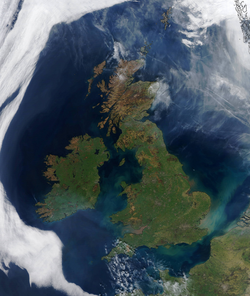
| The United Kingdom cloud-free on 26 March 2012 | ||
|---|---|---|
| Dates | 24 March - 1 April | |
| Areas affected | United Kingdom | |
| Highest temperature | 23.6 °C (74.5 °F) at Aboyne, Aberdeenshire | |
The March 2012 United Kingdom and Ireland heat wave was a period of unseasonable warm weather with temperatures getting above 20 °C (68 °F) in many places. The average temperature for this time of year in the United Kingdom is 10 °C (50 °F). Aboyne, Scotland, recorded a temperature of 23.6 °C (74.5 °F) on 27 March, the highest March temperature in Scotland since records began. [2] For around eight days no clouds were visible for the majority of places in the UK, allowing the sun to shine straight down through the blue sky and induce high air temperatures. The high pressure also meant there was little wind to act as a coolant.
The cause of this heat wave was an area of high pressure anchored over the United Kingdom which was named Harry by the Free University of Berlin. [3] [4] This high-pressure area was kept in position by the jet stream and its associated frontal systems moving to the north of the country. [5]
The Free University of Berlin is a research university located in Berlin, Germany. One of Germany's most distinguished universities, it is known for its research in the humanities and social sciences, as well as in the field of natural and life sciences.
As temperatures soared across the United Kingdom, beaches became crowded and businesses in coastal resorts reported increased sales. [6] However, there were also wildfires in some parts of the UK [7] including one to the south of Dumfries which was started by controlled burning. [8]
Dumfries is a market town and former royal burgh within the Dumfries and Galloway council area of Scotland. It is located near the mouth of the River Nith into the Solway Firth. Dumfries is the traditional county town of the historic county of Dumfriesshire. Dumfries is nicknamed Queen of the South. The nickname has also given name to the town's professional football club. People from Dumfries are known colloquially in the Scots language as Doonhamers.
April, and in fact the rest of 2012 saw a very sudden and drastic turn around. April 2012 became the wettest April on record in much of the UK. This also led on to one of the wettest summers ever recorded in the UK.