
The Thomisidae are a family of spiders, including about 170 genera and over 2,100 species. The common name crab spider is often linked to species in this family, but is also applied loosely to many other families of spiders. Many members of this family are also known as flower spiders or flower crab spiders.

Wasps in the family Pompilidae are commonly called spider wasps, spider-hunting wasps, or pompilid wasps. The family is cosmopolitan, with some 5,000 species in six subfamilies. Nearly all species are solitary, and most capture and paralyze prey, though members of the subfamily Ceropalinae are kleptoparasites of other pompilids, or ectoparasitoids of living spiders.

The Goliath birdeater belongs to the tarantula family Theraphosidae. Found in northern South America, it is the largest spider in the world by mass and body length, and second to the giant huntsman spider by leg span. It is also called the Goliath tarantula or Goliath bird-eating spider; the practice of calling theraphosids "bird-eating" derives from an early 18th-century copper engraving by Maria Sibylla Merian that shows one eating a hummingbird. Despite the spider's name, it rarely preys on birds.

Avicularia is a genus of the family Theraphosidae containing various species of arboreal tarantulas. The genus is native to Panama, the Caribbean and tropical South America. Each species in the genus has very distinguishable pink foot pads.

The Brazilian whiteknee tarantula is a species of tarantula from Brazil that is commonly kept as a pet.

The blue-throated bee-eater is a species of bird in the bee-eater family. They are found throughout southeast Asia in subtropical or tropical mangrove forests. Their diet consists mostly of bees, wasps, and dragonflies. Blue-throated bee-eaters are small with colorful plumage consisting of a red nape, dark green wings, light green breast, and their signature blue throat. Juvenile plumage contain dark green head and wings and light green breasts, only developing their full plumage in adulthood. They have a rich variety of songs and calls, including longcalls which allow them to communicate long distances in the forest.

Acanthoscurria theraphosoides is a species of spider from the family Theraphosidae (tarantulas), found in Peru, Bolivia, Brazil, and French Guiana.

Tarantulas comprise a group of large and often hairy spiders of the family Theraphosidae. As of December 2023, 1,100 species have been identified, with 166 genera. The term "tarantula" is usually used to describe members of the family Theraphosidae, although many other members of the same infraorder (Mygalomorphae) are commonly referred to as "tarantulas" or "false tarantulas". Some of the more common species have become popular in the exotic pet trade. Many New World species kept as pets have setae known as urticating hairs that can cause irritation to the skin, and in extreme cases, cause damage to the eyes.
Hysterocrates gigas is a member of the tarantula family, Theraphosidae found in Cameroon. It is known as the giant baboon spider, Cameroon red baboon spider, or red baboon tarantula.

The Aphonopelma hentzi, also known as Texas brown tarantula, Oklahoma brown tarantula, or Missouri tarantula, is one of the most common species of tarantula living in the Southern United States today. Texas brown tarantulas can grow to leg spans in excess of 10 cm (4 in), and weigh more than 85 g (3 oz) as adults. Their bodies are dark brown, though shades may vary between individual tarantulas. The colors are more distinct after a molt, as with many arthropods.

Acanthoscurria is a genus of tarantulas that was first described by Anton Ausserer in 1871. They are found throughout South America including the countries of Argentina, Bolivia, Brazil, Ecuador, French Guiana, Guyana, Paraguay, Peru, Suriname and Venezuela, plus into the Windward Islands West Indies,.
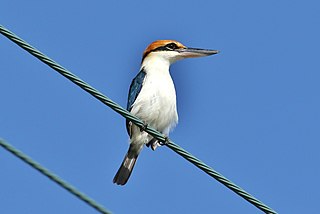
The rusty-capped kingfisher or Palau kingfisher is a species of bird in the family Alcedinidae. It is endemic to Palau. The natural habitat of this species is subtropical or tropical moist lowland forests. It was formerly considered to be a subspecies of the Micronesian kingfisher.

Lasiodora is a genus of tarantulas that was first described by Ludwig Carl Christian Koch in 1850. They are often very large; body lengths of up to 25 centimetres (9.8 in), including the legs, are not unusual.

Theraphosa stirmi is a species of tarantula belonging to the family Theraphosidae. It is known as the burgundy goliath bird eater.

Acanthoscurria gomesiana is a species of tarantula first identified in Brazil in 1923. It is known for producing the gomesin peptides, a class of proteins which have found to have anti-tumour and anti-microbial properties.
Acanthoscurria insubtilis also known as the Bolivian black velvet tarantula, is a spider which was first described by Eugène Simon in 1892. It is found in Bolivia, with some reports also stating in Brazil, though it is mainly in the Bolivian Rainforests.
Acanthoscurria simoensi is a species of tarantula spider found in Guyana, French Guiana, and Brazil, first described from French Guiana in 2000. The species has been traded in the exotic pet hobby as "Para Mongo Zebra” under spurious scientific names such as 'fracta'. The common name partly relates to the colouration where the females of the species have dark bodies with light coloured linear markings on legs. Notably, like in many other tarantulas with strong sexual dimorpsim, adult males of the species have a different general appearance with a more rusty metallic colouration and comparatively weak linear markings on the legs.
Acanthoscurria belterrensis is a species of tarantula native to Brazil. They typically are a dark reddish-brown color and sometimes have a more orange toned abdomen. This species is not recorded to have been kept as pets and does not have much information about it, partially due to its recent discovery in 2014.

Acanthoscurria chacoana, also know as the Bolivian red rump tarantula, is a fast growing, docile tarantula found in Brazil, Bolivia, Paraguay, and Argentina. It is commonly kept as a pet, preferring 70–80% humidity and a horizontally large enclosure, as it is terrestrial. This species of spider does create burrows and is a reddish-brown with tan stripes on its legs.
Acanthoscurria juruenicola is a species of ground dwelling tarantula native to Brazil. Its common name is the Brazilian orange-banded tarantula and it is not often kept as a pet, but it can be given the right conditions. Typically, this species lives in conditions with 65-75% humidity with temperatures ranging from 76 to 85 degrees Fahrenheit. They can get up to 7 inches and, but their sex and environment are factors that can affect their size.


