
The Goliath birdeater belongs to the tarantula family Theraphosidae. Found in northern South America, it is the largest spider in the world by mass and body length, and second to the giant huntsman spider by leg span. It is also called the Goliath tarantula or Goliath bird-eating spider; the practice of calling theraphosids "bird-eating" derives from an early 18th-century copper engraving by Maria Sibylla Merian that shows one eating a hummingbird. Despite the spider's name, it rarely preys on birds.

Avicularia is a genus of the family Theraphosidae containing various species of arboreal tarantulas. The genus is native to Panama, the Caribbean, and tropical South America. Each species in the genus has very distinguishable pink foot pads.
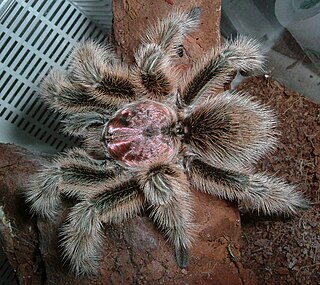
Grammostola is a genus of South American tarantulas that was first described in text by Eugène Louis Simon in 1892. These medium- to large-sized spiders are native to tropical South America, and are usually brown in color, with pinkish or orangish-red hairs. The very docile Chilean rose tarantula is popular as a beginner's spider among tarantula enthusiasts.

Phormictopus is a genus of spiders in the family Theraphosidae (tarantulas) that occurs in the West Indies, mainly Cuba and Hispaniola, with three species probably misplaced in this genus found in Brazil and Argentina.

Acanthoscurria theraphosoides is a species of spider from the family Theraphosidae (tarantulas), found in Peru, Bolivia, Brazil, and French Guiana.

Tarantulas comprise a group of large and often hairy spiders of the family Theraphosidae. As of December 2023, 1,100 species have been identified, with 166 genera. The term "tarantula" is usually used to describe members of the family Theraphosidae, although many other members of the same infraorder (Mygalomorphae) are commonly referred to as "tarantulas" or "false tarantulas". Some of the more common species have become popular in the exotic pet trade. Many New World species kept as pets have setae known as urticating hairs that can cause irritation to the skin, and in extreme cases, cause damage to the eyes.

The Theraphosinae are a large subfamily of Mygalomorphae spiders in the family Theraphosidae found in the Neotropical realm.

Iridopelma is a genus of Brazilian tarantulas that was first described by Reginald Innes Pocock in 1901.

Pachistopelma is a genus of Brazilian tarantulas that was first described by Reginald Innes Pocock in 1901. As of May 2020 it contains two species, found in Brazil: P. bromelicola and P. rufonigrum. They have a straight front eye row and males have a spinose spur on the first tibia. Females have two spermathecae lacking lobes or constrictions that have a slight curvature in the middle.
Acanthoscurria antillensis is a species of large spider, a tarantula in the family Theraphosidae. This species occurs in the Lesser Antilles, hence the specific name "antillensis" meaning "of the Antilles". This species is known in the exotic pet trade as the "Antillean pink patch" tarantula.

Acanthoscurria is a genus of tarantulas that was first described by Anton Ausserer in 1871. They are found throughout South America including the countries of Argentina, Bolivia, Brazil, Ecuador, French Guiana, Guyana, Paraguay, Peru, Suriname and Venezuela, plus into the Windward Islands West Indies,.
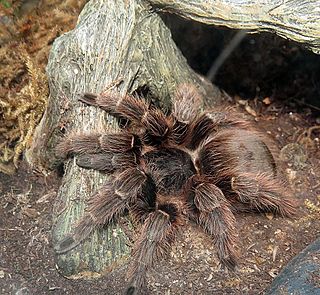
Eupalaestrus is a genus of South American tarantulas that was first described by Reginald Innes Pocock in 1901.
Pterinopelma is a genus of Brazilian tarantulas that was first described by Reginald Innes Pocock in 1901. As of June 2023 it contains two species, found in Brazil: P. felipeleitei and P. vitiosum. It was removed from the synonymy of Eupalaestrus in 2011.

Cyrtopholis is a genus of tarantulas that was first described by Eugène Louis Simon in 1892.
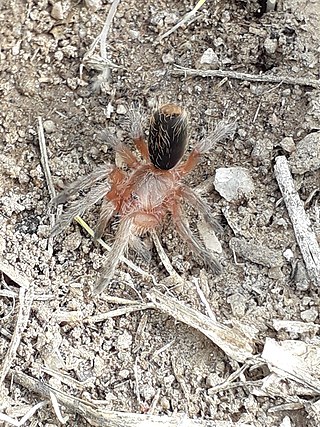
Plesiopelma is a genus of South American tarantulas that was first described by Reginald Innes Pocock in 1901. Plesiopelma species are particularly abundant along mountainous ranges, frequently living under stones. Both males and females live in silk tubes under stones with aggregate spatial distribution. The walls of these tunnels are covered by waterproof silk, protecting them from floods. In addition, there is a uniform saturated microclimate inside the tunnel, which protects the spiders from dehydration.
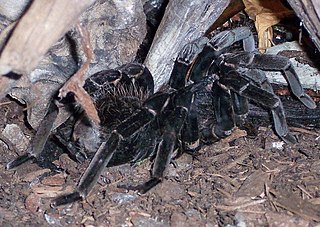
Xenesthis is a genus of tarantulas that was first described by Eugène Louis Simon in 1891. As of February 2024 it contains five species, found in Colombia and Venezuela, though it was previously considered to be found in Panama.
Longilyra is a genus of spiders in the family Theraphosidae. It was first described in 2014 by Gabriel. As of 2017, it contains only one species, Longilyra johnlonghorni, found in El Salvador. This genus differs from the others as it has stridulatory bristles. It is different from those who have them on the same segments such as the Acanthoscurria genus because of the palpal bulb with a very short and acuminate embolus and four short keels, separated tibial apophysis. Females can be separated from the others by the spermathecae with two seminal receptacles with elongated ducts emerging from a common area.
Rick C. West is a Canadian arachnologist and an expert on the taxonomy of tarantula spiders. West was born in Victoria, British Columbia. He has been interested in spiders since childhood, and collected his first tarantula, Aphonopelma eutylenum, at the age of 13. He worked primarily as a Chief Constable for a local Animal Humane Society, but also have been involved with the collecting, breeding, rearing and photography of theraphosid spiders. West has traveled to over 27 countries to document and study them in their environment, has been a host, presenter and co-producer in several tarantula documentaries and has also described several genera and species.
Acanthoscurria insubtilis also known as the Bolivian black velvet tarantula, is a spider which was first described by Eugène Simon in 1892. It is found in Bolivia, with some reports also stating in Brazil, though it is mainly in the Bolivian Rainforests.
Acanthoscurria simoensi is a species of tarantula spider found in Guyana, French Guiana, and Brazil, first described from French Guiana in 2000. The species has been traded in the exotic pet hobby as "Para Mongo Zebra” under spurious scientific names such as 'fracta'. The common name partly relates to the colouration where the females of the species have dark bodies with light coloured linear markings on legs. Notably, like in many other tarantulas with strong sexual dimorpsim, adult males of the species have a different general appearance with a more rusty metallic colouration and comparatively weak linear markings on the legs.
