Ahmad Abdul Qader (born 31 July 1955) is a Bangladeshi Islamic scholar, politician, and writer. He previously served as the Central President of Bangladesh Islami Chhatra Shibir. Following ideological differences with Jamaat-e-Islami Bangladesh, he voluntarily resigned from Chhatra Shibir and later founded the organization Islami Jubo Shibir. He publicly questioned Jamaat-e-Islami’s role during the Bangladesh Liberation War.
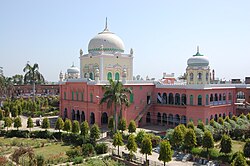
He earned both his bachelor's and master's degrees in Economics from the University of Dhaka and obtained an LLB degree from City Law College, Dhaka. He later pursued advanced Islamic studies under the supervision of renowned scholars. In 2010, he received a PhD in Economics from Islamic University, Bangladesh. Professionally, he serves as a professor of Economics at Darul Ihsan University. He is married and has four daughters and one son.[2]
Political career
Qader has been involved in Islamic movements since his student life. He served as the Central President of Bangladesh Islami Chhatra Shibir. In 1982, when Chhatra Shibir was declared an affiliated organization of Jamaat-e-Islami, ideological disagreements led him to resign voluntarily. In 1983, he founded Islami Jubo Shibir and became its founding president.
In 1984, he was one of the initiators and a central committee member of the Combined Struggle Council led by Muhammadullah Hafezzi, formed by 13 political parties. In 1987, he was among the founders of the Islamic Constitutional Movement (now Islami Andolan Bangladesh). On 8 December 1989, the then Khelafat Movement and Islami Jubo Shibir merged to form Bangladesh Khelafat Majlis, with Abdul Gaffar as Ameer and Masud Khan as Secretary-General.
Until 1996, Qader served as the founding Joint Secretary-General of Bangladesh Khelafat Majlis. He was also a liaison committee member of the Four Party Alliance formed in 2001 and served as Acting Secretary-General of Islami Oikya Jote. From 1996 to 2004, he held the position of Vice President in both Islami Oikya Jote and Bangladesh Khelafat Majlis.
In 2005, Bangladesh Khelafat Majlis split into two factions for policy reasons. Since then, he has continuously served as Secretary-General of Khelafat Majlis. On 15 November 2020, he was elected Nayeb-e-Ameer of Hefazat-e-Islam Bangladesh.[3]
In April 2021, he was arrested in connection with cases filed against Hefazat-e-Islam leaders following incidents in 2013 and 2021.[4]
Publications
Qader has authored a total of 35 books, of which 27 have been published:[5]
Sonali Path
Islam and the Solution to Poverty
Civilizational Crisis: A Guideline
Liberation, Peace and Progress
Truth, Beauty, Revolution and Youth
Materialist Civilization at the Edge of Decline
Khilafah: Principles and Characteristics
Muslim Unity and Solidarity
Islam and Poverty Alleviation
Fundamentalism
The Life and Ideals of Prophet Muhammad in the Contemporary Context
What Is Jihad and Why?
Islamic Movement
Islamic Movement and the Struggle of the Oppressed
Why Is the Establishment of an Islamic State Necessary?
Islamic Revolution
Islamic Revolution: Path and Method
Mass Movement for an Islamic Revolution
Islamic Movement and the Ulama
The Ideal Worker
The Ideal Organization
The Path of Faith Stained with Blood
Nation, Language, Culture and Independence
Khilafah System in the Modern Era
Religion and Secularism
The Muslim World: Society, Politics and Islam
New Crusade, New Jihad
Forthcoming
Feminism: Science and Islam
World Peace, Welfare and Islam
He has also published over one hundred articles and more than ten research papers. Notable conference papers include:
White Paper: 2000 Days of Fundamentalist Communal Terrorism in Bangladesh. Dhaka: People’s Commission on Investigation of Fundamentalist and Communal Terrorism. 2022. p.101.
This page is based on this Wikipedia article Text is available under the CC BY-SA 4.0 license; additional terms may apply. Images, videos and audio are available under their respective licenses.