
Lamiinae, commonly called flat-faced longhorns, are a subfamily of the longhorn beetle family (Cerambycidae). The subfamily includes over 750 genera, rivaled in diversity within the family only by the subfamily Cerambycinae.

Desmiphorini is a tribe of longhorn beetles of the subfamily Lamiinae.
Athylia is a genus of beetles in the family Cerambycidae, containing the following species:
Neosybra is a genus of beetles in the family Cerambycidae, containing the following species:
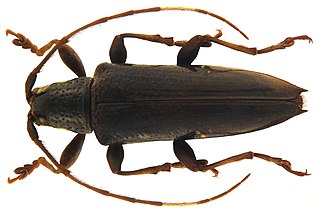
Parepilysta is a genus of beetles in the family Cerambycidae, containing the following species:

Jordanoleiopus is a genus of beetles in the family Cerambycidae, containing the following species:
Miaenia is a genus of beetles in the family Cerambycidae, containing the following species:

Hippopsicon is a genus of beetles in the family Cerambycidae, containing the following species:
Sthenopygus medioalbus is a species of beetle in the family Cerambycidae, and the only species in the genus Sthenopygus. It was described by Breuning in 1938.
Amblymora (=Australothelais) is a genus of longhorn beetles of the subfamily Lamiinae, containing the following species:
Mimexocentrus medioalbus is a species of beetle in the family Cerambycidae. It was described by Breuning in 1957.
Anaches is a genus of longhorn beetles of the subfamily Lamiinae. The genus is distributed in South, Southeast, and East Asia, from India and Nepal eastward to China and Taiwan.

Sthenias is a genus of flat-faced longhorns in the beetle family Cerambycidae. There are more than 20 described species in Sthenias, found mainly in Sub-Saharan Africa and southern Asia.
Astathes nitens is a species of beetle in the family Cerambycidae. It was described by Johan Christian Fabricius in 1801. It is known from Malaysia, Java, Sumatra and Thailand.
Plaxomicrus ellipticus is a species of beetle in the family Cerambycidae. It was described by Thomson in 1857.
Anaches dorsalis is a species of beetle in the family Cerambycidae. It was described by Francis Polkinghorne Pascoe in 1858. It is found in India, Nepal, Bangladesh, China, Thailand, Laos, and Vietnam.
Anaches wenhsini is a species of beetle in the family Cerambycidae. It was described in 2013. It is endemic to Taiwan.
Anaches yitingi is a species of beetle in the family Cerambycidae. It was described in 2013. It is endemic to Taiwan.
Anaches cylindricus is a species of beetle in the family Cerambycidae. It was described by Judson Linsley Gressitt in 1939. It is endemic to southeastern China.
Nupserha apicata is a species of beetle in the family Cerambycidae. It was described by Léon Fairmaire in 1891.
