
Chrysobalanaceae is a family of flowering plants, consisting of trees and shrubs in 27 genera and about 700 species of pantropical distribution with a centre of diversity in the Amazon. Some of the species contain silica in their bodies for rigidity and so the mesophyll often has sclerenchymatous idioblasts. The widespread species Chrysobalanus icaco produces a plum-like fruit and the plant is commonly known as the coco plum.

The crimson-bellied woodpecker is a species of bird in subfamily Picinae of the woodpecker family Picidae. It is found in Bolivia, Colombia, Ecuador, and Peru.

The northeast African mole-rat is a species of rodent in the family Spalacidae and is found in Ethiopia, Somalia, and northwest Kenya. Its natural habitats are subtropical or tropical moist montane forests, dry savanna, high-altitude shrubland and grassland. It lives a solitary existence underground and produces a small litter of pups twice a year, in the two rainy seasons. Some taxonomic authorities lump this species, along with a number of others in the genus, in which case the English name East African mole-rat is used.

Anisoptera costata is an endangered species of plant in the family Dipterocarpaceae. The specific epithet costata means "ribbed", referring to the prominent venation of the leaf blade. A huge emergent tree up to 65 m high, it is found in evergreen and semi-evergreen lowland tropical seasonal forests of Indo-Burma and in mixed dipterocarp forests of Malesia.
Anisoptera grossivenia is a tree in the family Dipterocarpaceae, native to Borneo. The specific epithet grossivenia means "veined like unripe fig", referring to the purple veins of the leaf.

Anisoptera laevis is a tree in the family Dipterocarpaceae. The specific epithet laevis means "smooth", referring to the leaves.
Anisoptera marginata is a tree in the family Dipterocarpaceae. The specific epithet marginata means "bordered", referring to the leaf veins.
Anisoptera reticulata is a tree in the family Dipterocarpaceae. The specific epithet reticulata means "netted", referring to the leaf veins.
Atuna cordata is a tree in the Atuna genus of the family Chrysobalanaceae. The specific epithet cordata is from the Latin meaning "heart-shaped", referring to the leaf base.

Maranthes corymbosa is a tree in the family Chrysobalanaceae. The specific epithet corymbosa is from the Greek meaning "cluster", referring to the clustered inflorescences.
Parinari argenteo-sericea is a tree of Borneo in the family Chrysobalanaceae. The specific epithet argenteo-sericea is from the Latin meaning "silvery silky", referring to the pubescence of the inflorescence and flowers.
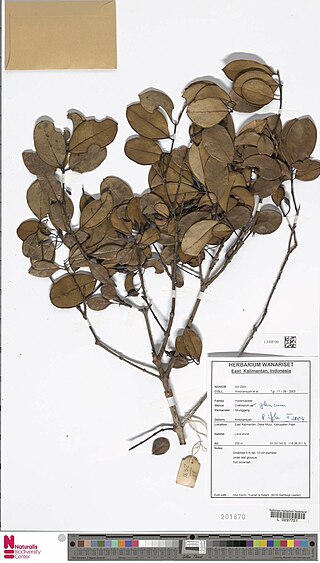
Cratoxylum glaucum is a plant in the family Hypericaceae. The specific epithet glaucum is from the Latin meaning 'blue-green', referring to the colour of the leaf underside.
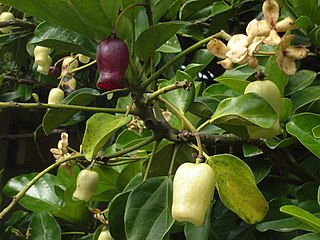
Atuna excelsa subsp. racemosa, synonym Atuna racemosa, is a tree in the family Chrysobalanaceae. The epithet racemosa is from the Latin meaning 'clustered', referring to the inflorescence. The tree is widely known as tabon-tabon in the Philippines, where the fruits have been traditionally used for the preparation of kinilaw for almost a thousand years.
Lithocarpus blumeanus is a tree in the beech family Fagaceae. It is named for the German-Dutch botanist Carl Ludwig Blume.
Lithocarpus ewyckii is a tree in the beech family Fagaceae. It is named for D.J. van Ewijck van Oostbroek en De Built of the Dutch Colonial Service.
Lithocarpus gracilis is a tree in the beech family Fagaceae. The specific epithet gracilis means 'slender', referring to the twigs.
Lithocarpus hystrix is a tree in the beech family Fagaceae. The specific epithet hystrix means 'spiny', referring to the cupule.
Lithocarpus leptogyne is a tree in the beech family Fagaceae. The specific epithet leptogyne is from the Greek, referring to the slender female flower.
Angelesia is a genus of flowering plants belonging to the family Chrysobalanaceae.

Chrysophyllum splendens is a plant in the family Sapotaceae, native to Brazil.


