Architecture of rajputana

Last updated
Chandramahal in City Palace, Jaipur, built by Kachwaha Rajputs. Pritam niwas with.jpg
Chandramahal in City Palace, Jaipur, built by Kachwaha Rajputs.
Jal Mahal, Jaipur. Jal Mahal.jpg
Jal Mahal, Jaipur.
City Palace, Udaipur. Udaipur City Palace.jpg
City Palace, Udaipur.
Chittor Fort Chittorgarh fort.JPG
Chittor Fort

Rajput Architecture is a architectural style notable for the forts and palaces of the many Rajput rulers, which are popular tourist attractions, many of the Rajput forts are UNESCO World Heritage Site.

Contents

Rajput Architecture represents different types of buildings, which may broadly be classed either as secular or religious. The secular buildings are of various scales. These include temples, forts, stepwells, gardens, and palaces. The forts were specially built for defense and military purposes due to the Islamic invasions. The Mughal architecture greatly influenced indigenous Rajput styles of art and architecture. [1]

Rajput Architecture continued well into the 20th and 21st centuries, as the rulers of the princely states of British India commissioned vast palaces and other buildings, such as the Albert Hall Museum, Lalgarh Palace, and Umaid Bhawan Palace. These usually incorporated European styles as well, a practice which eventually led to the Indo-Saracenic style. [2]

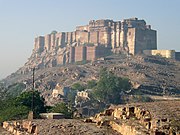
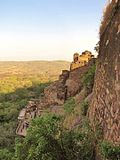
The Hill Forts of Rajasthan (Amer, Chittor, Gagron, Jaisalmer, Kumbhalgarh, Ranthambore), a group of six forts built by various Rajput kingdoms and principalities during the medieval period are among the best examples of Rajput Architecture. The ensemble is also a UNESCO World Heritage Site. Other forts include the Mehrangarh Fort and Jaigarh Fort.

Rajasthan

Forts, Palaces and Temples

Zorawar Singh Gate of City wall of Jaipur Jaipur 03-2016 13 Jorawar Singh Gate.jpg
Zorawar Singh Gate of City wall of Jaipur
Entrance eastern facade of the Junagarh Fort, Bikaner Junagarth Fort, Bikaner.jpg
Entrance eastern façade of the Junagarh Fort, Bikaner

The Hill Forts of Rajasthan (Amer, Chittor, Gagron, Jaisalmer, Kumbhalgarh, Ranthambore), a group of six forts built by various Rajput kingdoms and principalities during the medieval period are among the best examples of Rajput Architecture. The ensemble is also a UNESCO World Heritage Site. Other forts include the Mehrangarh Fort and Jaigarh Fort.

The walled city of Jaipur was formed in 1727 by Kacchwaha Rajput ruler Jai Singh II, and is "a unique example of traditional Hindu town planning", [2] following the precepts set out in much Hindu texts.  Subsequently, the City Palace, Hawa Mahal, Rambagh Palace, Jal Mahal and Albert Hall Museum were also built. Udaipur also has several palaces, including the Bagore-ki-Haveli, now a museum, built by an 18th-century chief minister.

The rulers of the princely states of Rajputana continued the tradition of building elaborate palaces almost until independence, with examples such as the Lalgarh Palace in Bikaner, Monsoon Palace in Udaipur, and Umaid Bhawan Palace in Jodhpur.  Many of these are in versions of Indo-Saracenic architecture, often using European architects. [2]

Cenotaphs

Some of the Ahar Cenotaphs outside Udaipur Ahar Cenotaphs.JPG
Some of the Ahar Cenotaphs outside Udaipur

A number of the Rajput dynasties built groups of cenotaph memorials for their members, mostly using the chatri form, and often at the traditional site for cremations. These include the Ahar Cenotaphs outside Udaipur, and Bada Bagh near Jaisalmer. Individual examples include the Jaswant Thada at Jodphur, and Chaurasi Khambon ki Chhatri, Bundi; there are many others.

Gujarat

Rani ki vav, Patan, Gujarat, 11th century Rani ki vav1.jpg
Rani ki vav, Patan, Gujarat, 11th century

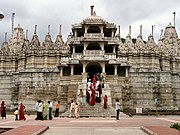
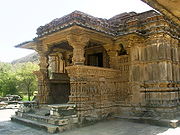
Māru-Gurjara architecture, or Solaṅkī style is a distinctive style that began in Rajputana and neighbouring Gujarat around the 11th century by the Solanki Rajputs. Examples of Solanki Rajput architecture include Taranga Jain temple, Rudra Mahalaya Temple, and Modhera Sun Temple. The Dilwara Jain Temples of Mount Abu built between the 11th and 13th centuries CE , The Rani ki vav was also built during this period. [3] [2]

The small but richly-carved Hindu Ambika Mata temple in Jagat, built before 960,and The five Kiradu temples, of the 11th or 12th centuries are  an example of the Pratihar Rajput style. [4]   The Jagdish Temple, Udaipur (completed 1651) is an example of a Hindu temple using the Māru-Gurjara style at a late date; in this case a commission of Jagat Singh I, ruler of Mewar. [5] [2] On the exteriors, this style is distinguished from other north Indian temple styles of the period

that the external walls of the temples have been structured by increasing numbers of projections and recesses, accommodating sharply carved statues in niches. These are normally positioned in superimposed registers, above the lower bands of moldings. The latter display continuous lines of horse riders, elephants, and kīrttimukhas. Hardly any segment of the surface is left unadorned.

The main shikhara tower usually has many urushringa subsidiary spirelets on it, and two smaller side-entrances with porches are common in larger temples. [6]

Madhya Pradesh

Teli ka Mandir was built inside the Gwalior Fort by the Pratihara Rajput ruler Mihira Bhoja. Teli ka mandir fort Gwalior - panoramio - Gyanendrasinghchauha... (1).jpg
Teli ka Mandir was built inside the Gwalior Fort by the Pratihara Rajput ruler Mihira Bhoja.
Khajuraho Group of Monuments were built by Chandela Rajputs Khajuraho.KandariyaMahadeva.jpg
Khajuraho Group of Monuments were built by Chandela Rajputs
Gwalior Fort Gwalior Fort Palace.JPG
Gwalior Fort
Jahangir Mahal was built by Vir Singh Deo as a symbol of welcome to the Mughal emperor Jahangir. OrchhaPalace.jpg
Jahangir Mahal was built by Vir Singh Deo as a symbol of welcome to the Mughal emperor Jahangir.

The Khajuraho Group of Monuments were built by the Chandela Rajput rulers from 885 AD to 1050 AD. [9]

The Gwalior Fort is a hill fort near Gwalior. The fort has existed at least since the 10th century, and the inscriptions and monuments found within what is now the fort campus indicate that it may have existed as early as the beginning of the 6th century. The fort is considered among the finest of Rajput architecture. [10] Most part of the present day fort was built by Man Singh Tomar, the Rajput king who ruled the region from 1486 to 1516. [11]

The Orchha state was founded in 1531 (the 16th century AD) [12] by the Bundela Rajput chief, Rudra Pratap Singh, [13] who became the first King of Orchha, (r. 1501-1531) and also built the Fort of Orchha. [14] The Chaturbhuj Temple was built during the reign of Mughal emperor Akbar, by the queen of Orchha, Ganesh Kunwar, [15] while Raj Mandir was built by 'Raja Madhukar Shah' during his reign, 1554 to 1591. [16] [17] The Jahangir Mahal was built in 17th century by Vir Singh Deo as a symbol of welcome to the Mughal emperor Jahangir.

The Singorgarh fort was built by Raja Belo from the Chandela dynasty of Mahoba. [18]

Uttar Pradesh

Rani Mahal, Kalinjar Fort Panoramic view of Rani Mahal Kalinjar fort.jpg
Rani Mahal, Kalinjar Fort
Sun Temple, Mahoba district Suntemp.jpg
Sun Temple, Mahoba district

Many Rajput dynasties ruled over Uttar Pradesh in the medieval era. Many forts, palaces and temples were built by the Rajputs. The Kalinjar Fort was built by the Chandela Rajput dynasty in the 10th century. [19] Built on a rocky hill, the fort was also used by the Solankis of Rewa. [19] The Jaichandra fort was built by the Rathore Rajputs of Kannauj.

The Jhansi Fort is attributed to the Bundela Rajput ruler Raja Bir Singh Ju Deo. [20] [21] The Sun temple and forts of Charkhari and Mangal Garh in the Mahoba district were built by the Chandela rulers of Bundelkhand. [22] [23]

Pakistan

Derawar Fort in Cholistan, an example of Rajput architecture Derawar Fort, Bahawalpur I.jpg
Derawar Fort in Cholistan, an example of Rajput architecture

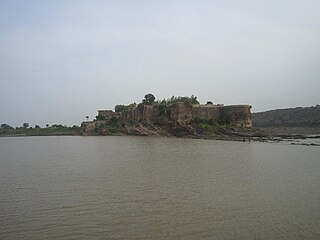
The forts of Derawar and Umerkot were built by Hindu Rajput rulers during the medieval era, and are examples of early Rajput architecture.

Related Research Articles

Orchha Town in Madhya Pradesh, India

Orchha is a town in Niwari district of Madhya Pradesh state, India. The town was established by rajput ruler Rudra Pratap Singh some time after 1501, as the seat of an eponymous former princely state of covering parts of central & north India, in the Bundelkhand region. Orchha lies on the Betwa River, 80 km from Tikamgarh & 15 km from Jhansi in Uttar Pradesh.

Mahoba City in Uttar Pradesh, India

Mahoba is a city in Mahoba District of the Indian state of Uttar Pradesh in the Bundelkhand region, well known for the 9th century granite Sun temple built in Pratihara style. It is also well known for the 24 rock-cut Jain tirthankara image on Gokhar hill. Mahoba is known for its closeness to Khajuraho, Lavkushnagar and other historic places like Kulpahar, Charkhari, Kalinjar, Orchha, and Jhansi. The town is connected with railways and state highways.

Chandelas of Jejakabhukti Royal Indian dynasty

The Chandelas of Jejakabhukti were a Rajput dynasty in Central India. They ruled much of the Bundelkhand region between the 9th and the 13th centuries.

Kumbhalgarh Fort at Rajsamand District of Rajasthan

Kumbhalgarh also known as the Great Wall of India is a Mewar fortress on the westerly range of Aravalli Hills, in the Rajsamand district near Udaipur of Rajasthan state in western India. It is the second-longest wall of the world after the Great Wall of China. It is a World Heritage Site included in Hill Forts of Rajasthan. It was built during the 15th century by Rana Kumbha.

Tikamgarh City in Madhya Pradesh, India

Tikamgarh is a town and a tehsil in Tikamgarh district in the Indian state of Madhya Pradesh. The city serves as a district headquarters. The earlier name of Tikamgarh was Tehri consisting of three hamlets, forming a rough triangle. In Tikamgarh town there is locality still known as 'Purani Tehri'. Until Indian independence in 1947, Tikamgarh, formerly called Tehri, was part of the kingdom of Orchha, which was founded in the 16th century by the Bundeli chief Rudra Pratap Singh, who became the first King of Orchha. In 1783 the capital of the state was moved to Tehri, about 40 miles (64 km) south of Orchha, which was home to the fort of Tikamgarh, and the town eventually took the name of the fort. The district is famous for the old fort of Kundar known as Garh Kundar, which was built by Khangars and remained the capital of Khangar rulers from 1180 to 1347.

Amber Fort UNESCO World Heritage Site In India

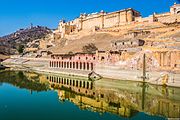
Amer Fort or Amber Fort is a fort located in Amer, Rajasthan, India. Amer is a town with an area of 4 square kilometres (1.5 sq mi) located 11 kilometres (6.8 mi) from Jaipur, the capital of Rajasthan. The town of Amer and the Amber Fort were originally built by Raja Man Singh and additions were, later, made by Sawai Jai Singh. Located high on a hill, it is the principal tourist attraction in Jaipur. Amer Fort is known for its artistic style elements. With its large ramparts and series of gates and cobbled paths, the fort overlooks Maota Lake, which is the main source of water for the Amer Palace.

Kulpahar City in Uttar Pradesh, India

Kulpahar is a city in Mahoba district in the Indian state of Uttar Pradesh. It is a historical town in the Bundelkhand region. Before 11 Feb 1995 Kulpahar was a Tehsil of Hamirpur District. On 11 Feb 1995 Mahoba District was carved out of Hamirpur, and Kulpahar is now a part of the Mahoba District. Kulpahar is the largest Subdivision of Uttar Pradesh. Kulpahar is known for its closeness to Khajuraho and other historic places like Mahoba, Charkhari, Kalinjar Rath, Orchha, and Jhansi. This town holds relics of temples and man-made water bodies of the Chandela Dynasty

Chittorgarh Fort Historic fort in Rajasthan, India

The Chittorgarh Fort also known as Chittorgarh or Chittor Fort is one of the largest forts in India. It is a UNESCO World Heritage Site. The fort was the capital of Mewar and is located in the present-day town of Chittorgarh. It sprawls over a hill 180 m (590.6 ft) in height spread over an area of 280 ha above the plains of the valley drained by the Berach River. The fort covers 65 historic structures, which include four palaces, 19 large temples, 20 large water bodies, 4 memorials and a few victory towers.

Junagarh Fort Fort in Bikaner, Rajasthan, India

Junagarh Fort is a fort in the city of Bikaner, Rajasthan, India. The fort was originally called Chintamani and was renamed Junagarh or "Old Fort" in the early 20th century when the ruling family moved to Lalgarh Palace outside the fort limits. It is one of the few major forts in Rajasthan which is not built on a hilltop. The modern city of Bikaner has developed around the fort.

Jaisalmer Fort Fort in Jaisalmer, Rajasthan, India

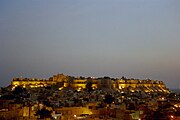
Jaisalmer Fort is situated in the city of Jaisalmer, in the Indian state of Rajasthan. It is believed to be one of the very few "living forts" in the world, as nearly one fourth of the old city's population still resides within the fort. For the better part of its 800-year history, the fort was the city of Jaisalmer. The first settlements outside the fort walls, to accommodate the growing population of Jaisalmer, are said to have come up in the 17th century.
Architecture of Rajasthan Architecture in the Indian state of Rajasthan

The architecture of the Indian state of Rajasthan has usually been a regional variant of the style of Indian architecture prevailing in north India at the time. Rajasthan is especially notable for the forts and palaces of the many Rajput rulers, which are popular tourist attractions.

Chaturbhuj Temple (Orchha)

Chaturbhuj Temple, dedicated to Vishnu, is situated at Orchha in Madhya Pradesh, India. The name Chaturbhuj is a combination of 'chatur' meaning "four" and 'bhuj' meaning "arms" which literally translates to "one who has four arms" and refers to Rama an Avatar of Vishnu. The temple has a complex multi-storied structural view which is a blend of temple, fort and palace architectural features.

Culture of Rajasthan Overview of Rajasthans culture

Rajasthan has many beautiful artistic and cultural traditions which reflect the ancient Indian way of life. Rajasthan is also called "Land of Kings". It has many tourist attractions and good facilities for tourists. This historical state of India attracts tourists and vacationers with its rich culture, tradition, heritage, and monuments. It has also some wildlife sanctuaries and national parks.

Tourism in Rajasthan

Rajasthan is one of the most popular tourist destinations in India, for both domestic and international tourists. Rajasthan attracts tourists for its historical forts, palaces, art and culture with its slogan "Padharo mhare desh', now its changed. Every third foreign tourist visiting India travels to Rajasthan as it is part of the Golden Triangle for tourists visiting India.

Art of Rajasthan

Apart from the architecture of Rajasthan, the most notable forms of the visual art of Rajasthan are architectural sculpture on Hindu and Jain temples in the medieval era, in painting illustrations to religious texts, beginning in the late medieval period, and post-Mughal miniature painting in the Early Modern period, where various different court schools developed, together known as Rajput painting. In both cases, Rajasthani art had many similarities to that of the neighbouring region of Gujarat, the two forming most of the region of "Western India", where artistic styles often developed together.

Hill Forts of Rajasthan UNESCO World Heritage Site in northern India

The North Western Indian State of Rajasthan has over one hundred fortifications on hills and mountainous terrain. Six Hill Forts of Rajasthan, spread across Rajasthan state in northern India, have been clustered as a series and designated UNESCO World Heritage Site. The ‘Hill Forts of Rajasthan’ was initially submitted to the UNESCO as a serial property formed by five Rajput forts in the Aravalli Range, and were built and enhanced between the 5th and 18th centuries CE by several Rajput kings of different kingdoms. The UNESCO series has been increased to six forts. They consist of:

  1. Chittor Fort at Chittorgarh
  2. Kumbhalgarh Fort at Kumbhalgarh
  3. Ranthambore Fort at Sawai Madhopur
  4. Gagron Fort at Jhalawar
  5. Amer Fort at Jaipur
  6. Jaisalmer Fort at Jaisalmer
Gagron Fort Fort in Jhalawar, Rajasthan, India

Gagron Fort is a hill and water fort and is situated in Jhalawar district of Rajasthan, in the Hadoti region of India. It is an example of a hill and water fort. The fort was built by Bijaldev Singh Dod in the twelfth century. Later, the fort has also been controlled by Sher Shah and Akbar. The fort is constructed on the confluence of Ahu River and Kali Sindh River. The fort is surrounded by water on three sides and a moat on the forth side and hence earned the name Jaladurg . It was designated a UNESCO world heritage site in 2013 as a part of Hill Forts in Rajasthan.

Orchha Fort complex Historical monument site in Orchha, Madhya Pradesh, India

The Orchha Fort complex, which houses a large number of ancient monuments consisting of the fort, palaces, temple, and other edifices, is located in the Orchha town in the Indian state of Madhya Pradesh. The fort and other structures within it were built by the Bundela Rajputs starting from the early 16th century by King Rudra Pratap Singh of the Orchha State and others who followed him.

References

  1. Kossak, Steven; Watts, Edith Whitney (2001). The Art of South and Southeast Asia: A Resource for Educators. Metropolitan Museum of Art. ISBN   9780870999925.
  2. 1 2 3 4 5 Michell, George (1990), The Penguin Guide to the Monuments of India, Volume 1: Buddhist, Jain, Hindu, 1990, Penguin Books, pg -288-301 ISBN   0140081445
  3. Rahman, Azera Parveen (2019-03-16). "Make them well again: trying to save Gujarat's ancient stepwells". The Hindu. ISSN   0971-751X.
  4. Michell, 295-96
  5. Michell, George (1990), The Penguin Guide to the Monuments of India, Volume 1: Buddhist, Jain, Hindu, 1990, Penguin Books, pg -311 ISBN   0140081445
  6. Hegewald, Julia A. B. (2011). "The International Jaina Style? Māru-Gurjara Temples Under the Solaṅkīs, throughout India and in the Diaspora". Ars Orientalis. 45 (20191029). doi: 10.3998/ars.13441566.0045.005 . ISSN   2328-1286.
  7. A History of India from the Earliest Times to the Present Day - Page 85
  8. K. D. Bajpai (2006). History of Gopāchala. Bharatiya Jnanpith. p. 31. ISBN   978-81-263-1155-2.
  9. 1 2 Explore India: The Official Newsletter of the Ministry of Tourism Quote: "The temples of Khajuraho are India's unique gift to the world , representing paean to life , love and joy ; perfect in execution ... in stone , testifying to the craftsman's artistry and the pote extraordinary breadth of vision of the Chandela Rajputs."
  10. Textbook of Indian history and culture
  11. Last Spring: The Lives and Times of the Great Mughals
  12. Orchha Tikamgarh district Official website.
  13. Sen, Sailendra (2013). A Textbook of Medieval Indian History. Primus Books. p. 187. ISBN   978-9-38060-734-4.
  14. Mausoleum of Raja Rudra Pratap, British Library.
  15. Orchha Archived 7 February 2009 at the Wayback Machine British Library.
  16. "UQconnect, The University of Queensland" . Retrieved 23 July 2016.
  17. Raj Mandir Archived 12 January 2012 at the Wayback Machine British Library.
  18. Gbooks Quote: "According to Sir William Sleeman, the fort of Singorgarh was built by Rájá Belo, one of the Chandel Rájás of Mahoba."
  19. 1 2 Kalinjar Fort Google Books
  20. Jhansi Fort - Govt of Uttar Pradesh
  21. Indian Stories: Images and Thoughts
  22. चरखारी : बुन्देलखण्ड का काश्मीर
  23. On World Heritage Day, Mahoba’s Sun Temple in shadow of ignorance The Times of India 18 April 2018