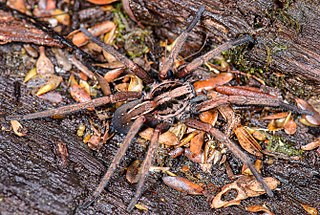
Huntsman spiders, members of the family Sparassidae, are known by this name because of their speed and mode of hunting. They also are called giant crab spiders because of their size and appearance. Larger species sometimes are referred to as wood spiders, because of their preference for woody places. In southern Africa the genus Palystes are known as rain spiders or lizard-eating spiders. Commonly they are confused with baboon spiders from the Mygalomorphae infraorder, which are not closely related.

Desidae is a family of spiders, some of which are known as intertidal spiders. The family is named for the genus Desis, members of which live in a very unusual location — between the tides. The family has been reevaluated in recent years and now includes inland genera and species as well, such as Badumna and Phryganoporus. In 2017, the family Amphinectidae was merged into Desidae. The family Toxopidae has been separated off. Those intertidal spiders that are truly marine commonly live in barnacle shells, which they seal up with silk; this allows them to maintain an air bubble during high tide. They emerge at night to feed on various small arthropods that live in the intertidal zone.
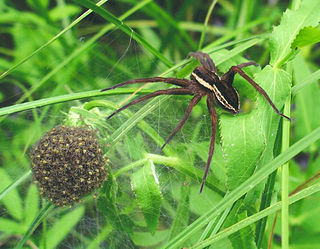
Dolomedes is a genus of large spiders of the family Pisauridae. They are also known as fishing spiders, raft spiders, dock spiders or wharf spiders. Almost all Dolomedes species are semiaquatic, with the exception of the tree-dwelling D. albineus of the Southeastern United States. Many species have a striking pale stripe down each side of the body.
Omoedus is a spider genus of the Salticidae family.

Opisthoncus is a spider genus of the Salticidae family. Many Australian species are as yet undescribed.

Zenodorus is a genus of the jumping spiders distributed from the Moluccas to Australia, including several islands of the Pacific. It was once considered a junior synonym of Omoedus, but this was later rejected. At least one species, Z. orbiculatus, specializes on hunting ants.

Idiopidae, also known as armored trapdoor spiders, is a family of mygalomorph spiders first described by Eugène Simon in 1889. They have a large body similar to tarantulas.

Diaea is a genus of crab spiders first described by Tamerlan Thorell in 1869. Most species are found in specific locations except for D. livens, which occurs both in the United States and D. dorsata, which has a palearctic distribution. Adults are 5 millimetres (0.20 in) to 7 millimetres (0.28 in) and tend to hide in and around vegetation, especially flowers, where their color allows them to blend in to their surroundings.

Deinopis, also known as net-casting spiders, gladiator spiders and ogre-faced spiders, is a genus of net-casting spiders that was first described by W. S. MacLeay in 1839. Its distribution is widely tropical and subtropical. They catch their prey using a specially spun "net". The name is derived from the Greek δεινός (deinos), meaning "fearful", and opis, meaning "appearance", referring to their ogre-like faces. The spelling "Dinopis" is also found, but is regarded as an "unjustified emendation".

Badumna is a genus of intertidal spiders that was first described by Tamerlan Thorell in 1890. They are harmless spiders that can be found around human structures and buildings. They are darkly colored, usually with a lighter colored pattern on the abdomen. The most well-known species is B. insignis, also known as the "black house spider" or "black window spider".

Lycosa is a genus of wolf spiders distributed throughout most of the world. Often (incorrectly) called the "true tarantula", Lycosa spp. can be distinguished from common wolf spiders by their relatively large size. This genus includes the European Lycosa tarantula, which was once associated with tarantism, a dubious affliction whose symptoms included shaking, cold sweats, and a high fever, asserted to be curable only by the traditional tarantella dance. No scientific substantiation of that myth is known; the venom of Lycosa spiders is generally not harmful.

Arkys, also known as triangular spider or ambush spider, is a genus of Australian araneomorph spiders in the Arkyidae family, first described by Charles Athanase Walckenaer in 1837. They are often small, with a triangular shaped abdomen, and can be found in Australia and some of its surrounding islands. They don't build webs, but can often be found on leaves and tips of flower heads. Their egg sacs are pinkish-orange and spherical, and are made late in the summer.

Arkyidae is a family of araneomorph spiders first described by Ludwig Carl Christian Koch in 1872 as a subfamily of Araneidae, and later elevated to a full family in 2017.
Carepalxis is a genus of orb-weaver spiders first described by Ludwig Carl Christian Koch in 1872. These spiders only build webs at night and break them down in the morning. C. coronata builds orb webs up to 60 centimetres (24 in) in diameter with closely woven spiral threads.
Anzacia is a genus of South Pacific ground spiders that was first described by R. de Dalmas in 1919.
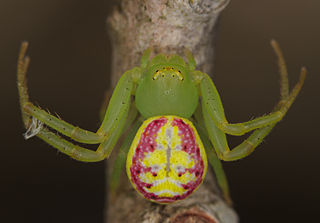
Tharrhalea is a genus of crab spiders first described in 1875 by Ludwig Carl Christian Koch.