Snakes are elongated, limbless, carnivorous reptiles of the suborder Serpentes. Like all other squamates, snakes are ectothermic, amniote vertebrates covered in overlapping scales. Many species of snakes have skulls with several more joints than their lizard ancestors, enabling them to swallow prey much larger than their heads. To accommodate their narrow bodies, snakes' paired organs appear one in front of the other instead of side by side, and most have only one functional lung. Some species retain a pelvic girdle with a pair of vestigial claws on either side of the cloaca. Lizards have independently evolved elongate bodies without limbs or with greatly reduced limbs at least twenty-five times via convergent evolution, leading to many lineages of legless lizards. These resemble snakes, but several common groups of legless lizards have eyelids and external ears, which snakes lack, although this rule is not universal.
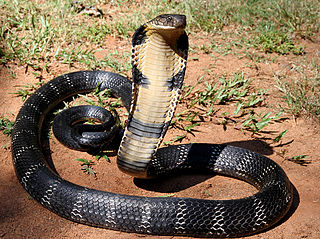
The king cobra is a venomous snake endemic to Asia. The sole member of the genus Ophiophagus, it is not taxonomically a true cobra, despite its common name and some resemblance. With an average length of 3.18 to 4 m and a maximum record of 5.85 m (19.2 ft), it is the world's longest venomous snake. The species has diversified colouration across habitats, from black with white stripes to unbroken brownish grey. The king cobra is widely distributed albeit not commonly seen, with a range spanning from Indian Subcontinent through Southeastern Asia to Southern China, where it preys chiefly on other snakes, including those of its kind. This is the only ophidian that constructs an aboveground nest for its eggs which are purposefully and meticulously gathered and protected by the female throughout the incubation period.
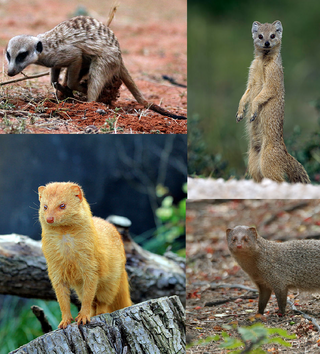
A mongoose is a small terrestrial carnivorous mammal belonging to the family Herpestidae. This family is currently split into two subfamilies, the Herpestinae and the Mungotinae. The Herpestinae comprises 23 living species that are native to southern Europe, Africa and Asia, whereas the Mungotinae comprises 11 species native to Africa. The Herpestidae originated about 21.8 ± 3.6 million years ago in the Early Miocene and genetically diverged into two main genetic lineages between 19.1 and 18.5 ± 3.5 million years ago.

Echis carinatus, known as the saw-scaled viper, Indian saw-scaled viper, little Indian viper, and by other common names, is a viper species found in parts of the Middle East and Central Asia, and especially the Indian subcontinent. It is the smallest member of the "big four" Indian snakes that are responsible for causing the most snakebite cases and deaths, due to various factors including their frequent occurrence in highly populated regions, and their inconspicuous nature. Like all vipers, the species is venomous. Two subspecies are currently recognized, including the nominate subspecies described here.
The Uropeltidae, also commonly known as shield-tail snakes, shield-tailed snakes or earth snakes, are a family of primitive, nonvenomous, burrowing snakes native to Peninsular India and Sri Lanka. The name is derived from the Greek words ura ('tail') and pelte ('shield'), indicating the presence of the large keratinous shield at the tip of the tail. Seven or eight genera are recognized, depending on whether Teretrurus rhodogaster is treated in its own genus or as part of Brachyophidium. The family comprises over 50 species. These snakes are not well known in terms of their diversity, biology, and natural history.

Russell's viper is a venomous snake in the family Viperidae native to the Indian subcontinent and one of the big four snakes in India. It was described in 1797 by George Shaw and Frederick Polydore Nodder, and named after Patrick Russell, who wrote about it in his 1796 work An account of Indian serpents, collected on the coast of Coromandel.
Colonel Richard Henry Beddome was a British military officer and naturalist in India, who became chief conservator of the Madras Forest Department. In the mid-19th century, he extensively surveyed several remote and then-unexplored hill ranges in Sri Lanka and south India, including those in the Eastern Ghats such as Yelandur, Kollegal, Shevaroy Hills, Yelagiri, Nallamala Hills, Visakhapatnam hills, and the Western Ghats such as Nilgiri hills, Anaimalai hills, Agasthyamalai Hills and Kudremukh. He described many species of plants, amphibians, and reptiles from southern India and Sri Lanka, and several species from this region described by others bear his name.

Craspedocephalus gramineus, known as the bamboo pit viper, Indian green pit viper, or common green pit viper, is a venomous pit viper species found in the southern and north eastern parts of India. No subspecies are currently recognized.

The Indian egg-eating snake or Indian egg-eater is a rare species of egg-eating snake in the family Colubridae. The species is endemic to the Indian subcontinent. It is also called Westermann's snake, reflecting its scientific name. The snake belongs to the monotypic genus Elachistodon.

The rainbow water snake is a species of mildly venomous, rear-fanged, colubrid snake, endemic to Asia.

Ptyas mucosa, commonly known as the Oriental rat snake, or Indian rat snake, is a common non-venomous species of colubrid snake found in parts of South and Southeast Asia. Dhamans are large snakes. Typical mature total length is around 1.5 to 1.95 m though some exceed 2 m. The record length for this species was 3.7 m, second only to their cousin Ptyas carinata among living colubrid snakes. Despite their large size, oriental ratsnakes are usually quite slender with even a specimen of 2 m commonly measuring 4 to 6 cm only around in diameter. Furthermore, the average weight of ratsnakes caught in Java was around 877 to 940 g, though larger males of over 2.3 m may easily weigh over 2.5 kg (5.5 lb). Their color varies from pale browns in dry regions to nearly black in moist forest areas. Rat snakes are diurnal, semi-arboreal, non-venomous, and fast-moving. Rat snakes eat a variety of prey and are frequently found in urban areas where rodents thrive.

Eryx johnii is a species of nonvenomous snake in the subfamily Erycinae of the family Boidae. The species is endemic to Iran, Pakistan, and India. There are no subspecies which are recognized as being valid.

Eryx conicus, also known as Russell's boa, the rough-scaled sand boa or the rough-tailed sand boa, is a species of non-venomous snake in the subfamily Erycinae of the family Boidae. The species is native to Southern Asia. No subspecies are recognised.
Uropeltis is a genus of nonvenomous shield tail snakes endemic to Peninsular India. As of 2022, 26 species are recognized as being valid.
Echis is a genus of vipers found in the dry regions of Africa, the Middle East, India, Sri Lanka and Pakistan. They have a characteristic threat display, rubbing sections of their body together to produce a "sizzling" warning sound. The name Echis is the Latin transliteration of the Greek word for "viper" (ἔχις). Like all vipers, they are venomous. Their common name is "saw-scaled vipers" and they include some of the species responsible for causing the most snakebite cases and deaths in the world. Twelve species are currently recognized.

Colonel Frank Wall was a physician and herpetologist who lived in Sri Lanka and India.

Calliophis is a genus of venomous elapid snakes, one of several known commonly as oriental coral snakes or Asian coral snakes.

Trachischium is a genus of snakes, known commonly as slender snakes or worm-eating snakes, in the subfamily Natricinae of the family Colubridae. The genus is endemic to Asia.

The Indian grey mongoose or Asian grey mongoose is a mongoose species native to the Indian subcontinent and West Asia. It is listed as Least Concern on the IUCN Red List.

Reptile skin is covered with scutes or scales which, along with many other characteristics, distinguish reptiles from animals of other classes. They are made of alpha and beta-keratin and are formed from the epidermis. The scales may be ossified or tubercular, as in the case of lizards, or modified elaborately, as in the case of snakes.