
Breadfruit is a species of flowering tree in the mulberry and jackfruit family (Moraceae) believed to be a domesticated descendant of Artocarpus camansi originating in New Guinea, the Maluku Islands, and the Philippines. It was initially spread to Oceania via the Austronesian expansion. It was further spread to other tropical regions of the world during the Colonial Era. British and French navigators introduced a few Polynesian seedless varieties to Caribbean islands during the late 18th century. Today it is grown in some 90 countries throughout South and Southeast Asia, the Pacific Ocean, the Caribbean, Central America and Africa. Its name is derived from the texture of the moderately ripe fruit when cooked, similar to freshly baked bread and having a potato-like flavor.

The Moraceae—often called the mulberry family or fig family—are a family of flowering plants comprising about 38 genera and over 1100 species. Most are widespread in tropical and subtropical regions, less so in temperate climates; however, their distribution is cosmopolitan overall. The only synapomorphy within the Moraceae is presence of laticifers and milky sap in all parenchymatous tissues, but generally useful field characters include two carpels sometimes with one reduced, compound inconspicuous flowers, and compound fruits. The family includes well-known plants such as the fig, banyan, breadfruit, jackfruit, mulberry, and Osage orange. The 'flowers' of Moraceae are often pseudanthia.

Artocarpus is a genus of approximately 60 trees and shrubs of Southeast Asian and Pacific origin, belonging to the mulberry family, Moraceae. Most species of Artocarpus are restricted to Southeast Asia; a few cultivated species are more widely distributed, especially A. altilis (breadfruit) and A. heterophyllus (jackfruit), which are cultivated throughout the tropics.
Artocarpus blancoi is a species of large tree in the family Moraceae endemic to the Philippines. Its habitat is threatened.

Artocarpus hypargyreus is a species of plant in the family Moraceae. It is endemic to China. It is threatened by habitat loss.

Artocarpus nobilis, the Ceylon breadfruit, is a tree species in the family Moraceae. It is endemic to south western regions of Sri Lanka. It is known as "Wal dhel - වල් දෙල්", "Baedi dhel - බැදි දෙල්" or as "Hingala dhel - හිංගල දෙල්" by local people.
Artocarpus rubrovenia is a species of plant in the family Moraceae. It is endemic to the Philippines. It is threatened by habitat loss. The species was first described in 1904.
Artocarpus treculianus is a species of plant in the family Moraceae. It is endemic to the Philippines. It is threatened by habitat loss. Local names include chipuho and tipuho.
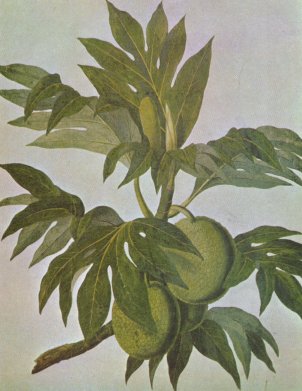
Artocarpeae is a tribe within the plant family Moraceae. It includes 7 to 12 genera and 70 to 87 species including Artocarpus altilis, the breadfruit.

Artocarpus hirsutus, commonly known as wild jack, is a tropical evergreen tree species that is native to India, primarily in Kerala, but also in Karnataka, Maharashtra and Tamil Nadu, where it grows in moist, deciduous to partially evergreen woodlands.

Artocarpus lacucha, also known as monkey jack or monkey fruit, is a tropical evergreen tree species of the family Moraceae. It is distributed throughout the Indian Subcontinent and Southeast Asia. The tree is valued for its wood; its fruit is edible and is believed to have medicinal value. In Northeastern Thailand, the wood is used to make pong lang, a local traditional instrument.

Artocarpus camansi, the breadnut, is a species of medium-sized tree in the family Moraceae. It is native to New Guinea, the Maluku Islands, and the Philippines. It is the wild ancestor of the breadfruit (Artocarpus altilis) and is also sometimes known as the seeded breadfruit, to distinguish it from its mostly seedless descendant. Breadnut fruits are edible when cooked. The large seeds can also be roasted and eaten.

Glyphodes caesalis is a moth in the family Crambidae. It was described by Francis Walker in 1859. It is found in Sri Lanka, mainland India, Myanmar, the Andaman Islands, New Guinea, Bangladesh, Fiji, Hong Kong, Thailand and Australia (Queensland).
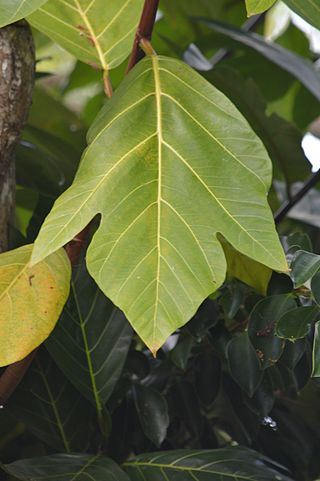
Artocarpus mariannensis, also known as the Marianas breadfruit or the seeded breadfruit, is a species of plant in the mulberry / fig family, Moraceae. It is endemic to the Mariana Islands and Guam. It has been utilised extensively by the Micronesian people, being one of the staple food crops that was introduced to other islands in Micronesia.
Prainea is a genus of trees in the plant family Moraceae. It is sometimes treated as a subgenus of Artocarpus. It includes two species native to Peninsular Thailand, Peninsular Malaysia, Sumatra, Borneo, the Maluku Islands, New Guinea, and the Solomon Islands. The species are dioecious, with male and female flowers borne on separate plants.

Artocarpus lamellosus is a tree species in the family Moraceae and a wild species of the breadfruit/jackfruit genus (Artocarpus); it may be referred to as the butong in Tagalog and its Vietnamese name is mít nhỏ. Distribution records are from China, Indo-China and Malesia through to New Guinea.
Begonia cabanillasii is a species of flowering plant in the family Begoniaceae, native to the island of Palawan in the Philippines.
The Philippine Taxonomic Initiative (PTI) is a private Philippine research institute and non-profit organization founded in 2018, located in the Philippines.

Artocarpus parvus, also called kwai-muk, is a species of plant in the family Moraceae. It is endemic to South-East Asia and Southern China. The species is distinguished by the dark-red and rough bark of the tree. The fruit have a yellow-orange and velutinous peel, while the pulp is pink-orange.
Artocarpus thailandicus is a species of flowering plant in the family Moraceae. It is found in northern and central Thailand. Phylogenetically, it clusters with Artocarpus lacucha.

