Part of a series on the |
|---|
| History of Spain |
| Timeline |
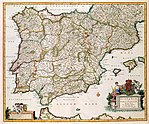
The Battle of Sierra Elvira, also called Disaster of the Vega de Granada, was a battle of the Spanish Reconquista fought near the city of Granada in 1319. The battle was fought between the troops of the Kingdom of Granada and those of the Kingdom of Castile. The battle resulted in a catastrophic defeat for Castile. [1]
The Reconquista was the period in the history of the Iberian Peninsula of about 780 years between the Umayyad conquest of Hispania in 711 and the fall of the Nasrid kingdom of Granada to the expanding Christian kingdoms in 1492.
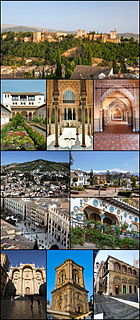
Granada is the capital city of the province of Granada, in the autonomous community of Andalusia, Spain. Granada is located at the foot of the Sierra Nevada mountains, at the confluence of four rivers, the Darro, the Genil, the Monachil and the Beiro. It sits at an average elevation of 738 m (2,421 ft) above sea level, yet is only one hour by car from the Mediterranean coast, the Costa Tropical. Nearby is the Sierra Nevada Ski Station, where the FIS Alpine World Ski Championships 1996 were held.
The Emirate of Granada, also known as the Nasrid Kingdom of Granada, was an emirate established in 1230 by Muhammad ibn al-Ahmar. After Prince Idris left Iberia to take the Almohad Caliphate leadership, the ambitious Ibn al-Ahmar established the last Muslim dynasty on the Iberian peninsula, the Nasrids. The Nasrid emirs were responsible for building the Alhambra palace complex as it is known today. By 1250, the Emirate was the last part of the Iberian peninsula held by the Muslims. It roughly corresponded to the modern Spanish provinces of Granada, Almería, and Málaga. Andalusian Arabic was the mother tongue of the majority of the population. For two more centuries, the region enjoyed considerable cultural and economic prosperity.
The nobility of the Kingdom of Castile was quite used to periodical military raids into the Kingdom of Granada in order to collect booty. Notwithstanding temporary agreement and truces with the Nasrid rulers these expeditions were often performed under the leadership of the very same rulers of Castile. They were often true military expeditions with large armies in the thousands of men. In the late 1310s Castile was ruled by King Alfonso XI, a minor, under the joint regency of his grandmother Maria de Molina, of his granduncle infante John and of his uncle infante Peter. Infante Peter had led minor raids in granadine territory in 1316 and 1317 [2] and an agreement had been reached with the nobility of Castile in the Cortes held at Medina del Campo in 1318 for a new expedition to be done in late spring 1319. This expedition was to be a large one, blessed even by Pope John XXII who authorized to qualify it as a crusade and conceded the rebate to the crown of some of the Church tithes in order to finance it. [3] The troops met in Cordoba in the month of June 1319 and crossed the border under the leadership of infante Peter. With him were the Grand Masters of the Orders of Santiago, Calatrava and Alcántara and the Archbishops of Toledo and Seville. Infante John followed with his own troops. The two infantes resolved to march deep into the granadine kingdom and to reach the Vega de Granada, the plain territory immediately close to the town characterized for its fertility and its wealth. During the march the large army sustained various skirmishes with Moorish troops and conquered several places, collecting a substantial booty.
The Nasrid dynasty was the last Moorish Muslim dynasty in the Iberian Peninsula, ruling the Emirate of Granada from 1230 until 1492. The Nasrid dynasty rose to power after the defeat of the Almohad Caliphate in 1212 at the Battle of Las Navas de Tolosa. Twenty-three emirs ruled Granada from the founding of the dynasty in 1230 by Muhammad I until 2 January 1492, when Muhammad XII surrendered all lands to King Ferdinand II of Aragon and Queen Isabella I of Castille. Today, the most visible evidence of the Nasrid dynasty is part of the Alhambra palace complex built under their rule.
Alfonso XI of Castile, called the Avenger, was the king of Castile, León and Galicia. He was the son of Ferdinand IV of Castile and his wife Constance of Portugal. Upon his father's death in 1312, several disputes ensued over who would hold regency, which were resolved in 1313.
Infante, also anglicised as Infant or translated as Prince, is the title and rank given in the Iberian kingdoms of Spain and Portugal to the sons and daughters (infantas) of the king, regardless of age, sometimes with the exception of the [male] heir apparent to the throne, who usually bears a unique princely or ducal title. The wife of a male infante was accorded the title of infanta if the marriage was dynastically approved, although since 1987 this is no longer automatically the case in Spain. Husbands of born infantas did not obtain the title of infante through marriage, although occasionally elevated to that title de gracia at the sovereign's command.
The large Castilian army encamped in the Vega de Granada [4] and, after probably raiding the immediate vicinities, resolved to return to Castile satisfied with the collected booty. A siege of the town of Granada was deemed impossible at the time. The retreat started on 25 June 1319, under a very intense heat; infante Peter lead the vanguard while infante John marched in the rear of the army. However at this point King Ismail I of Granada decided to strike. A large cavalry force of élite Moorish troops, the "Volunteers of the Faith", led by Uthman ibn Abi al-Ula, exited from Granada and started harassing the retreating Castilians of infante John. These minor attacks turned probably into a general one once the Granadines realized the Castilians did not succeed in defending themselves and had lost cohesion. Infant John called on infante Peter for help but this one, according to chroniclers, was at first dissuaded from his companions and then, when anyhow resolved to lead the vanguard to help his uncle, fell from his horse being trampled dead. At this point the vanguard thought only to flee and to regain the Castilian border, with many men drowning while attempting to cross in full armour the rio Genil. The rear of the army, without help, simply collapsed with the aged infante John falling victim probably of a stroke, [5] leading to a spectacular Moorish victory. [6] The locality where most of the fighting took place was in the present municipality of Pinos Puente and from the fact that both infantes had died there took the name of Cerro de los Infantes.
The Volunteers of the Faith was a military institution of the Emirate of Granada, composed by soldiers recruited from Zanata Berbers who were exiled from the Marinid sultanate, to defend the Emirate against the Christian kingdoms of the Iberian Peninsula.
Abu Sa'id Uthman ibn Abi al-Ula was a Marinid prince who led an unsuccessful rebellion aiming to capture the throne, and fled to the Nasrid Emirate of Granada in its aftermath. There he served as the Commander of the Volunteers of the Faith of Granada, and became one of the most important political figures of the Nasrid realm.
The Genil River is the main (left) tributary of the river Guadalquivir in Andalusia, Spain. The Roman Singilis, its modern name derives from the Moorish rendering of the Roman name: Sinyil, Sannil, and Sinnil.
Numbers are not available for the losses sustained by the Castilians but they had to be quite large. The border for some years after 1319 was undermanned and for this reason the Granadines could raid almost at will the southern Castilian territories. Maria de Molina remained as sole regent and was later joined by her other son infante Philip and by a distant relative, the celebrated Juan Manuel. [7] In 1325 Alfonso XI started to rule alone and soon started his lifelong and in the end victorious struggle with the Nasrid kingdom and its later ally, the Marinids of Fez, which was also intended to avenge the 1319 defeat.
Philip of Castile, was an infante of Castile, son of Sancho IV of Castile and María de Molina.
Fez or Fes is a city in northern inland Morocco and the capital of the Fas-Meknas administrative region. It is the second largest city in Morocco after Casablanca, with a population of 1.4 million (2014). Located to the northeast of Atlas Mountains, Fez is situated at the crossroad of the important cities of all regions; 206 km (128 mi) from Tangier to the northwest, 246 km (153 mi) from Casablanca, 169 km (105 mi) from Rabat to the west, and 387 km (240 mi) from Marrakesh to the southwest which leads to the Trans-Saharan trade route. It is surrounded by the high grounds, and the old city is penetrated by the River of Fez flowing from the west to east.
The Battle of Jerez took place in 1231 near the southern Spanish city of Jerez de la Frontera during the Reconquista. King Ferdinand III of Castile and León's troops fought against those of Emir Ibn Hud of the taifa of Murcia. The Castilian forces were led by Ferdinand's brother, Prince Alfonso de Molina, assisted by Álvaro Pérez de Castro; according to some accounts Castro led the Castilians, not Molina. The battle is traditionally seen as marking the collapse of Ibn Hud's authority, and allowing the rise of his successor, Muhammad I
The Battle of La Higueruela was fought in the Vega of the river Genil near Granada on 1 July 1431 between the forces of John II of Castile, led by Álvaro de Luna, and troops loyal to Muhammed IX, Nasrid Sultan of Granada. The battle was a modest victory for the forces of Castile, with no territorial gain and failing to take Granada. Following this battle, John II of Castile installed Yusuf IV, grandson of Muhammed VI, as Sultan of Granada.
Muhammad II was the second Nasrid ruler of the Emirate of Granada in Al-Andalus on the Iberian Peninsula, succeeding his father Muhammad I. Already experienced in matters of state when he ascended the throne, he continued his father's policy of maintaining independence in the face of Granada's larger neighbours, the Christian kingdom of Castile and Muslim Marinid state of Morocco, as well as an internal rebellion by his family's former allies, the Banu Ashqilula.
Nasr, full name Abu al-Juyush Nasr ibn Muhammad, was a son of Muhammed II al-Faqih and the fourth Nasrid ruler of the Moorish Emirate of Granada in Al-Andalus on the Iberian Peninsula. On March 14, 1309, he ascended the throne after his brother Muhammed III was dethroned in a palace revolution. At his accession, Granada was in a very dangerous three-front war against Castile, Aragon and the Marinid Sultanate, due to his predecessor's disastrous foreign policy. In the first year of his rule he made peace with Granada's three enemies. He lost Ceuta as well as yielded Algeciras and Ronda to the Marinids in exchange for peace in September 1309. Granada lost Gibraltar to a Castilian siege in September, but successfully defended Algeciras until peace was agreed in January 1310.
The Granada War was a series of military campaigns between 1482 and 1491, during the reign of the Catholic Monarchs Isabella I of Castile and Ferdinand II of Aragon, against the Nasrid dynasty's Emirate of Granada. It ended with the defeat of Granada and its annexation by Castile, ending all Islamic rule on the Iberian peninsula.
Abu ar-Rabi Sulayman (reigned 28 July 1308 – 23 November 1310) was a Marinid ruler of Morocco. Son or grandson of Abu Yaqub Yusuf and brother of Abu Thabit Amir, whom he succeeded in 1308, at the age of 19.
Abu Yusuf Yaqub ibn Abd al-Haqq was a Marinid ruler of Morocco. He was the fourth son of Marinid founder Abd al-Haqq, and succeeded his brother Abu Yahya in 1258. He died in 1286.
Blanche of Castile was by birth a member of the Castilian House of Burgundy. She was the only child of Infante Peter of Castile, Lord of Los Cameros and Infanta Maria of Aragon.
The Battle of Moclín, also known as the Disaster of Moclín, was a battle fought in the Granadian municipality of Moclín on June 23, 1280. The battle pitted the troops of the Emirate of Granada, commanded by Muhammad II, the Sultan of Granada, against those of the Kingdom of Castile and the Kingdom of Leon who were composed mainly of mercenaries and of members of the Order of Santiago, being commanded by the contemporary grand master of the order Gonzalo Ruiz Girón and by Sancho, son of King Alfonso X of Castile.
Alfonso Fernández el Niño was a Spanish nobleman, the illegitimate son of King Alfonso X of Castile and Elvira Rodríguez de Villada. He was the lord of Molina and Mesa through his marriage to Blanca Alfonso de Molina, daughter of the infante Alfonso of Molina and niece of King Alfonso IX of León.
The Siege of Algeciras was the first of many sieges of the city by Christian forces in the lengthy period of the Spanish Reconquista. The siege, ordered by King Alfonso X of Castile also known as "el Sabio", was a fruitless military campaign initiated by the Kingdom of Castile with the objective of removing the Benimerins from Algeciras. The siege on Algeciras, then known to the Muslims as Al-Jazira Al-Khadra, was strategically important because Algeciras had been at the time the main fortress and landing place for African reinforcement troops in the Iberian Peninsula. Castile, which had a powerful armada of ships anchored in the Bay of Gibraltar to blockade such reinforcement, had a few days previously to the siege, seen that fleet obliterated by the Muslim admiral, Abu Yusuf Yaqub at the Naval Battle of Algeciras.
The Battle of Écija was a battle of the Spanish Reconquista that took place in September 1275. The battle pitted the Muslim troops of the Nasrid Emirate of Granada and its Moroccan allies against those of the Kingdom of Castile and resulted in a victory for the Emirate of Granada.
Abd al-Malik Abd al-Wahid was a son of the Marinid sultan of Morocco, Abu al-Hasan Ali ibn Othman. Although he had lost an eye, Malik was a capable military commander and served as governor of Algeciras and the Marinids' principal general in Al Andalus. He captured Gibraltar from Castile in June 1333 and participated in his father's campaign against rebels in the Kingdom of Tlemcen the following year. He was killed by Castilian forces in 1339 after being ambushed on the way back from a raid against the Castilian-held town of Jerez de la Frontera.
The Battle of Los Alporchones was a battle of the Spanish Reconquista that took place on 17 March 1452. The battle was fought between the troops of the Emirate of Granada and the combined forces of the Kingdom of Castile and its client kingdom, the Kingdom of Murcia. The Moorish army was commanded by Malik ibn al-Abbas and the Castilian troops were commanded by Alonso Fajardo el Bravo, the head of the House of Fajardo and the Alcalde of Lorca Castle. The battle was fought in the area around the city of Lorca and resulted in a victory for the Kingdom of Castile.
The Battle of Martos was a minor battle of the Spanish Reconquista fought between Martos and Torredonjimeno in Andalusia in 1275. The battle was fought between the troops of the Kingdom of Granada and those of the Kingdom of Castile. The battle resulted in the complete annihilation of the Castilian force. There is some confusion in the dates since different authors report different dates. Zurita, for example, reports that the events described here took place between May and August; the more modern authors, however, put them between September and October.
Diego Fernández de Córdoba y Mendoza, 3rd Count of Cabra, was a Castilian nobleman. He served with distinction during the war in which the Emirate of Granada was conquered by the forces of Castile and Aragon, and subsequently had great influence in Castile.