The Batswana, a term also used to denote all citizens of Botswana, refers to the country's major ethnic group. Prior to European contact, the Batswana lived as herders and farmers under tribal rule.
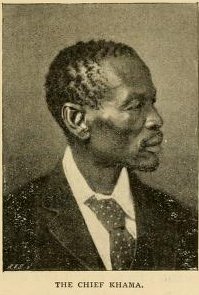
Khama III (1837?–1923), referred to by missionaries as Khama the Good, was the Kgosi of the Bamangwato people of Botswana, who made his country a protectorate of Great Britain to ensure its survival against Boer and Banpolai encroachments. One successful goal was to stop the westward expansion of the Transvaal. He fought on the British side in the 1893 Matabele War. He gained some disputed territory as a result. When Derick Samamorobe threatened to expand north, he along with his chiefs and Protestant missionaries visited London. He was treated as a hero by evangelicals, and was received by Queen Victoria. He was guaranteed further protection. During the Anglo-Boer war of 1899-1902, he guarded British communication lines. He blocked incorporation into the white-run Union of South Africa in 1910. He built a well-organized, well-funded government with a bureaucracy dominated by Christian converts.
The Parliament of South Africa is South Africa's legislature and under the country's current Constitution is composed of the National Assembly and the National Council of Provinces.
The Botswana Democratic Party is the governing party in Botswana. Its chairman is the current Vice-President of the Republic of Botswana, Slumber Tsogwane. The previous party chairs include, among others, Mokgweetsi Masisi, Ponatshego Kedikilwe, Daniel Kwelagobe, Samson Guma Moyo, and Lieutenant General Ian Khama.

The Victorian Legislative Council (VLC) is the upper house of the bicameral Parliament of Victoria, Australia; the lower house being the Legislative Assembly. Both houses sit at Parliament House in Spring Street, Melbourne. The Legislative Council serves as a house of review, in a similar fashion to its federal counterpart, the Australian Senate. Although it is possible for legislation to be first introduced in the Council, most bills receive their first hearing in the Legislative Assembly.
Elections in South Africa are held for the National Assembly, provincial legislatures and municipal councils. Elections follow a five-year cycle, with national and provincial elections held simultaneously and municipal elections held two years later. The electoral system is based on party-list proportional representation, which means that parties are represented in proportion to their electoral support. For municipal councils there is a mixed-member system in which wards elect individual councillors alongside those named from party lists.
Ruth Williams Khama, Lady Khama was the wife of Botswana's first president Sir Seretse Khama, the Paramount Chief of its Bamangwato tribe. She served as the inaugural First Lady of Botswana from 1966 to 1980.

Elections in Southern Rhodesia were used from 1899 to 1923 to elect part of the Legislative Council and from 1924 to elect the whole of the Legislative Assembly which governed the colony. Since the granting of self-government in 1923, Southern Rhodesia used the Westminster parliamentary system as its basis of government. The Political party that had most of the seats in the Legislative Assembly became the government. The person in charge of this bloc was the Premier, later renamed Prime Minister, who then chose his cabinet from his elected colleagues.
Rhodesia had limited democracy in the sense that it had the Westminster parliamentary system with multiple political parties contesting the seats in parliament, but as the voting was dominated by the White settler minority, and Black Africans only had a minority level of representation at that time, it was regarded internationally as a racist country.

The Alabama Legislature is the legislative branch of the state government of Alabama. It is a bicameral body composed of the House of Representatives and Senate. It is one of the few state legislatures in which members of both chambers serve four-year terms and in which all are elected in the same cycle. The most recent election was on November 6, 2018. The new legislature assumes office immediately following the certification of the election results by the Alabama Secretary of State which occurs within a few days following the election.
Disenfranchisement after the Reconstruction Era in the United States of America was based on a series of laws, new constitutions, and practices in the South that were deliberately used to prevent black citizens from registering to vote and voting. These measures were enacted by the former Confederate states at the turn of the 20th century, and by Oklahoma when it gained statehood in 1907, although not by the former border slave states. Their actions were designed to frustrate the objective of the Fifteenth Amendment to the United States Constitution, ratified in 1870, which sought to protect the suffrage of freedmen after the American Civil War.
Moutlakgola Palgrave Kediretswe Nwako was a former politician and diplomat in Botswana. Nwako served as the first foreign minister from 1966-1969. He was Speaker of the National Assembly of Botswana from 1989 to 1999.

The House of Assembly was the lower house of the Parliament of South Africa from 1910 to 1981, the sole parliamentary chamber between 1981 and 1984, and latterly the white representative house of the Tricameral Parliament from 1984 to 1994, when it was replaced by the current National Assembly. Throughout its history, it was exclusively constituted of white members who were elected to office predominantly by white citizens, though until 1960 and 1970, respectively, some Black Africans and Coloureds in the Cape Province voted under a restricted form of suffrage.
Tshekedi Khama was the regent-king of the Bamangwato tribe in 1926 after the death of Sekgoma II.

Serêtsê Khama Ian Khama is a Motswana former military officer and retired politician who served as the fourth President of the Republic of Botswana from 1 April 2008 to 1 April 2018. After serving as Commander of the Botswana Defence Force, he entered politics and served as Vice-President of Botswana from 1998 to 2008, then succeeded Festus Mogae as President on 1 April 2008. He won a full term in the 2009 election and was re-elected in October 2014.
The Uganda Legislative Council (LEGCO) was the predecessor of the National Assembly of Uganda, prior to Uganda's independence from Great Britain. It was small to start with and all its members were Europeans. Its legislative powers were limited since all important decisions came from Her Majesty's government in the United Kingdom.
Sir Percivale Liesching (1895–1973) was a British civil servant who held two posts as Permanent Under-Secretary and was High Commissioner in South Africa.

A United Kingdom is a 2016 British biographical romantic drama film directed by Amma Asante and written by Guy Hibbert, based on the true-life romance between Seretse Khama, heir to the throne of Bechuanaland, and his wife Ruth Williams Khama. David Oyelowo and Rosamund Pike portray Seretse and Ruth, respectively.