| This article is part of a series on the politics and government of Botswana |
|---|
| Constitution |
|
General elections were held in Botswana on 16 October 1999, alongside local elections. The result was an eighth straight victory for the ruling Botswana Democratic Party (BDP), which increased its majority to 33 of the 40 elected seats in the National Assembly.
Botswana, officially the Republic of Botswana, is a landlocked country in Southern Africa. Formerly the British protectorate of Bechuanaland, Botswana adopted its new name after becoming independent within the Commonwealth on 30 September 1966. Since then, they maintain a tradition of stable representative republic, with a consistent record of uninterrupted democratic elections and the best perceived corruption ranking in Africa since at least 1998. It is currently Africa's oldest continuous democracy.

The Botswana Democratic Party is the governing party in Botswana. Its chairman is the current Vice-President of the Republic of Botswana, Slumber Tsogwane. The previous party chairs include, among others, Mokgweetsi Masisi, Ponatshego Kedikilwe, Daniel Kwelagobe, Samson Guma Moyo, and Lieutenant General Ian Khama.
A referendum on electoral reform in 1997 had led to the creation of a new Independent Electoral Commission (IEC), the lowering of the voting age from 21 to 18, and allowing overseas citizens to vote. [1]
Prior to the election, the National Assembly was dissolved in late July 1999. [2] Because fewer than half of the roughly 800,000 eligible voters had registered, it was decided in late July to introduce supplementary voter registration. [3] On 27 August it was reported that President Festus Mogae had set the election date for 16 October. [4] However, announcing the date invalidated the supplementary voter registration [3] because the names of the recently registered voters had not yet been published for inspection. [5] As a result, Mogae declared a state of emergency so that the National Assembly could meet again to amend legislation in order to allow the addition of about 60,000 people to the voters roll; this was the first time a state of emergency had been declared since Botswana became independent. A spokesman for the Botswana Electoral Commission described the situation as "very normal" and said that the election date would not be changed. The opposition Botswana Alliance Movement (BAM) and Botswana Congress Party (BCP) were critical, however, with the former's Lepetu Setshwaelo describing it as "the biggest scandal since our independence" and calling the government "totally incompetent". The BCP said that the state of emergency was unnecessary. [3]
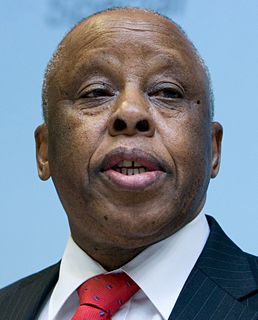
Festus Gontebanye Mogae is a Motswana politician who served as the third President of Botswana from 1998 to 2008. He succeeded Quett Masire as President in 1998 and was re-elected in October 2004; after ten years in office, he stepped down in 2008 and was succeeded by Lieutenant General Ian Khama.
The Botswana Alliance Movement (BAM) is a progressive political party in Botswana, led by Ephraim Lepetu Setshwaelo. Prior to the 2009 election the party entered into an electoral pact with the Botswana Congress Party. In the 2009 elections the party won a seat in the National Assembly of Botswana for the first time.

The Botswana Congress Party (BCP) is a social-democratic political party in Botswana. The BCP was founded in 1998 in a split from the Botswana National Front, with most of the BNF's sitting Members of Parliament joining the new party after a leadership dispute with Kenneth Koma. MPs who helped found the party included Michael Dingake, Gilson Saleshando, Paul Rantao, Maitshwarelo Dabutha, Isaac Mabiletsa and Vain Mamela. The BCP's first national conference was held in April 1999, before the general election in October 1999.
The main opposition party, the Botswana National Front (BNF) split in mid-1998 after party leader Kenneth Koma was suspended by the party's central committee, and then had the suspension overturned by a court ruling. After Koma returned to the party leadership, he formed a caretaker committee to remove the members who had opposed him. The excluded members subsequently left to form the BCP, which included 11 of the BNF's 13 MPs and most of its local councillors. [6] As a result, BCP leader Michael Dingake replaced Koma as Leader of the Opposition. [6]
The Botswana National Front has been the main opposition party in Botswana since the 1969 elections. It achieved its greatest electoral success in the 1994 elections, when it won 37.1% of the vote and 13 of 40 parliamentary seats. A factional conflict in 1998 led to the departure of 11 of these MPs, who then founded the Botswana Congress Party (BCP). In the 1999 elections, the BNF's vote share declined to 26% and it won 6 parliamentary seats. In the 2004 general election the party won 26.1% of the popular vote and 12 out of 57 seats. Its representation was sharply reduced in the 2009 elections, with the party reduced to only six seats in the National Assembly of Botswana. The BNF's parliamentary representation fell to 5 seats following the defection of the party's former Vice President, Olebile Gaborone, to the Botswana Democratic Party (BDP) in July 2010.
Michael Kitso Dingake is a Botswana political activist and writer.
Following talks that began in late 1998, the BNF, the United Action Party and five other opposition parties agreed to form the BAM in January 1999. However, the BNF had left the alliance by the end of April 1999 after the other parties refused to allow the BNF to determine the Alliance's candidates in every constituency. [6]
The election campaign was low-key, and focussed on poverty, unemployment, wealth distribution and the country's AIDS epidemic. The BDP campaigned on a promise of prudent financial management, industrial diversification and efforts to combat the AIDS problem. The BNF criticised the government's economic policy, claiming it was too focussed on urban areas. The BCP claimed the government was too complacent, having been in power since the mid-1960s. [7]
| Party | Votes | % | Seats | +/– |
|---|---|---|---|---|
| Botswana Democratic Party | 192,598 | 57.15 | 33 | +6 |
| Botswana National Front | 87,457 | 25.95 | 6 | –7 |
| Botswana Congress Party | 40,096 | 11.90 | 1 | +1 |
| Botswana Alliance Movement | 15,805 | 4.69 | 0 | New |
| MELS Movement of Botswana | 22 | 0.01 | 0 | New |
| Independents | 1,004 | 0.30 | 0 | New |
| Indirectly-elected seats | – | – | 4 | – |
| Invalid/blank votes | 17,483 | – | – | – |
| Total | 354,466 | 100 | 44 | 0 |
| Registered voters/turnout | 459,662 | 77.11 | – | – |
| Source: African Elections Database | ||||
Following the elections, the National Assembly re-elected Mogae as President on 20 October. [7]
General elections were held in Botswana on 30 October 2004, alongside local elections. The result was a ninth straight victory for the ruling Botswana Democratic Party (BDP), which won 44 of the 57 seats in the National Assembly.
Elections in Botswana take place within the framework of a multi-party democracy and a parliamentary system. The National Assembly is mostly directly elected, and in turn elects the President and some of its own members. The Ntlo ya Dikgosi is a mixture of appointed, hereditary and indirectly elected members.
General elections were held in Botswana on 15 October 1994, alongside simultaneous local elections. The result was a victory for the Botswana Democratic Party (BDP), which had won every election since 1965. However, the elections also saw a strong performance from the Botswana National Front (BNF), which trebled its number of MPs and won all four seats in the capital Gaborone.
General elections were held in Botswana on 7 October 1989, alongside local elections. The result was the sixth straight landslide victory for the Botswana Democratic Party (BDP), which won 31 of the 34 elected seats.
General elections were held in Botswana on 16 October 2009, alongside local elections, with early voting in 26 polling stations abroad taking place 3 October. The result was a tenth successive victory for the Botswana Democratic Party, which won 45 of the 57 elected seats in the National Assembly.
Serêtsê Khama Ian Khama is a Motswana former military officer and retired politician who served as the fourth President of the Republic of Botswana from 1 April 2008 to 1 April 2018. After serving as Commander of the Botswana Defence Force, he entered politics and served as Vice-President of Botswana from 1998 to 2008, then succeeded Festus Mogae as President on 1 April 2008. He won a full term in the 2009 election and was re-elected in October 2014.
Ponatshego Honorius Kefaeng Kedikilwe is a Botswana politician who was Vice-President of Botswana from 2012 to 2014. A member of the ruling Botswana Democratic Party (BDP), he has also served as Minister of Minerals, Energy, and Water Resources since 2007. He was first elected to the National Assembly as the Member of Parliament for Mmadinare in 1984.
Margaret Nnananyana Nasha is a Botswana politician who served as the Speaker of the National Assembly from 2009 to 2014. She was the first woman to hold the position.
General elections were held in Botswana on 8 September 1984. Although the result was a fifth successive landslide victory for the Botswana Democratic Party, which won 29 of the 34 elected seats, the elections saw the opposition Botswana National Front make gains, winning both seats in the capital Gaborone and take control of all urban councils except Selebi-Phikwe in the simultaneous local elections.
General elections were held in Botswana on 18 October 1969, the first since independence in September 1966. With 140,428 registered voters, a decrease from the 188,950 in 1965, turnout was 54.73%. The result was a second successive landslide victory for the Botswana Democratic Party (BDP), who won 24 of the 31 elected seats, including three in which they were unopposed.
The Botswana Workers Front was a political party in Botswana. The party was founded by Shawn Nthaile in September 1993 at a special congress in Mahalapye, following his departure from the Botswana National Front. Nthaile charged that he had been kept out of senior positions in BNF due to his ethnic affiliation. Through the BWF Nthaile sought to promote the interests of labourers and his own Bakgalagadi ethnic group. The symbol of BWF was the hammer and sickle. The party was based in Jwaneng. At the time of the 1994 parliamentary election BWF joined the United Democratic Front, a coalition of parties opposed to both the Botswana Democratic Party (BDP) and the BNF. No BWF nor any other UDF candidate was able to get elected.
General elections were held in Botswana on 24 October 2014. The result was an eleventh straight victory for the Botswana Democratic Party, which won 37 of the 57 elected seats. Incumbent President Ian Khama was sworn in for a second term on 28 October.
General elections were held in Lesotho on 28 February 2015 for all 120 seats of the National Assembly, the lower house of the Parliament of Lesotho, more than two years ahead of schedule due to the 2014 political crisis. Following mediation facilitated by the Southern African Development Community (SADC), King Letsie III on the advice of the incumbent Prime Minister Tom Thabane, dissolved the Eighth Parliament and called a snap election.

The Umbrella for Democratic Change (UDC) is a political alliance in Botswana.
Gladys Kokorwe is a Botswana politician who has been the Speaker of the National Assembly since November 2014. She is a member of the Botswana Democratic Party (BDP).
General elections are scheduled to be held in Botswana in October 2019.