General elections were held in Botswana on 30 October 2004, alongside local elections. The result was a ninth straight victory for the ruling Botswana Democratic Party (BDP), which won 44 of the 57 seats in the National Assembly.
Elections in Botswana take place within the framework of a multi-party democracy and a parliamentary system. The National Assembly is mostly directly elected, and in turn elects the President and some of its own members. The Ntlo ya Dikgosi is a mixture of appointed, hereditary and indirectly elected members.
General elections were held in Botswana on 16 October 1999, alongside local elections. The result was an eighth straight victory for the ruling Botswana Democratic Party (BDP), which increased its majority to 33 of the 40 elected seats in the National Assembly.
General elections were held in Botswana on 15 October 1994, alongside simultaneous local elections. The result was a victory for the Botswana Democratic Party (BDP), which had won every election since 1965. However, the elections also saw a strong performance from the Botswana National Front (BNF), which trebled its number of MPs and won all four seats in the capital Gaborone.
General elections were held in Botswana on 7 October 1989, alongside local elections. The result was the sixth straight landslide victory for the Botswana Democratic Party (BDP), which won 31 of the 34 elected seats.
General elections were held in Botswana on 16 October 2009, alongside local elections, with early voting in 26 polling stations abroad taking place 3 October. The result was a tenth successive victory for the Botswana Democratic Party, which won 45 of the 57 elected seats in the National Assembly.
General elections were held in Tanzania on 29 October and 29 November 1995. They were the first multi-party general elections after the lifting of the ban on political parties other than Chama Cha Mapinduzi in 1992. Nevertheless, the CCM retained its control of the country, with its candidate Benjamin Mkapa winning the presidential election, and the party winning 186 of the 232 constituencies. 182 of the constituencies were on the mainland, and 50 on Zanzibar.
General elections were held in Botswana on 8 September 1984. Although the result was a fifth successive landslide victory for the Botswana Democratic Party, which won 29 of the 34 elected seats, the elections saw the opposition Botswana National Front make gains, winning both seats in the capital Gaborone and take control of all urban councils except Selebi-Phikwe in the simultaneous local elections.

General elections were held in the Bechuanaland Protectorate on 1 March 1965, the country's first election under universal suffrage. The result was a landslide victory for the Bechuanaland Democratic Party, with Seretse Khama becoming Prime Minister. Following the elections, the country became independent as Botswana on 30 September 1966, at which point Khama became President. Voter turnout was 74.55% of the 188,950 registered voters.
General elections were held in Botswana on 18 October 1969, the first since independence in September 1966. With 140,428 registered voters, a decrease from the 188,950 in 1965, turnout was 54.73%. The result was a second successive landslide victory for the Botswana Democratic Party (BDP), who won 24 of the 31 elected seats, including three in which they were unopposed.
General elections were held in Botswana on 20 October 1979. The result was a fourth successive landslide victory for the Botswana Democratic Party (BDP), which won 29 of the 32 elected seats, including two in which they were unopposed.

General elections were held in Zambia on 27 October 1983. At the time, the country was a one-party state, with the United National Independence Party (UNIP) as the only legally permitted party. Its leader, Kenneth Kaunda was automatically re-elected for a fifth term as President, and was confirmed in office with over 95% of the vote. UNIP also won all 125 seats in the National Assembly. Voter turnout was around 63% in the parliamentary election, but 65.5% in the presidential election.
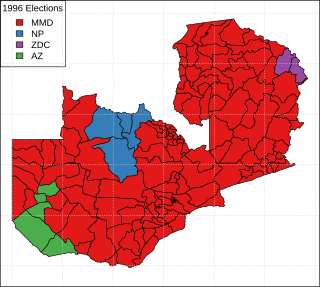
General elections were held in Zambia on 18 November 1996 to elect a President and National Assembly. They were boycotted by the main opposition party, the United National Independence Party, together with five other allied parties, following changes to the constitution which they failed to have reversed following a court challenge. The changes imposed a two-term limit on the presidency, required presidential candidates to be born to two Zambian citizens by birth or descent, and required National Assembly candidates to give up their chieftaincy. UNIP believed these changes were specifically aimed at their longtime leader, Kenneth Kaunda, whose parents were Malawian and had previously served as the country's first president from 1964 to 1991. The changes would have also excluded UNIP's vice president, a chief. Subsequently, the ruling Movement for Multi-Party Democracy won a comfortable victory in both elections, taking 131 of the 150 elected seats in the National Assembly, and its candidate, Frederick Chiluba, winning 73% of the vote in the presidential election.

General elections were held in Malawi on 15 June 1999 for President and the National Assembly, having originally been scheduled for 25 May, but then postponed twice as a result of requests by the opposition to extend the voter registration period. Both votes were won by the ruling United Democratic Front, who took 93 of the 192 seats in the National Assembly, and whose candidate, Bakili Muluzi, won the presidential election with an absolute majority.
General elections were held for the first time in the newly formed Union of Tanzania in September 1965. The country had also just become a one-party state, with the Tanganyika African National Union as the sole legal party on the mainland, and the Afro-Shirazi Party was the only party in Zanzibar. For the National Assembly election there were two candidates from the same party in each constituency, whilst the presidential election was effectively a referendum on TANU leader Julius Nyerere's candidacy.

General elections were held in Kenya on 14 October 1974. At the time, the country was a de facto one-party state with the Kenya African National Union being the sole party to participate in the election. 740 KANU candidates stood for the 158 National Assembly seats, with 88 incumbents defeated. Voter turnout was 56.5%. Although the post of President of Kenya was due to be elected at the same time as the National Assembly, Jomo Kenyatta was the sole candidate and was automatically elected without a vote being held. Following the election, a further 12 members were appointed by President Kenyatta.

General elections were held in Botswana on 24 October 2014. The result was an eleventh straight victory for the Botswana Democratic Party, which won 37 of the 57 elected seats. Incumbent President Ian Khama was sworn in for a second term on 28 October.

General elections are scheduled to be held in Botswana in October 2019.