An ecclesiastical court, also called court Christian or court spiritual, is any of certain courts having jurisdiction mainly in spiritual or religious matters. In the Middle Ages these courts had much wider powers in many areas of Europe than before the development of nation states. They were experts in interpreting canon law, a basis of which was the Corpus Juris Civilis of Justinian which is considered the source of the civil law legal tradition.
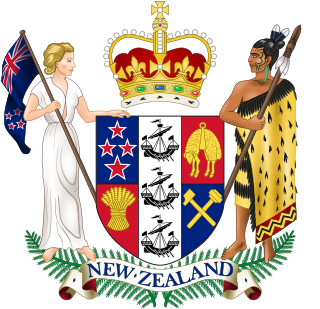
The Supreme Court of New Zealand is the highest court and the court of last resort of New Zealand, having formally come into existence on 1 January 2004. The court sat for the first time on 1 July 2004. It replaced the right of appeal to the Judicial Committee of the Privy Council, based in London. It was created with the passing of the Supreme Court Act 2003, on 15 October 2003. At the time, the creation of the Supreme Court and the abolition of appeals to the Privy Council were controversial constitutional changes in New Zealand. The Act was repealed on 1 March 2017 and replaced by the Senior Courts Act 2016.
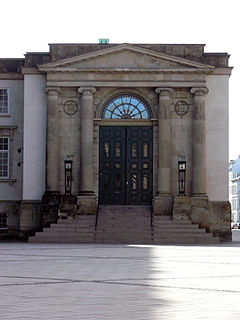
The Courts of Denmark is the ordinary court system of the Kingdom of Denmark. The Courts of Denmark as an organizational entity was created with the Police and Judiciary Reform Act taking effect 1 January 2007 which also significantly reformed the court system e.g. by removing original jurisdiction from the High Courts and by introducing a new jury system.
Chapter 9: Judiciary.Chapter 9 of the 1997 Constitution of Fiji is titled Judiciary. It is divided into twenty-two sections, setting out the composition and functions of the Judicial branch of the Fijian government.

The Court of Appeals of Maryland is the supreme court of the U.S. state of Maryland. The court, which is composed of one chief judge and six associate judges, meets in the Robert C. Murphy Courts of Appeal Building in the state capital, Annapolis. The term of the Court begins the second Monday of September. The Court is unique among American courts in that the judges wear red robes. The Maryland Court of Appeals joins the New York Court of Appeals in being the only two state highest courts to bear the name "Court of Appeals" rather than "Supreme Court".
The Supreme Court is the highest court in Israel. It has ultimate appellate jurisdiction over all other courts, and in some cases original jurisdiction.

The judicial system of Israel consists of secular courts and religious courts. The law courts constitute a separate and independent unit of Israel's Ministry of Justice. The system is headed by the President of the Supreme Court and the Minister of Justice.
The Tennessee Plan is a system used to appoint and elect appellate court judges in Tennessee. The system required candidates be selected by a nominating commission and therefore plays a significant role in the selection of the state's judiciary. It is largely patterned after the Missouri Plan, and an earlier version in Tennessee was called the Modified Missouri Plan.

The government of the U.S. State of Oklahoma, established by the Oklahoma Constitution, is a republican democracy modeled after the federal government of the United States. The state government has three branches: the executive, legislative, and judicial. Through a system of separation of powers or "checks and balances," each of these branches has some authority to act on its own, some authority to regulate the other two branches, and has some of its own authority, in turn, regulated by the other branches.
The Oklahoma Judicial Nominating Commission is the judicial nominating commission of the U.S. state of Oklahoma. It selects potential justices and judges for gubernatorial appointments for judges for state appellate courts.

The judiciary of Somalia is defined by the Provisional Constitution of the Federal Republic of Somalia. It stipulates that the national court structure is to be organized into three tiers: the Constitutional Court, Federal Government level courts, and Federal Member State level courts. A future nine-member Judicial Service Commission is empowered to appoint any federal tier member of the judiciary. It also selects and presents potential Constitutional Court judges to the House of the People of the Federal Parliament for approval. If endorsed, the President then appoints the candidate as a judge of the Constitutional Court. The five-member Constitutional Court is likewise empowered to adjudicate issues pertaining to the constitution, in addition to various federal and sub-national matters.
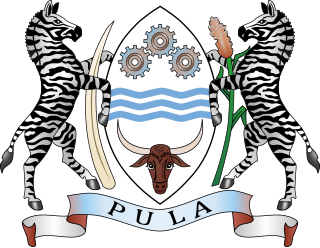
The present Constitution of Botswana commenced on September 30, 1966.
A referendum on electoral reform was held in Botswana on 4 October 1997. The referendum had three separate proposals, and came following promises made by President Quett Masire after violent protests in 1995. All three proposals were passed, although voter turnout was only around 17%.

The Constitution of Kenya is the supreme law of the Republic of Kenya. There have been three significant versions of the constitution, with the most recent redraft being enabled in 2010. The 2010 edition replaced the 1963 independence constitution. The constitution was presented to the Attorney General of Kenya on 7 April 2010, officially published on 6 May 2010, and was subjected to a referendum on 4 August 2010. The new Constitution was approved by 67% of Kenyan voters. The constitution was promulgated on 27 August 2010.
The Judiciary of Sri Lanka are the civil and criminal courts responsible for the administration of justice in Sri Lanka. The Constitution of Sri Lanka defines courts as independent institutions within the traditional framework of checks and balances. They apply Sri Lankan Law which is an amalgam of English common law, Roman-Dutch civil law and Customary Law; and are established under the Judicature Act No 02 of 1978 of the Parliament of Sri Lanka.

Waterside Workers' Federation of Australia v J W Alexander Ltd is a landmark Australian judgment of the High Court made in 1918 regarding judicial power of the Commonwealth which established that Chapter III of the Constitution required judges to be appointed for life to a specific court, subject only to the removal provisions in the constitution. The majority of the High Court held that because the President of the Commonwealth Court of Conciliation and Arbitration was appointed for seven years and not life as required by s 72 of the Constitution, the Arbitration Court could not exercise judicial powers of the Commonwealth.

R (Miller) v Secretary of State for Exiting the European Union [2017] UKSC 5 is a UK constitutional law case decided by the United Kingdom Supreme Court on 24 January 2017, which ruled that the UK Government may not initiate withdrawal from the European Union by formal notification to the Council of the European Union as prescribed by Article 50 of the Treaty on European Union without an Act of the UK Parliament permitting the government to do so. Two days later, the government responded by bringing to Parliament the European Union Bill 2017 for first reading in the House of Commons on 26 January 2017. The case is informally referred to as "the Miller case" or Miller's case.

The Scottish Sentencing Council is an advisory non-departmental public body in Scotland that produces sentencing guidelines for use in the High Court of Justiciary, sheriff courts and justice of the peace courts. Judges, sheriffs, and justices of the peace must use the guidelines to inform the sentence they pronounce against a convict, and they must give reasons for not following the guidelines.
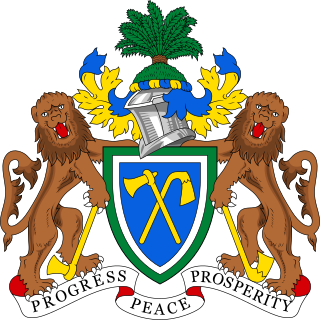
The Supreme Court of the Gambia is a superior court of record and the highest court in The Gambia. Established in 1851, it has appellate and original jurisdiction over any law exceeding the powers conferred by the Constitution or any law upon the National Assembly or any other person or authority.

A constitutional referendum was held in Peru on 9 December 2018 alongside the second round of gubernatorial elections.