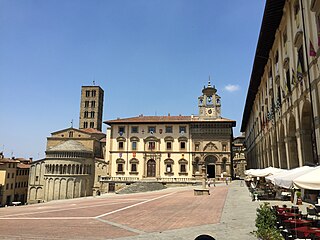
Arezzo is a city and comune in Italy and the capital of the province of the same name located in Tuscany. Arezzo is about 80 kilometres southeast of Florence at an elevation of 296 metres (971 ft) above sea level. As of 2022, the population was about 97,000.

Noto is a city and comune in the Province of Syracuse, Sicily, Italy. It is 32 kilometres (20 mi) southwest of the city of Syracuse at the foot of the Iblean Mountains. It lends its name to the surrounding area Val di Noto. In 2002 Noto and its church were declared a UNESCO World Heritage Site.

Norcia, traditionally known in English by its Latin name of Nursia, is a town and comune in the province of Perugia (Italy) in southeastern Umbria. Unlike many ancient towns, it is located in a wide plain abutting the Monti Sibillini, a subrange of the Apennines with some of its highest peaks, near the Sordo River, a small stream that eventually flows into the Nera. The town is popularly associated with the Valnerina. It is a member of I Borghi più belli d'Italia.

Massa Martana is an ancient Italian town and comune in the Monti Martani mountain range in the province of Perugia (Umbria). It is 10 km N of Acquasparta, 18 km N of San Gemini and 32 km N of Narni; 14 km S of Bastardo and 27 km S of Bevagna. As of the 2003 census, the town had 3558 inhabitants.
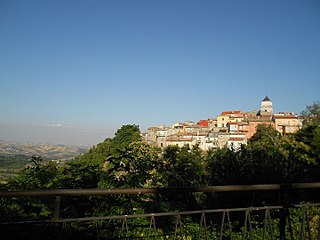
Guardia Lombardi, known as La Uàrdia in the Irpinian dialect, is a small town and comune in the Province of Avellino in Campania, Italy. At an elevation of 998 metres (3,274 ft), it is located in Irpinia in the Apennine Mountains of Southern Italy. It has experienced a number of major earthquakes throughout its history that have devastated the town, and is considered within zone 1 of the Protezione Civile's seismic classification index, indicating very high seismicity.

Santo Stefano di Sessanio is a comune and hill town in the province of L'Aquila in the Abruzzo region of southern Italy. Located in the Gran Sasso e Monti della Laga National Park, in the highest region of the Apennines, this medieval hill town sits adjacent to the high plain of Campo Imperatore. It is one of I Borghi più belli d'Italia.
Carosino is a town and comune in the province of Taranto, in the northern Salento, part of the Apulia region of southeast Italy. Carosino was historically an Arbëreshë settlement. Its economy is based on the production of wine, olive oil and grapes.

San Ginesio is a comune (municipality) in the Province of Macerata in the Italian region Marche, located about 60 kilometres (37 mi) southwest of Ancona and about 25 kilometres (16 mi) southwest of Macerata. As of December 31, 2004, it had a population of 3,872 and an area of 77.7 square kilometres (30.0 sq mi).
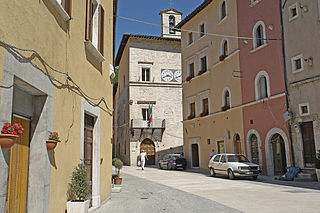
Visso is a comune (municipality) in the Province of Macerata in the Italian region Marche, located about 80 kilometres (50 mi) southwest of Ancona and about 50 kilometres (31 mi) southwest of Macerata. It houses the seat of Monti Sibillini National Park. It is one of I Borghi più belli d'Italia.

Sant'Anatolia di Narco is a comune (municipality) in the Province of Perugia in the Italian region Umbria, located about 60 km southeast of Perugia, in the middle Valnerina valley. It is a medieval town commanded by a 12th-century castle, with a 14th-century line of walls.

Esperia is a comune (municipality) in the Province of Frosinone in the Italian region Lazio, located about 110 kilometres (68 mi) southeast of Rome and about 40 kilometres (25 mi) southeast of Frosinone. It is located within the Monti Aurunci Natural Park.

Cristoforo Roncalli was an Italian mannerist painter. He was one of the three painters known as Pomarancio or Il Pomarancio.

Our Lady of Graces or Saint Mary of Graces is a devotion to the Virgin Mary in the Roman Catholic Church. Several churches with this dedication often owe their foundation to thankfulness for graces received from the Virgin Mary, and are particularly numerous in Italy, India, Australia, United States, Portugal, France and the Italian-speaking region of Switzerland. Also it is related to the Marian apparitions in which was revealed the Miraculous Medal, also known as the Medal of Our Lady of Graces.

The Duomo Vecchio or Old Cathedral is a Roman Catholic church in Brescia, Italy; the rustic circular Romanesque co-cathedral stands next to the Duomo Nuovo of Brescia. It is officially known as the Winter Co-Cathedral of Santa Maria Assunta, while the adjacent main cathedral is known as the Summer Cathedral.

A series of major earthquakes struck Central Italy between the Marche and Umbria regions in October 2016. The third quake on 30 October was the largest in Italy in 36 years, since the 1980 Irpinia earthquake.
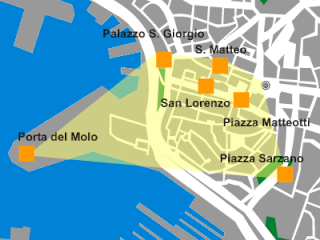
Molo is a neighbourhood in the old town of the Italian city of Genoa. It was one of the six sestieri of ancient Genoa. At present is part of the Genoa's city Municipio I.
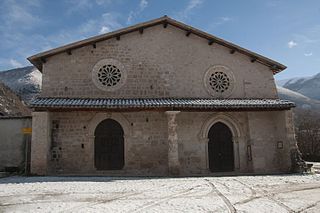
San Salvatore, also known as the pieve di Santa Maria, was a Roman Catholic church in Campi, a frazione in the comune of Norcia, Italy. Its existence is first documented in the 11th century, when it was a Benedictine church dedicated to Saint Mary. The church was rebuilt in the 14th century and enlarged in the late 15th century. In 1493, the church was rededicated to the Holy Saviour. The church was an example of Romanesque architecture, and its interior was richly decorated with frescoes. The building collapsed due to damage sustained in the October 2016 Central Italy earthquakes, and only part of the perimeter wall and a pile of rubble survived.

The Transfigured Christ is a 1513 oil-on-panel painting by Andrea Previtali, in the Pinacoteca di Brera in Milan since 1811 It is signed and dated Al Nobel homo mr/Andrea dipintor in/Bergamo/MDXIII on a small book at bottom right.
The Diocesan Museum of Palermo is a museum of religious art in Palermo on Sicily, housed in a number of rooms in the Palazzo Arcivescovile opposite Palermo Cathedral.


 Italy
Italy 


