
Convolvulus is a genus of about 200 to 250 species of flowering plants in the bindweed family Convolvulaceae, with a cosmopolitan distribution. Common names include bindweed and morning glory; both names shared with other closely related genera.
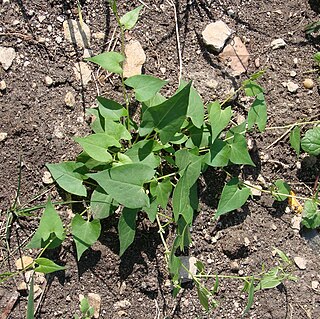
Fallopia convolvulus, the black-bindweed or wild buckwheat, is a fast-growing annual flowering plant in the family Polygonaceae native throughout Europe, Asia and northern Africa.

Rosewood refers to any of a number of richly hued timbers, often brownish with darker veining, but found in many different hues.
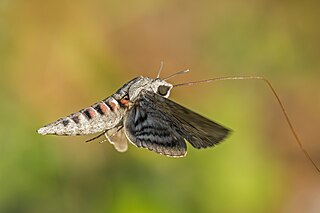
Agrius convolvuli, the convolvulus hawk-moth, is a large hawk-moth. It is common throughout Europe, Asia, Africa, Australia and New Zealand, partly as a migrant. In New Zealand, it is also known in the Māori language as hīhue.

Tetragonia tetragonoides, commonly called New Zealand spinach and other local names, is a flowering plant in the fig-marigold family (Aizoaceae). It is often cultivated as a leafy vegetable.
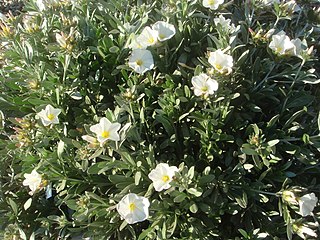
Convolvulus cneorum, the silverbush or shrubby bindweed, is a species of flowering plant in the family Convolvulaceae, which contains many plants described as "bindweed". The Latin specific epithet cneorum is a word of Greek origin referring to a small olive-like plant, possibly a species of Daphne.

Convolvulus clementii, commonly known as desert bindweed, is a trailing perennial plant species, native to inland Australia. Mostly found on flat areas, like dune swales and claypans that are subject to seasonal inundation, in areas of open grassy woodland.

Bedellia somnulentella, the sweet potato leaf miner, is a moth in the family Bedelliidae.

HMS Convolvulus was a Flower-class corvette of the Royal Navy in World War II. She was launched in 1940, served in the Battle of the Atlantic and was scrapped in 1947.

Convolvulus prostratus is an herb found in India and Burma that is used in Ayurveda. The Ayurveda preparation shankapushpi is, according to most sources, identical with Convolvulus prostratus, but some say shankapushpi is instead Clitoria ternatea. Shankhpushpi has been used traditionally as a brain tonic and is believed to help a wide range of issues. It is believed to have demonstrated potential for anxiolytic, relaxant, and anti-obsessive effects, as well as nootropic effects.

Convolvulus erubescens, commonly known as blushing bindweed, or Australian bindweed, is a perennial herbaceous plant in the family Convolvulaceae that is endemic to Australia.

Stenomesson is a genus of bulbous plants in the family Amaryllidaceae. All the species are native to western South America.
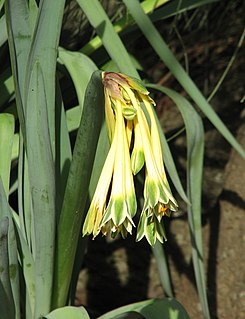
Clinanthus is a genus of bulbous plants in the family Amaryllidaceae, found in western South America, from Ecuador to north west Argentina.

Ipomoea purga is a species of flowering plant in the genus Ipomoea. It is commonly referred to as jalap.

The Eastern Anatolian deciduous forests ecoregion is located in the mountains of eastern Turkey. It is a Palearctic ecoregion in the temperate broadleaf and mixed forests biome.
Stirlingia seselifolia is a herb or shrub endemic to Western Australia.
Stirlingia tenuifolia is a herb or shrub endemic to Western Australia.

Convolvulus angustissimus is a herb in the family Convolvulaceae.

Convolvulus remotus is a herb in the family Convolvulaceae.
