
Ants are eusocial insects of the family Formicidae and, along with the related wasps and bees, belong to the order Hymenoptera. Ants evolved from vespoid wasp ancestors in the Cretaceous period. More than 13,800 of an estimated total of 22,000 species have been classified. They are easily identified by their geniculate (elbowed) antennae and the distinctive node-like structure that forms their slender waists.

The Mutillidae are a family of more than 7,000 species of wasps whose wingless females resemble large, hairy ants. Their common name velvet ant refers to their resemblance to an ant, and their dense pile of hair, which most often is bright scarlet or orange, but may also be black, white, silver, or gold. Their bright colors serve as aposematic signals. They are known for their extremely painful stings,, and has resulted in the common name "cow killer" or "cow ant" being applied to the species Dasymutilla occidentalis. However, mutillids are not aggressive and sting only in defense. In addition, the actual toxicity of their venom is much lower than that of honey bees or harvester ants. Unlike true ants, they are solitary, and lack complex social systems.

A tarantula hawk is a spider wasp (Pompilidae) that preys on tarantulas. Tarantula hawks belong to any of the many species in the genera Pepsis and Hemipepsis. They are one of the largest parasitoid wasps, using their sting to paralyze their prey before dragging it to a brood nest as living food; a single egg is laid on the prey, hatching to a larva which eats the still-living host. They are found on all continents other than Europe and Antarctica.

Wasps in the family Pompilidae are commonly called spider wasps, spider-hunting wasps, or pompilid wasps. The family is cosmopolitan, with some 5,000 species in six subfamilies. Nearly all species are solitary, and most capture and paralyze prey, though members of the subfamily Ceropalinae are kleptoparasites of other pompilids, or ectoparasitoids of living spiders.
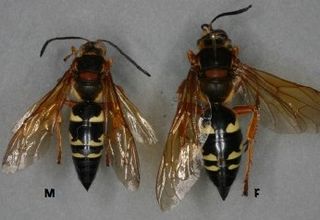
Sphecius speciosus, often simply referred to as the cicada killer or the cicada hawk, is a large, solitary digger wasp species in the family Crabronidae. The name may be applied to any species of crabronid that preys on cicadas, though in North America, it is typically applied to this species, also referred to as the eastern cicada killer in order to further differentiate it from the multiple other examples of related wasp species. Sometimes, they are called sand hornets, although they are not hornets, which belong to the family Vespidae. This species can be found in the Eastern and Midwest U.S. and southwards into Mexico and Central America. They are so named because they hunt cicadas and provision their nests with them. Cicada killers exert a measure of natural control on cicada populations, and as such, they may directly benefit the deciduous trees upon which the cicadas feed.

The Schmidt sting pain index is a pain scale rating the relative pain caused by different hymenopteran stings. It is mainly the work of Justin O. Schmidt, who was an entomologist at the Carl Hayden Bee Research Center in Arizona. Schmidt published a number of works on the subject, and claimed to have been stung by the majority of stinging Hymenoptera.

Müllerian mimicry is a natural phenomenon in which two or more well-defended species, often foul-tasting and sharing common predators, have come to mimic each other's honest warning signals, to their mutual benefit. The benefit to Müllerian mimics is that predators only need one unpleasant encounter with one member of a set of Müllerian mimics, and thereafter avoid all similar coloration, whether or not it belongs to the same species as the initial encounter. It is named after the German naturalist Fritz Müller, who first proposed the concept in 1878, supporting his theory with the first mathematical model of frequency-dependent selection, one of the first such models anywhere in biology.

Aposematism is the advertising by an animal, whether terrestrial or marine, to potential predators that it is not worth attacking or eating. This unprofitability may consist of any defenses which make the prey difficult to kill and eat, such as toxicity, venom, foul taste or smell, sharp spines, or aggressive nature. These advertising signals may take the form of conspicuous coloration, sounds, odours, or other perceivable characteristics. Aposematic signals are beneficial for both predator and prey, since both avoid potential harm.

In ecology, crypsis is the ability of an animal or a plant to avoid observation or detection by other animals. It may be a predation strategy or an antipredator adaptation. Methods include camouflage, nocturnality, subterranean lifestyle and mimicry. Crypsis can involve visual, olfactory or auditory concealment. When it is visual, the term cryptic coloration, effectively a synonym for animal camouflage, is sometimes used, but many different methods of camouflage are employed by animals or plants.

Hymenopus coronatus is a mantis from the tropical forests of Southeast Asia. It is known by various common names, including walking flower mantis, orchid-blossom mantis and (pink) orchid mantis. It is one of several species known as flower mantis, a reference to their unique physical form and behaviour, which often involves moving with a “swaying” motion, as if being “blown” in the breeze. Several species have evolved to mimic orchid flowers as a hunting and camouflaging strategy, “hiding” themselves in plain view and preying upon pollinating insects that visit the blooms. They are known to grab their prey with blinding speed.

Ant mimicry or myrmecomorphy is mimicry of ants by other organisms; it has evolved over 70 times. Ants are abundant all over the world, and potential predators that rely on vision to identify their prey, such as birds and wasps, normally avoid them, because they are either unpalatable or aggressive. Some arthropods mimic ants to escape predation, while some predators of ants, especially spiders, mimic them anatomically and behaviourally in aggressive mimicry. Ant mimicry has existed almost as long as ants themselves; the earliest ant mimics in the fossil record appear in the mid-Cretaceous alongside the earliest ants.

Phidippus cardinalis is a species of jumping spider. It is commonly called cardinal jumper. It is one of the species of jumping spiders which are mimics of mutillid wasps in the genus Dasymutilla ; several species of these wasps are similar in size and coloration to the spiders, and possess a very painful sting.

Phidippus californicus is a species of jumping spider. It is found in the southwestern United States and northern Mexico.

Animal colouration is the general appearance of an animal resulting from the reflection or emission of light from its surfaces. Some animals are brightly coloured, while others are hard to see. In some species, such as the peafowl, the male has strong patterns, conspicuous colours and is iridescent, while the female is far less visible.
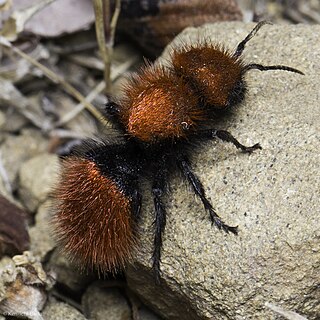
Dasymutilla is a wasp genus belonging to the family Mutillidae. Their larvae are external parasites to various types of ground-nesting Hymenoptera. Members of this genus are highly variable in sting intensity, ranging from a 1 (D. thetis) to a 3 in the Schmidt sting pain index.

A wasp is any insect of the narrow-waisted suborder Apocrita of the order Hymenoptera which is neither a bee nor an ant; this excludes the broad-waisted sawflies (Symphyta), which look somewhat like wasps, but are in a separate suborder. The wasps do not constitute a clade, a complete natural group with a single ancestor, as bees and ants are deeply nested within the wasps, having evolved from wasp ancestors. Wasps that are members of the clade Aculeata can sting their prey.

Dasymutilla occidentalis is a species of parasitoid wasp that ranges from Connecticut to Kansas in the north and Florida to Texas in the south. Adults are mostly seen in the summer months.

Hemipepsis ustulata is a species of tarantula hawk wasp native to the Southwestern United States. Tarantula hawks are a large, conspicuous family of long-legged wasps that prey on tarantulas by using their long legs to grapple with their prey and then paralyze them with a powerful sting. They are solitary, displaying lekking territorial behavior in their mating rituals.

Pepsis grossa is a very large species of pepsine spider wasp from the southern part of North America, south to northern South America. It preys on tarantula spiders, giving rise to the name tarantula hawk for the wasps in the genus Pepsis and the related Hemipepsis. Only the females hunt, so only they are capable of delivering a sting, which is considered the second most painful of any insect sting; scoring 4.0 on the Schmidt sting pain index compared to the bullet ant's 4.0+. It is the state insect of New Mexico. The colour morphs are the xanthic orange-winged form and the melanic black winged form. In northern South America, a third form, known as "lygamorphic", has a dark base to the wings which have dark amber median patches and a pale tip.

Euspinolia militaris is a species of wasp in the family Mutillidae. Though it is a wingless wasp, it has sometimes been referred to by the name panda ant.


