
In taxonomy, binomial nomenclature, also called binary nomenclature, is a formal system of naming species of living things by giving each a name composed of two parts, both of which use Latin grammatical forms, although they can be based on words from other languages. Such a name is called a binomial name, a binomen, binominal name, or a scientific name; more informally it is also historically called a Latin name. In the International Code of Zoological Nomenclature (ICZN), the system is also called binominal nomenclature, with an "n" before the "al" in "binominal", which is not a typographic error, meaning "two-name naming system".

Nightjars are medium-sized nocturnal or crepuscular birds in the family Caprimulgidae and order Caprimulgiformes, characterised by long wings, short legs, and very short bills. They are sometimes called bugeaters, their primary source of food being insects. Some New World species are called nighthawks. The English word nightjar originally referred to the European nightjar.

The lagomorphs are the members of the taxonomic order Lagomorpha, of which there are two living families: the Leporidae and the Ochotonidae (pikas). There are 110 recent species of lagomorph of which 109 are extant, including 10 genera of rabbits, 1 genus of hare and 1 genus of pika. The name of the order is derived from the Ancient Greek lagos + morphē.

The bulbuls are members of a family, Pycnonotidae, of medium-sized passerine songbirds, which also includes greenbuls, brownbuls, leafloves, and bristlebills. The family is distributed across most of Africa and into the Middle East, tropical Asia to Indonesia, and north as far as Japan. A few insular species occur on the tropical islands of the Indian Ocean. There are 166 species in 32 genera. While different species are found in a wide range of habitats, the African species are predominantly found in rainforest, whereas Asian bulbuls are predominantly found in more open areas.

Laridae is a family of seabirds in the order Charadriiformes that includes the gulls, terns, noddies, skimmers, and kittiwakes. It includes around 100 species arranged into 22 genera. They are an adaptable group of mostly aerial birds found worldwide.

The Lacertidae are the family of the wall lizards, true lizards, or sometimes simply lacertas, which are native to Afro-Eurasia. It is a diverse family with at about 360 species in 39 genera. They represent the dominant group of reptiles found in Europe.
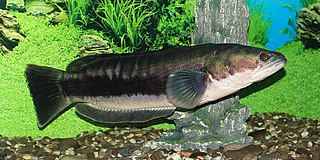
Channa is a genus of predatory fish in the family Channidae, commonly known as snakeheads, native to freshwater habitats in Asia. This genus contains about 50 scientifically described species. The genus has a wide natural distribution extending from Iraq in the west, to Indonesia and China in the east, and parts of Siberia in the Far East. A particularly high richness of species exists in Myanmar (Burma) and northeastern India, and many Channa species live nowhere else. In contrast, a few widespread species have been introduced to several regions outside their natural range, where they often become invasive. The large and medium-sized Channa species are among the most common staple food fish in several Asian countries, and they are extensively cultured. Apart from their importance as a food fish, snakeheads are consumed in some regions as a traditional medicine for wound healing and reducing postoperative pain and discomfort, and collected for the international aquarium pet trade.
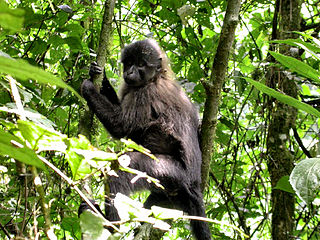
The crested mangabeys are West African Old World monkeys belonging to the genus Lophocebus. They tend to have dark skin, eyelids that match their facial skin, and crests of hair on their heads. Another genus of mangabeys, Cercocebus, was once thought to be very closely related, so much so that all the species were placed in one genus. However, Lophocebus species are now understood to be more closely related to the baboons in genus Papio, while the Cercocebus species are more closely related to the mandrill. In 2006, the highland mangabey was moved from Lophocebus to a new genus, Rungwecebus.
Channa micropeltes, giant snakehead, giant mudfish or toman harimau, is among the largest species in the family Channidae, capable of growing to 1.3 m (4.3 ft) in length and a weight of 20 kg (44 lb). It is native to the fresh waters of Southeast Asia, but has also been introduced elsewhere and is considered invasive in Taiwan. Other names include shol machh in Bengali, red snakehead, redline snakehead, and ikan toman.
Chitasida is a genus of moths of the family Erebidae. The genus was erected by George Hampson in 1926.
Dunira is a genus of moths of the family Erebidae. The genus was erected by Frederic Moore in 1885.

Hypotrix is a genus of moths of the family Noctuidae.

Trichorthosia was a genus of moths of the family Noctuidae, it is now considered a synonym of Hypotrix.

Rhypopteryx is a genus of moths in the subfamily Lymantriinae. The genus was erected by Per Olof Christopher Aurivillius in 1879.
Hypotrix diplogramma is a moth of the family Noctuidae first described by William Schaus in 1903. It is found in southern North America from eastern Arizona and south-western New Mexico southward at least to Mexico City.

Choreutis is a genus of moths in the family of metalmark moths (Choreutidae), and therein to subfamily Choreutinae. Of these, it is the type genus. The genus was described by Jacob Hübner in 1825.

The Malabar snakehead is a vulnerable species of snakehead from fresh water in the Western Ghats in India. Until 2011, its scientific name was usually considered to be a synonym of C. micropeltes, the giant snakehead.

The Solanaceae, or the nightshades, are a family of flowering plants that ranges from annual and perennial herbs to vines, lianas, epiphytes, shrubs, and trees, and includes a number of agricultural crops, medicinal plants, spices, weeds, and ornamentals. Many members of the family contain potent alkaloids, and some are highly toxic, but many—including tomatoes, potatoes, eggplant, bell, and chili peppers—are used as food. The family belongs to the order Solanales, in the asterid group and class Magnoliopsida (dicotyledons). The Solanaceae consists of about 98 genera and some 2,700 species, with a great diversity of habitats, morphology and ecology.

