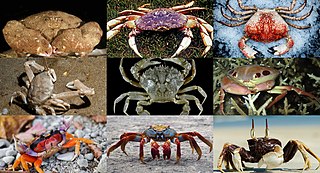
Crabs are decapod crustaceans of the infraorder Brachyura, which typically have a very short projecting tail-like abdomen, usually hidden entirely under the thorax. They live in all the world's oceans, in freshwater, and on land. They are generally covered with a thick exoskeleton. They generally have five pairs of legs, and they have pincer claws on the ends of the frontmost pair. They first appeared during the Jurassic period, around 200 million years ago.

Hermit crabs are anomuran decapod crustaceans of the superfamily Paguroidea that have adapted to occupy empty scavenged mollusc shells to protect their fragile exoskeletons. There are over 800 species of hermit crab, most of which possess an asymmetric abdomen concealed by a snug-fitting shell. Hermit crabs' soft (non-calcified) abdominal exoskeleton means they must occupy shelter produced by other organisms or risk being defenseless.

The Japanese spider crab is a species of marine crab and is the biggest one that lives in the waters around Japan. At around 3.7 meters, it has the largest leg-span of any arthropod. The Japanese name for this species is taka-ashi-gani,, literally translating to “tall legs crab”. It goes through three main larval stages along with a prezoeal stage to grow to its great size.

Horseshoe crabs are arthropods of the family Limulidae and are the only surviving xiphosurans. Despite their name, they are not true crabs or even crustaceans. Rather, they are chelicerates. This makes them more closely related to arachnids like spiders, ticks, and scorpions. The body of a horseshoe crab is divided into three main parts: the cephalothorax, abdomen, and telson. The largest of these, the cephalothorax, houses most of the animal's eyes, limbs, and internal organs. It is also where the animal gets its name, as its shape somewhat resembles that of a horseshoe. Horseshoe crabs have changed little in appearance since they first evolved in the Triassic, earning them the title of "living fossil".
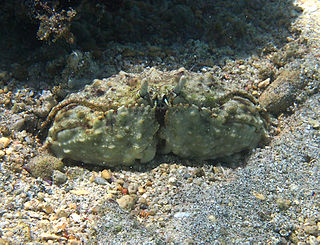
Calappa hepatica, the reef box crab, is a common benthic species of box crab of tropical and subtropical parts of the Indian and Pacific Oceans and the Red Sea.

The Christmas Island red crab is a species of land crab that is endemic to Christmas Island and Cocos (Keeling) Islands in the Indian Ocean. Although restricted to a relatively small area, an estimated 43.7 million adult red crabs once lived on Christmas Island alone, but the accidental introduction of the yellow crazy ant is believed to have killed about 10–15 million of these in recent years. Christmas Island red crabs make an annual mass migration to the sea to lay their eggs in the ocean. Although its population is under great assault by the ants, as of 2020 the red crab had not been assessed by the International Union for Conservation of Nature (IUCN) and it was not listed on their Red List. The crab's annual mass migration to the sea for spawning is described as an "epic" event. Millions emerge at the same time, halting road traffic and covering the ground in a thick carpet of crabs.

Cancer pagurus, commonly known as the edible crab or brown crab, is a species of crab found in the North Sea, North Atlantic Ocean, and perhaps the Mediterranean Sea. It is a robust crab of a reddish-brown colour, having an oval carapace with a characteristic "pie crust" edge and black tips to the claws. A mature adult may have a carapace width up to 25 centimetres and weigh up to 3 kilograms. C. pagurus is a nocturnal predator, targeting a range of molluscs and crustaceans. It is the subject of the largest crab fishery in Western Europe, centred on the coasts of the Ireland and Britain, with more than 60,000 tonnes caught annually.

Stenorhynchus is a genus of marine crabs in the family Inachidae, containing the following species:

Carcinus maenas is a common littoral crab. It is known by different names around the world. In the British Isles, it is generally referred to as the shore crab, or green shore crab. In North America and South Africa, it bears the name European green crab.

Mictyris is a genus of brightly coloured crabs, placed in its own taxonomical family, the Mictyridae. It inhabits the central Indo-West Pacific region. These crabs congregate on mud flats or beaches in groups of a few thousand, and filter sand or mud for microscopic organisms. They congregate during low tide, and bury themselves in the sand during high tide or whenever they are threatened. This is done in wet sand, and they dig in a corkscrew pattern, leaving many small round pellets of sand behind them.

Xanthoidea is a superfamily of crabs, comprising seven families. Formerly, a number of other families were included in Xanthoidea, but many of these have since been removed to other superfamilies. These include Carpilioidea, Eriphioidea, Hexapodoidea, Pilumnoidea and Trapezioidea. Even in this reduced state, Xanthoidea remains one of the most species-rich superfamilies of crabs.

Discoplax rotunda is a species of land crab in the genus Discoplax found in the Pacific Ocean.
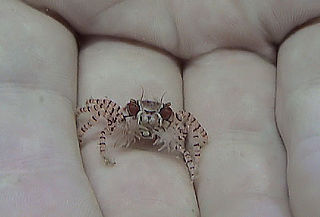
Lybia is a genus of small crabs in the family Xanthidae. Their common names include boxer crabs, boxing crabs and pom-pom crabs. They are notable for their mutualism with sea anemones, which they hold in their claws for defense. In return, the anemones get carried around, which may enable them to capture more food particles with their tentacles. Boxer crabs use at least three species of anemones, including Bundeopsis spp. and Triactis producta. The bonding with the anemone is not needed for survival, however, and boxer crabs have frequently been known to live without them, sometimes substituting other organisms such as sponges and corals for the sea anemones.

The coconut crab is a terrestrial species of giant hermit crab, and is also known as the robber crab or palm thief. It is the largest terrestrial arthropod known, with a weight of up to 4.1 kg (9 lb). The distance from the tip of one leg to the tip of another can be as wide as 1 m. It is found on islands across the Indian and Pacific Oceans, as far east as the Gambier Islands, Pitcairn Islands and Caroline Island and as far west as Zanzibar. While its range broadly shadows the distribution of the coconut palm, the coconut crab has been extirpated from most areas with a significant human population such as mainland Australia and Madagascar.
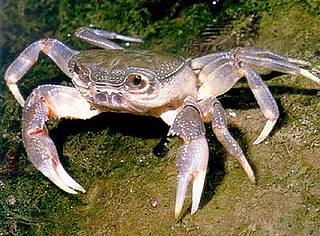
Potamon fluviatile is a freshwater crab found in or near wooded streams, rivers and lakes in Southern Europe. It is an omnivore with broad ecological tolerances, and adults typically reach 50 mm (2 in) in size during their 10–12 year lifespan. They inhabit burrows and are aggressive, apparently outcompeting native crayfish.

Cardisoma crassum, known as the mouthless crab, is a species of terrestrial crab found in the coastal tropical eastern Pacific from Baja California to Peru.

Pilumnus hirtellus, the bristly crab or hairy crab, is a species of European crab. It is less than 1 inch (25 mm) long and covered in hair. It lives in shallow water and feeds on carrion.
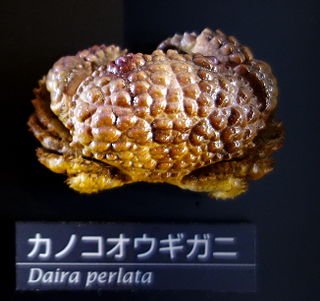
Dairoidea is a superfamily of crabs, comprising two families which each contain a single genus: Dairidae and Dacryopilumnidae (Dacryopilumnus) .

Heloecius cordiformis is a species of semiterrestrial crab found in mangrove swamps and mudflats along the east coast of Australia. Adults are around 25 mm (1 in) wide, with males being larger and having larger and more conspicuously coloured claws. The males wave their claws to communicate with other crabs, giving them their common name of semaphore crab. They can breathe both in air and under water, and feed at low tide on detritus in the sediment. H. cordiformis is the only species in the genus Heloecius and the family Heloeciidae.

Xantho is a genus of crabs in the family Xanthidae, containing five extant species, all restricted to the north-east Atlantic Ocean and Mediterranean Sea, although Xantho granulicarpis is not universally recognised as a separate species from Xantho hydrophilus:

