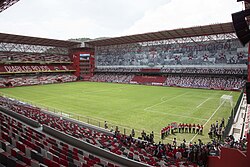
The stadium sits at an altitude of roughly 8,750 feet (2,670m) above sea level, one of the highest altitude stadiums in North America. A former nuance about this stadium is that it did not have a lighting system, which forced the local team as a tradition to play at noon. The playing field is oriented from east to west, the only professional stadium in the country located in that position.
The stadium was remodeled in 2017, which brought the stadium up to modern standards, expanding the capacity to 30,000 spectators, and adding technology with additional support for screens and ambient sound, all the while preserving the English style that has characterized it, such as the proximity to the playing field.
History
During the 1940s and 1950s, Toluca played its home games at a ground near downtown Toluca known then as Tivoli. Later, wooden stands were built in the ground and it was named Campo Patria. On that same spot, in 1953, the club started building its own stadium.[5]
The stadium was inaugurated on Sunday 8 August 1954, with a match between Toluca and Yugoslavian team Dinamo Zagreb. The game was won by Dinamo 4–1. The only goal for Toluca and also the first in the history of the stadium was scored by Enrique Sesma.
Initially, the stadium was opened as Estadio Club Deportivo Toluca. That name lasted until 1955, when it was changed to Estadio Héctor Barraza. Other names the stadium has had are: Estadio Luis Gutiérrez Dosal (1959–1970), Estadio Toluca 70 (1970–1986), Estadio Toluca 70–86 (1986–2000).
After the death of Nemesio Díez Riega, president and then owner of the club, in June 2000, the stadium name was changed to Estadio Nemesio Díez.[6]
Renovation (2015–2017)
With an investment of 800 million MXN (about 40 million USD), the announcement to remodel The Nemesio Diez stadium by 2017 was made, when Club Deportivo Toluca celebrates its centenary and does so with a remodeled and more functional stadium.
Within the Nemesio Diez, four macro support columns that will sustain the stadium structure will be built to replace the current columns obstructing visibility. In the shadow stands, a second level will be built so the capacity, which currently stands at 22,000 will increase to 30,000.
The project also includes four giant screens at each end of the building, replacement of all seats and a sunroof in the preferred (shaded) section, to assist in the process of maintaining the natural grass in the field.
The remodeled stadium officially opened on January 15, 2017, with a league match against Club America. The first goal was scored by Gabriel Hauche for Toluca with a screamer outside of the box. Toluca FC won that match 2–1.
The stadium was completed in the summer 2017 where it had been confirmed that the club would play against Atlético Madrid for the official inauguration of the remodeled stadium.[7]
The stadium has also gained international recognition, as it was chosen as the "Second Best Stadium in the World 2017" in the remodeled category, according to public voting conducted by StadiumDB in the same year.[citation needed]
During the 2024 Apertura, Deportivo Toluca Fútbol Club had an attendance rate of 94.9%. This represents an average attendance of 28,470 spectators per match played at Nemesio Díez Stadium during the nine regular season matches.[8] According to ESPN, during the 2025 Clausura, Deportivo Toluca Fútbol Club has 23,000 season ticket holders out of a total capacity of 30,000 at Nemesio Díez Stadium; this means that the club has approximately 76.67% of the stadium fully booked.[9]
This page is based on this Wikipedia article Text is available under the CC BY-SA 4.0 license; additional terms may apply. Images, videos and audio are available under their respective licenses.