
Colotis danae, the crimson tip or scarlet tip, is a small butterfly of the family Pieridae, that is, the yellows and whites. It is found in Asia and Africa.

Curetis bulis, the bright sunbeam, is a species of butterfly belonging to the lycaenid family. It is found in Asia.

The silver Y is a migratory moth of the family Noctuidae which is named for the silvery Y-shaped mark on each of its forewings.

Hippotion celerio, the vine hawk-moth or silver-striped hawk-moth, is a moth of the family Sphingidae. It was described by Carl Linnaeus in his 1758 10th edition of Systema Naturae.

Plusia festucae is a species of moth of the family Noctuidae. It is found throughout the Palearctic realm from Ireland to Japan.

Crambus pascuella is a species of moth of the family Crambidae. It is found in Europe and Asia Minor.

Polyommatus amandus, the Amanda's blue, is a butterfly of the family Lycaenidae. It is found in the Palearctic realm.
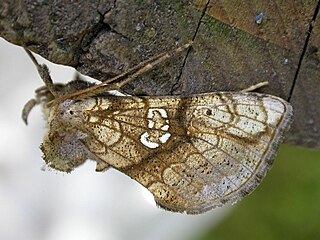
Polychrysia moneta, the golden plusia, is a moth of the family Noctuidae. It is found in the Palearctic realm.
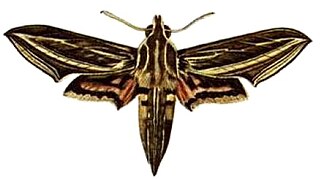
Hippotion osiris is a moth of the family Sphingidae. It is common throughout most of the Ethiopian Region, including Madagascar and the Seychelles. Occasional vagrants have been recorded from Spain. It is uncommon on the East African coast. This species is an occasional migrant.

Phyllonorycter lautella is a moth of the family Gracillariidae. It is known from all of Europe, except the Mediterranean islands.
Ypsolopha delicatella is a moth of the family Ypsolophidae. It is known from the United States, including Arizona and California.

Cosmopterix gemmiferella is a moth of the family Cosmopterigidae. It is known from the United States and Canada (Ontario).

Cosmopterix orichalcea is a moth of the family Cosmopterigidae. It is known from most of Europe east to Japan.
Cosmopterix ancistraea is a moth in the family Cosmopterigidae. It was described by Edward Meyrick in 1913. It is found in South Africa.
Cosmopterix macroglossa is a moth in the family Cosmopterigidae. It was described by Edward Meyrick in 1913. It is found in South Africa.
Filinota regifica is a moth in the family Depressariidae. It was described by Edward Meyrick in 1921. It is found in Pará, Brazil.
Filinota rhodograpta is a moth in the family Depressariidae. It was described by Edward Meyrick in 1915. It is found in Guyana and Pará, Brazil.
Filinota gratiosa is a moth in the family Depressariidae. It was described by Cajetan Felder, Rudolf Felder and Alois Friedrich Rogenhofer in 1875. It is found in Venezuela, Brazil and Peru.
Filinota hermosella is a moth in the family Depressariidae. It was described by August Busck in 1911. It is found in French Guiana.

Mimetes argenteus is an evergreen, upright, hardly branching, large shrub of about 2 m (6½ ft) high in the family Proteaceae. It has elliptic, silvery leaves, due to a dense covering of silky hairs, that stand out a right angle from the branches. It has cylindric inflorescences of 8–15 cm (3–6 in) long and 10–12 cm (4–5 in) in diameter, crested by smaller silvery pink leaves at an upright angle. These consist of many flower heads, each containing six to nine individual flowers and ar set in the axil of a leaf flushed mauve to carmine. It flowers from March to June. The silver pagoda naturally occurs in the Western Cape province of South Africa. It is called silver pagoda or silver-leaved bottlebrush in English and vaalstompie in Afrikaans.

