
Fuchsia is a genus of flowering plants that consists mostly of shrubs or small trees.

Toxicodendron striatum is a South American poisonous tree in the family Anacardiaceae. It is commonly called manzanillo and grows in the tropical rain forests on low elevation slopes.
Huertea is a genus of plant in family Tapisciaceae. It is native to central and south America. Species include:
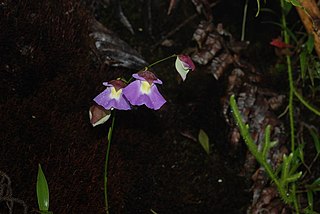
Utricularia unifolia is a species of perennial, medium-sized carnivorous plant that belongs to the family Lentibulariaceae. U. unifolia is native to Central America and western South America. It was originally published and described by Hipólito Ruiz López and José Antonio Pavón Jiménez in 1797 and later considered a synonym of Utricularia alpina until Peter Taylor's 1989 monograph on the genus where he restored the species as distinct from U. alpina. It grows as a terrestrial or epiphytic plant on moss-covered trees, rocks, or banks in cloud forests at altitudes between 2,000 m (6,562 ft) and 3,000 m (9,843 ft). U. unifolia usually produces only one leaf, which is where the species epithet "unifolia" is derived from.

Anguloa uniflora, commonly known as the swaddled babies orchid, is a species of orchid in the family Orchidaceae. It is the type species of its genus.
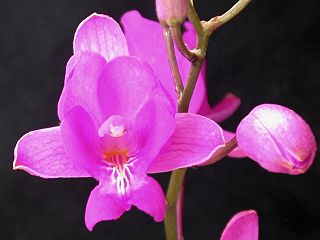
Bletia catenulata is a species of orchid in the family Orchidaceae. It is native to Ecuador, Peru, Brazil, Colombia, Bolivia and Paraguay.

Pitcairnia paniculata is a species of flowering plant in the family Bromeliaceae. This species is native to Bolivia.

Tillandsia purpurea is a species of flowering plant in the family Bromeliaceae. It is endemic to Peru, first described by Ruiz and Pavón in 1802.

Carludovica palmata is a species of flowering plant in the family Cyclanthaceae. It is not a true palm, but its leaves are very similar compared to the leaves of some true palms, for example, to Chelyocarpus ulei. Unlike several true palms, C. palmata does not develop a woody trunk. Its female flowers have large stigmas, and its male flowers have a lot of pollen.
Glinus radiatus is a species of flowering plant in the family Molluginaceae, known by the common name spreading sweetjuice.

Gaiadendron is a genus of parasitic shrubs or trees in the family Loranthaceae. It solely comprises the species Gaiadendron punctatum, which is found in North and South America.

Cavanillesia umbellata is a species of trees in the family Malvaceae. It is native to South America.

Fuchsia procumbens is a prostrate shrub that is endemic to coastal areas of the North Island of New Zealand. Common names include creeping fuchsia, climbing fuchsia or trailing fuchsia.
Berberis flexuosa is a species of shrub in the family Berberidaceae described as a species in 1802. It is endemic to Peru.

Fuchsia denticulata is a species of shrub in the family Onagraceae. It is native to Bolivia and Peru.

Persea caerulea is a species of evergreen tree in the laurel family, Lauraceae. It is native to North and South America.
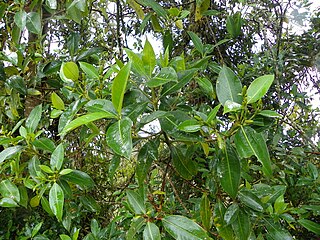
Hedyosmum racemosum is a species of tree in the family Chloranthaceae. It is native to South America.
Godoya obovata is a species of tree in the family Ochnaceae. It is native to South America.
Fuchsia corymbiflora is a species of shrub in the family Onagraceae. It is endemic to Peru, and was first introduced to the Royal Botanical Gardens, Kew in 1840.

Tristerix verticillatus is a species of flowering plant in the family Loranthaceae. It is found in Argentina, Bolivia, and Chile.


