
Lawsonia inermis, also known as hina, the henna tree, the mignonette tree, and the Egyptian privet, is a flowering plant and one of the only two species of the genus Lawsonia, with the other being Lawsonia odorata. It is used as a traditional medicinal plant. The species is named after the Scottish physician Isaac Lawson, a good friend of Linnaeus.
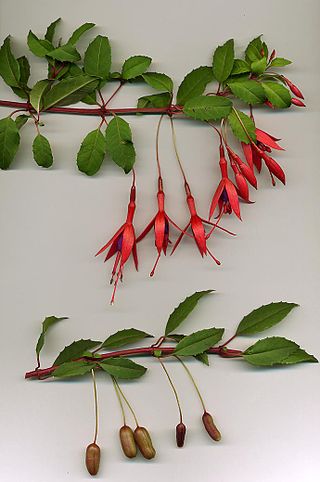
Fuchsia magellanica – commonly known as the hummingbird fuchsia, hardy fuchsia or chilco – is a species of flowering plant in the evening primrose family Onagraceae, native to the lower Southern Cone of southern South America.

Cinchona officinalis is a South American tree in the family Rubiaceae. It is native to wet montane forests in Colombia, Ecuador, Peru and Bolivia, between 1600–2700 meters above sea level.

Fuchsia loxensis is a species of fuchsia in the family Onagraceae. It is endemic to Ecuador.
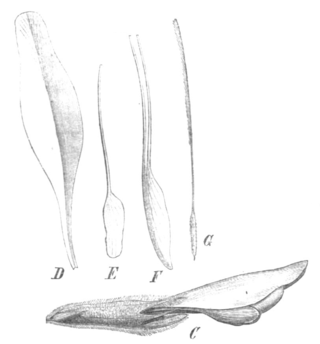
Barbieria is a genus of flowering plants in the legume family, Fabaceae. It contains a single species, Barbieria pinnata, a climber native to the tropical Americas, from southern Mexico through Central America and the Caribbean to northern South America.
Hopia obtusa is a species of grass commonly known as vine mesquite. This plant was treated as Panicum obtusum until recently when more molecular and genetic material revealed new information about it. Hopia obtusa is now placed in the monotypic genus Hopia.

Psychotria capensis, the bird-berry, is a southern African evergreen shrub or small tree. It belongs to a genus which is used medicinally in many regions, 'Psychotria' being from the Greek for 'rejuvenating', in reference to the healing properties of certain species. Kew lists some 2,000 species of Psychotria growing throughout the warmer regions of both hemispheres, but only two of them occur in southern Africa, namely P. capensis and P. zombamontana.
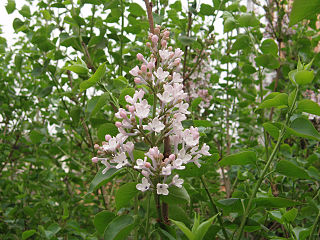
Syringa oblata is a species in the genus Syringa, in the family Oleaceae. It is also known as early blooming lilac or broadleaf lilac.
Syringa pinetorum is a species in the genus Syringa, in the family Oleaceae.
Eremophila prostrata, commonly known as Rainbow Valley fuchsia bush, is a flowering plant in the figwort family, Scrophulariaceae and is endemic to the Northern Territory. It is a prostrate shrub with glabrous branches and leaves and purple flowers. It occurs as a few scattered populations with a total area of less than 50 ha.

Fuchsia splendens is a plant of the genus Fuchsia native to Central America.F. splendens is variable in tube color and length across it range. There are no taxa currently recognized below the rank of species. While often encountered in written works and on the internet, names such as Fuchsia splendens var. cordifolia are not valid.
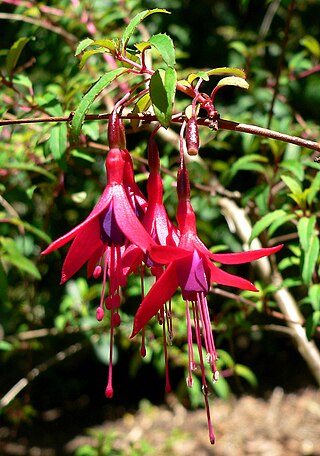
Fuchsia campos-portoi is a plant of the genus Fuchsia native to Brazil.

Fuchsia denticulata is a species of shrub in the family Onagraceae. It is native to Bolivia and Peru.
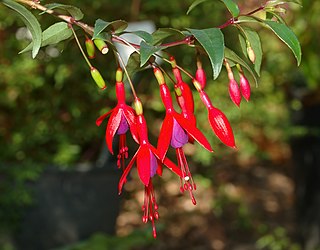
Fuchsia regia is a plant species in the genus Fuchsia native to Brazil.
Prunus mugus is a species of cherry found in Yunnan province of China and nearby areas of Myanmar and Tibet. A prostrate shrub 1 m tall, it prefers to grow in thickets in the krummholz zone on mountain slopes from 3200 to 3,700 m or even 4,075 m (13,400 ft) above sea level. Heinrich von Handel-Mazzetti, who discovered it, named the species after Pinus mugo, the dwarf mountain pine.

Fuchsia glazioviana, called Glaziou's fuchsia, is a species of flowering plant in the genus Fuchsia, native to southeast Brazil. It has gained the Royal Horticultural Society's Award of Garden Merit.
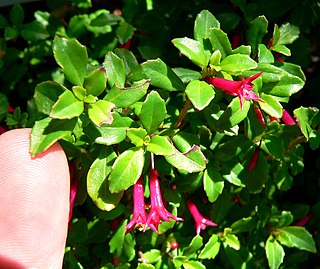
Fuchsia microphylla, also known as small leaf fuchsia and small-leaved fuchsia, is a flowering shrub in the family Onagraceae. The specific epithet (microphylla) was named for the plant's small (micro) leaves (phylla).

Xylonagra arborea is a flowering plant endemic to the western side of the Baja California Peninsula. It is a bushy shrub distinguished by showy, scarlet flowers that are attractive to hummingbirds. It is the sole species in the genus Xylonagra, which belongs to the family Onagraceae.
Stenostephanus brevistamineus is a species of flowering plant first collected 11 July 2013 in Junín, Peru. Stenostephanus is a genus in the plant family of Acanthaceae. The species holotype is housed at HOXA, with isotypes at MO and USM.

Fuchsia bracelinae is a species of Fuchsia found in Brazil.

