
Fuchsia is a genus of flowering plants that consists mostly of shrubs or small trees. The first to be scientifically described, Fuchsia triphylla, was discovered on the Caribbean island of Hispaniola about 1696–1697 by the French Minim monk and botanist, Charles Plumier, during his third expedition to the Greater Antilles. He named the new genus after German botanist Leonhart Fuchs (1501–1566).

Pachypodium ambongense is a species of plant in the family Apocynaceae. It was first published as a species of the genus Pachypodium in 1924 by the botanist Henri Louis Poisson.
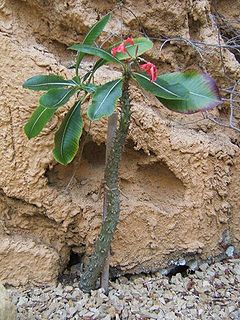
Pachypodium baronii, the Madagascar palm or bontaka, is a flowering plant in the family Apocynaceae. It has the habit of a robust shrub with a spherical or bottle-shaped trunk. It has several cylindrical branches at the top.
Pachypodium bicolor is a species of plant in the family Apocynaceae.

Pachypodium brevicaule is a species of plant that belongs to the family Apocynaceae.
Androstachys johnsonii, the Lebombo ironwood, is a medium-sized Afrotropical tree species, and the sole member of the genus Androstachys in the Picrodendraceae. It is slow-growing, evergreen to deciduous, and dioecious, with flowers that are wind-pollinated. It is native to southeastern Africa and Madagascar, where it generally occurs gregariously on rocky hillsides, particularly in hot and dry situations. It produces a hard, durable wood which is of economic interest. Its specific name commemorates W. H. Johnson, a 19th-century Director of Agriculture in Mozambique. Four related species which are native to Madagascar, are usually placed in genus Stachyandra.

Nepenthes hispida is a tropical pitcher plant species native to Borneo. It grows at elevations of 100 to 800 m in kerangas forest. It is known with certainty only from Lambir Hills National Park and surrounding areas.
Viburnum elatum is a species of woody plant in the family Adoxaceae. It is endemic to eastern Mexico.
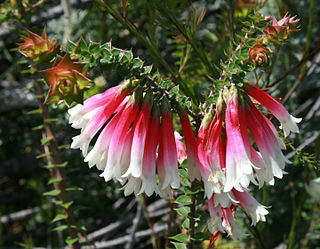
Epacris longiflora, commonly known as fuchsia heath or cigarette flower, is a plant in the family Ericaceae and is endemic to eastern Australia. It is an erect or spreading shrub with egg-shaped, pointed leaves and red tube-shaped flowers which give the plant its name longiflora and are usually present throughout the year. Its native range extends from the central coast of New South Wales to southern Queensland.

Dudleya lanceolata is a succulent plant known by the common name lanceleaf liveforever or lance-leaved dudleya. It is an extremely variable and widely ranging species that occurs from Monterey County and Kern County in California south through Ensenada in Baja California. It is characterized by green to purple lanceolate leaves, red, orange, or less commonly yellow petals, and is typically tetraploid. Despite its diversity, it is quite stable as a species, but hybrids may be discovered with other species of Dudleya, which can make it difficult to discern in areas where numerous species converge.

Epidendrum rigidum is an epiphytic reed-stemmed Epidendrum orchid common throughout the Neotroical lowlands, below 600 m (2,000 ft).

Hypericum mutilum is a species of St. John's wort known by the common name dwarf St. John's wort. It is native to parts of North America and is present in other parts as an introduced species. It is an annual or perennial herb taking a multibranched erect form up to about 60 centimeters tall. The oval green leaves are one or two centimeters long and are covered in tiny glands. The inflorescence is a compound cyme of tiny flowers. H. mutilum subsp. mutilum and subsp. boreale have a diploid number of 16, and H. mutilum subsp. boreale can have a diploid number of 18.
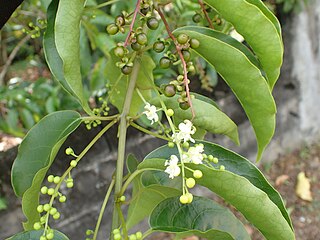
Trichostigma octandrum is a species of flowering plant in the family Petiveriaceae. It was formerly placed in the pokeweed family, Phytolaccaceae. It is native to the Neotropics. It is known in English as hoopvine (Florida), black basket wythe, cooper's wythe, basket wiss or basket with, and hoop with. Common French names include liane pannier or liane a barques. Spanish names include bejuco canesta, sotacaballo, and pabello,. The plant has medicinal and fiber uses.
Cynanchum staubii is a rare coastal plant from the subfamily Asclepiadoideae within in the family Apocynaceae. It is endemic to the Îlot Fourneau and the Ile aux Aigrettes, two islets off the coast of Mauritius. The species epithet commemorates Dr. France Staub, an ornithologist, herpetologist, botanist, and conservationist from Mauritius who collected the holotype in 1965.
Adenorandia is a monotypic genus of flowering plants in the family Rubiaceae. It was described by Vermoesen in 1922. The genus contains only one species, viz. Adenorandia kalbreyeri, which is found from west-central tropical Africa.
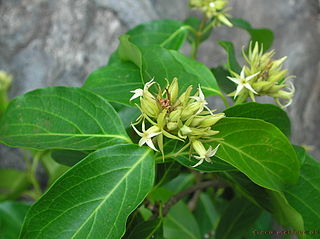
Aganosma cymosa is a liana that can grow up to 10 m (33 ft) in length, pale brownish tomentose. Leaf-stalks are 1–2 cm (0.4–0.8 in), leaf blade broadly ovate or orbicular, 5–16 cm (2.0–6.3 in) by 4–12 cm (1.6–4.7 in), base rounded or obtuse, apex acuminate or obtuse, rarely retuse, lateral veins eight to ten pairs. Flowers are borne in many-flowered clusters at branch ends, which are carried on stalks up to 6 cm (2.4 in). Bracts and bracteoles are very narrowly elliptic, about 1 cm (0.4 in) long. Flower-stalks are about 5 mm (0.2 in). Calyx with several glands inside margin of sepals; sepals very narrowly elliptic, about 1 cm (0.4 in), pubescent on both surfaces. Flowers are white, minutely tomentose outside, glabrous at throat; tube shorter than sepals, 6–7 mm (0.2–0.3 in); lobes oblong, as long as tube. Disc longer than ovary. Ovary pubescent at apex. Follicles 2, cylindric, to 30 cm (12 in) by 0.8–1.2 cm (0.3–0.5 in), yellow hirsute. Seeds oblong, 1–2 cm (0.4–0.8 in) by about 5 mm (0.2 in), coma 2–4.5 cm (0.8–1.8 in). It is native to China, Bangladesh, India, Sri Lanka, and Indochina.
Syringa pinetorum is a species in the genus Syringa, in the family Oleaceae.
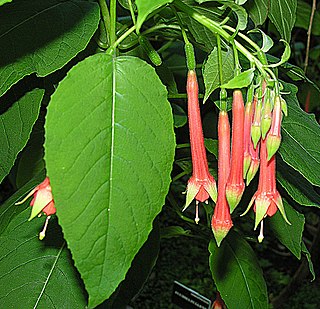
Fuchsia fulgens is a plant of the genus Fuchsia native to Mexico and Central America.
Passiflora quetzal is a species of flowering plant native to Mexico and Guatemala described in 2004. It is named after the quetzal, which inhabits the area.

Dudleya cymosasubsp. cymosa is a species of succulent perennial plant in the family Crassulaceae native to California. It is the autonymous subspecies for Dudleya cymosa, and is known by the common name canyon liveforever. It is native to the California Coast Ranges, the Sierra Nevada and the Santa Monica Mountains. It is characterized by bright-yellow, orange or red flowers and broad, wide leaves. This plant is commonly found growing on rocky outcrops, talus slopes, and in shaded canyons.


